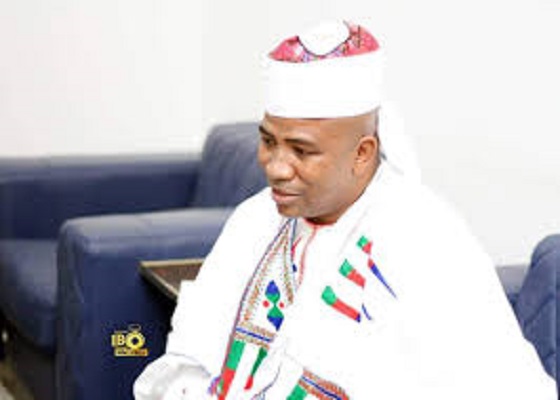


JOS, NIGERIA — Former territorial claims made by pastoralist associations have resurfaced in national media discourse, re-igniting critical questions regarding grazing rights, state autonomy, and the statutory boundaries of land ownership under the Nigerian Constitution.
The renewed debate centers on historical statements attributed to Alhaji Bello Abdullahi Bodejo, the National President of Miyetti Allah Kautal Hore. In a series of highly publicized press briefings, Bodejo aggressively challenged the eviction directives issued by sub-national executives, maintaining that forest reserves belong to no single ethnic group and declaring that Fulani pastoralist communities could not be forcibly removed from their long-term operational settlements.
The Ondo Forestry Ultimatum
The foundational friction traces back to a high-stakes administrative standoff in the Southwest zone, when the late Executive Governor of Ondo State, Arakunrin Oluwarotimi Akeredolu, SAN, issued a strict seven-day quit notice ordering unregistered herders to vacate the state’s gazetted forest reserves. The executive order was deployed as a direct counter-measure to combat a severe spike in agrarian kidnappings, rural executions, and structural destruction attributed to criminal syndicates operating from deep within the thick jungle canopies.
Bodejo flatly rejected the governor’s statutory authority to enforce the clearance. He countered that Fulani pastoralists had actively inhabited and grazed the Ondo forest reserves for over 250 years, arguing that their historical occupation superseded ad-hoc state-level security directives.
The “All Lands Belong to Fulani” Assertion
The controversy escalated dramatically when Bodejo pushed his arguments past local grazing access into sweeping territorial declarations. He claimed that historically, “all the lands in Nigeria belong to the Fulani,” a phrase that immediately triggered immense public outrage and sharp rebuttals from socio-cultural organizations across the Southern and Middle Belt regions.
Legal scholars, pan-Yoruba groups like Afenifere, and South-South coalitions swiftly intervened to dismantle the narrative, pointing out that the assertion has zero backing under the operational laws of the Federal Republic of Nigeria. Constitutional experts emphasized that land tenure in Nigeria is strictly governed by statutory frameworks that completely reject historical or ethnic pre-eminence over sovereign territory.
What the Law Actually Says
To clarify the ongoing national friction, constitutional lawyers and land administrators point to three immovable pillars of Nigerian law that directly invalidate arbitrary territorial claims:
- The Land Use Act of 1978: Embedded firmly within Section 315 of the 1999 Constitution, this statute vests all land within the territory of each state solely in the Executive Governor of that state. The land is held in trust by the governor for the common benefit of all citizens. No ethnic group holds ancestral or inherent rights to public land outside this state-trust mechanism.
- Sub-National Authority Over Forests: State governments possess full, unchallengeable statutory power to regulate, gazette, license, and restrict access to their internal forest reserves. Utilizing a forest reserve for habitation or commercial grazing without express written approval and licensing from the state ministry of agriculture or forestry constitutes an illegal trespass.
- Freedom of Movement vs. Property Trespass: While Section 41 of the Constitution guarantees every Nigerian the right to move freely and reside in any part of the federation, legal precedents set by the Supreme Court explicitly clarify that the right to move freely does not grant a citizen the right to trespass on private properties, systematically destroy commercial farmlands, or occupy state-protected reserves without administrative clearance.
Modern Postscript
The archival debate is receiving fresh analytical scrutiny from intelligence agencies as the national security architecture handles deeper complications involving the Miyetti Allah leadership.
Bodejo himself remains a high-profile subject of state scrutiny. Following an initial arrest by the Department of State Services (DSS) and subsequent handovers to financial watchdogs, the Economic and Financial Crimes Commission (EFCC) finalized a twelve-count criminal charge against him in late June 2026. The federal prosecution is currently preparing to formally arraign the pastoralist leader before an Abuja Federal High Court over severe allegations bordering on money laundering and the illicit receipt of $2.53 million in physical foreign currency linked to suspected terrorism financing.
As the federal state pushes the matter into the judiciary, legal observers note that the strict enforcement of statutory land laws remains the only viable path to balancing ethnic livestock herding with the physical safety and agricultural sovereignty of local farming host communities.