
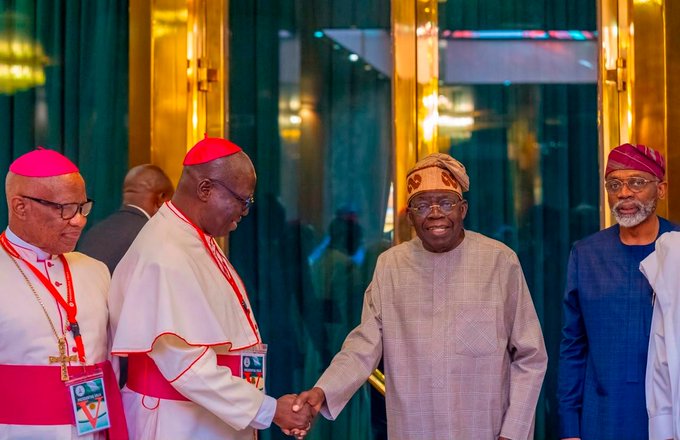


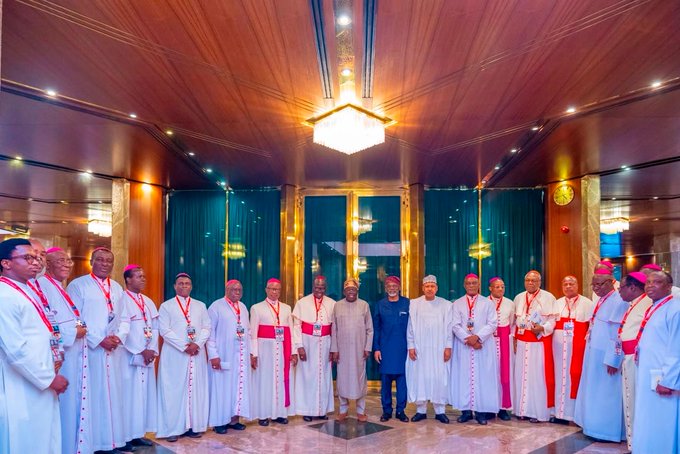
ABUJA — President Bola Ahmed Tinubu on Tuesday hosted the leadership of the Catholic Bishops’ Conference of Nigeria (CBCN) at the State House, assuring the delegation that security restructuring and economic interventions are putting the nation on a course toward stability and prosperity.
However, the meeting—led by CBCN President and Archbishop of Kaduna, Most Rev. Matthew Ndagoso—has drawn intense public scrutiny and sharp criticism from community leaders, civil society groups, and human rights monitors. Critics argue that the administration’s political structure and diplomatic maneuvers have left it fundamentally out of touch with the scale of violence targeting Christian communities.
The Executive Structure and Sensitivity Gap
Central to the growing public outrage is the executive administration’s composition and its perceived disconnect from ground realities:
- Executive Sensitivity Deficit: Critics emphasize that with both President Bola Ahmed Tinubu and Vice President Kashim Shettima sharing the same religious faith, the administration suffers from a profound sensitivity deficit regarding the targeted killings of Christian populations.
- Perceived Indifference to Regional Slaughter: Regional leaders in the Middle Belt and South West argue that the executive leadership lacks the religious and cultural empathy needed to fully grasp the trauma, displacement, and existential terror faced by bereaved families suffering daily assaults from Islamic extremist groups and armed militias.
- Failure to Acknowledge Sectarian Motivations: Opponents contend that this administrative disconnect explains why the presidency frequently frames targeted massacres as simple “socio-economic clashes” or “farmer-herder conflicts,” deliberately avoiding the religious ideology driving many of the violent invasions.
State House Engagements vs. Ground Realities
During the high-level meeting at the State House, President Tinubu outlined military expansions and economic interventions:
- Security Re-engineering: The President announced recent approvals for expanding the armed forces, procuring modern hardware, and constructing new military barracks to combat terrorism and kidnapping.
- Defense of INEC Neutrality: Reassuring the delegation on democratic governance, President Tinubu insisted that the Independent National Electoral Commission (INEC) remains completely neutral, brushing off opposition complaints.
- Return of Mission Schools: Addressing CBCN requests on mission schools, the President noted that state governors hold the constitutional authority to return institutional properties to religious bodies.
Allegations of US Lobbying and Clergy Silence
Despite the President’s assurances, human rights advocates and regional watchers have condemned the optics of the visit against the backdrop of ongoing violence:
- US Lobbying Controversy: The Villa visit comes amid reports indicating that lobbyists operating in the United States, acting on behalf of the administration, worked to convince foreign officials that reported massacres of Christians were exaggerated or false, effectively shielding the government from international scrutiny.
- Critique of the Catholic Hierarchy: Religious scholars and rights activists have criticized the Catholic bishops for providing what many view as a strategic photo opportunity. Critics argue that by maintaining a muted, diplomatically polite stance at the State House while massacres continue unabated, the clergy risks validating official narratives that downplay systemic violence.
Summary of Key Dynamics
  EXECUTIVE COMPOSITION: Shared-faith presidency (President Tinubu & VP Shettima)
  CRITICS' CONCERN:      Lack of empathy/sensitivity to religious massacres in Middle Belt & South West
  DIPLOMATIC ACTION:     Alleged US lobbying efforts to downplay sectarian killings internationally
  PUBLIC OUTRAGE:        Catholic hierarchy accused of lending credibility to official narratives
As security challenges continue to strain national cohesion, governance experts and religious advocates emphasize that lasting peace requires genuine political empathy, structural security reforms, and an unvarnished acknowledgement of the ideological drivers behind regional violence.