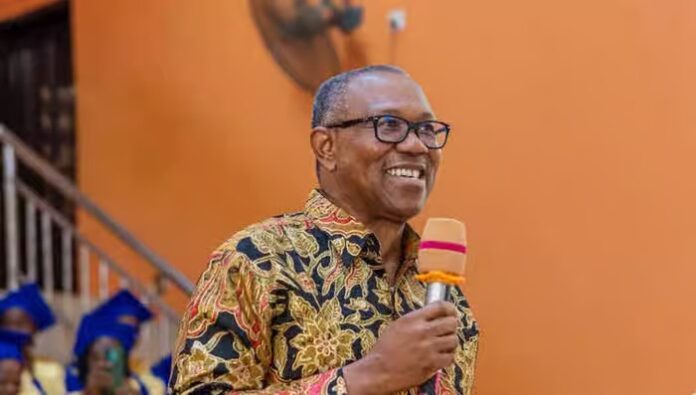


LAGOS, NIGERIA — In the hyper-partisan arena of Nigerian digital politics, academic credentials have become the ultimate weapon of political warfare. A viral claim circulating across social media platforms has accused the Labour Party (LP) presidential candidate in the 2023 elections, Peter Obi, of an impossible chronological feat: attending university before completing secondary school.
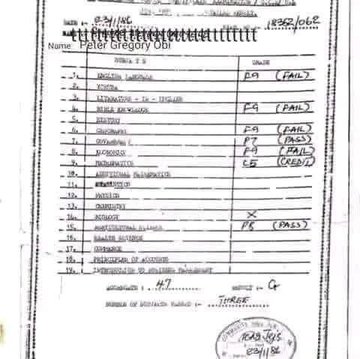
The controversy, which surfaced in the wake of intense national debates regarding the academic verification of top political figures, relies heavily on two leaked documents: a degree certificate from the University of Nigeria, Nsukka (UNN) and a General Certificate of Education (GCE) statement of results. Critics assert that a glaring timeline contradiction exists between the two papers, suggesting double standards from a politician who heavily critiqued administrative opacity during the recent electoral cycle.
However, an objective forensic examination of the documents reveals that the narrative of a chronologically inverted education is entirely false, stemming from a fundamental misreading of institutional administrative practices.
The Anatomy of the Misconception
The primary drivers of the online controversy point to two specific documents to substantiate the claim:
- The University Degree: A certificate issued by the Council and Senate of the University of Nigeria, Nsukka, which states that Gregory Peter Onwubuasi Obi was admitted to the degree of Bachelor of Arts in Philosophy with Second Class Honours (Lower Division) in June 1984.
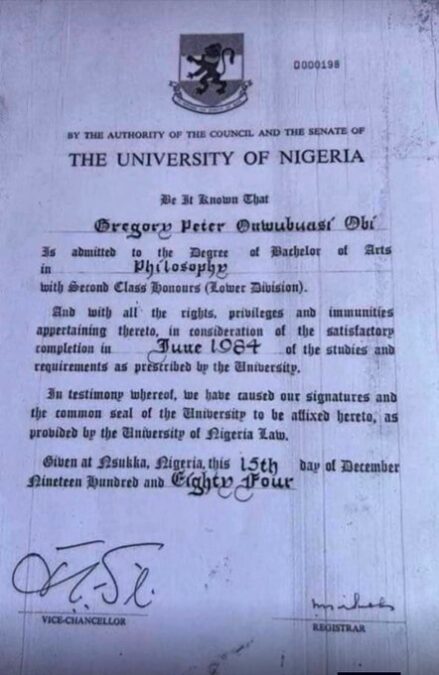
- The Secondary School Record : A formal statement of results bearing the name Peter Gregory Obi, which displays a prominent date stamp at the bottom reading 23/11/86.
To the untrained eye, comparing June 1984 (university graduation) to November 1986 (the date stamp on the GCE document) yields an apparent two-year anomaly. This led internet commentators to mockingly deduce that Obi completed secondary school two years after finishing his university education.
Understanding Examination Timelines vs. Stamping Dates
The discrepancy completely dissolves when the structure of the West African Examinations Council (WAEC) records is properly analyzed.
A close look at the header of the document in School Cert shows that the actual examination period is explicitly captured at the top right as NOV/DEC 1978. This confirms that Obi sat for the GCE Ordinary Level examinations in 1978, a full two years before his admission into UNN and six years prior to his graduation in 1984.
The source of public confusion is the date 23/11/86 at the base of the sheet, which accompanies an official validation stamp from Community High School. In Nigerian academic administration, it is standard practice for candidates to request certified true copies or collect original notifications of results years after the examination was written. The 1986 date merely denotes when this specific copy was officially stamped and released by the school authority—not when the examination took place.
The Verified Timeline
When mapped chronologically based on the actual academic milestones rather than processing dates, the timeline aligns perfectly with standard educational pathways:
| Milestone | Actual Year | Document Reference |
| GCE O-Level Examinations | 1978 | Indicated in the header of School Cert |
| University Graduation (UNN) | 1984 | Explicitly stated in University Degree |
| Administrative Stamping of GCE | 1986 | Indicated in the lower stamp of School Cert |
Editorial Perspective: The Weaponization of Information
This incident highlights a growing vulnerability within the Nigerian public square: the weaponization of bureaucratic paperwork. For a graduate-level readership, this case serves as a poignant reminder of the necessity for media literacy in the digital age.
As political actors increasingly deploy administrative documents out of context to score partisan points, the line between genuine investigative journalism and engineered disinformation continues to blur. In this instance, a simple distinction between an examination date and a clerical stamp date is all it takes to separate political fiction from factual reality.