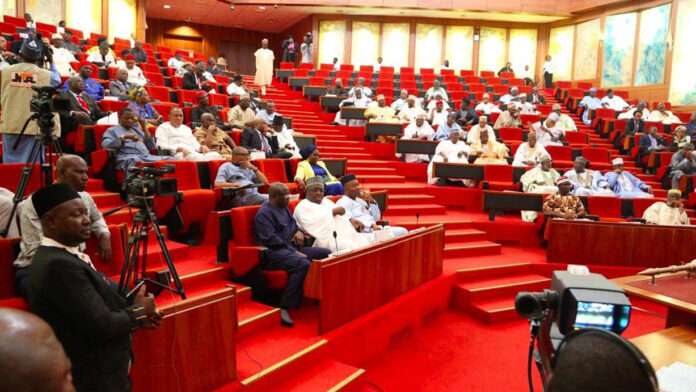

ABUJA, NIGERIA — The Nigerian Senate on Thursday performed a dramatic policy reversal, rescinding controversial amendments to its Standing Orders regarding the oath-taking and voting procedures for presiding officers.
The decision to rescind the rules comes just 48 hours after they were initially adopted, a move the Senate leadership attributed to the discovery of significant “constitutional inconsistencies” during further legislative review.
Constitutional Alignment
The motion to rescind was moved by Senate Leader Opeyemi Bamidele, who argued that the recently introduced amendments to Order 2(2) and Order 3(1) could potentially conflict with Section 52 of the 1999 Constitution. These orders had sought to alter the sequence of the inauguration process, specifically concerning when senators-elect are eligible to cast votes for the Senate Presidency.
In his lead debate, Bamidele emphasised the necessity of ensuring that the upper chamber’s rules remain consistent with parliamentary conventions and established legislative practice. Following the motion, the Senate resolved to return to its previous procedural framework to preserve the integrity of the institution.
Controversial Eligibility Clause Intact
Despite the procedural U-turn, the Senate notably left untouched the controversial Order 5(a). This specific rule continues to serve as a high-stakes political filter for the 11th National Assembly, as it restricts the contest for the Senate Presidency and other principal offices to ranking senators.
Under the retained Order 5(a), eligibility for top leadership is limited to senators who have served at least two terms, with the requirement that one of those terms must be the immediate 10th Assembly. This maintains a significant barrier for “new power entrants,” effectively blocking former senators or outgoing governors who are not currently in the 10th Senate from vying for leadership positions in 2027.
Political Implications
The decision to retain the two-term eligibility filter while rescinding the procedural hurdles is being viewed by analysts as a strategic compromise. The Senate leadership appears to be addressing legal vulnerabilities that could lead to constitutional challenges, while simultaneously protecting the interests of the current “inner circle” of ranking lawmakers.
The legislative session on Thursday was marked by intense deliberation, following earlier public friction where ranking members had questioned the transparency of the rapid rule changes. With this latest development, the procedural path for the 2027 inauguration is clarified, even as the battle over leadership eligibility continues to narrow the field of potential candidates.