
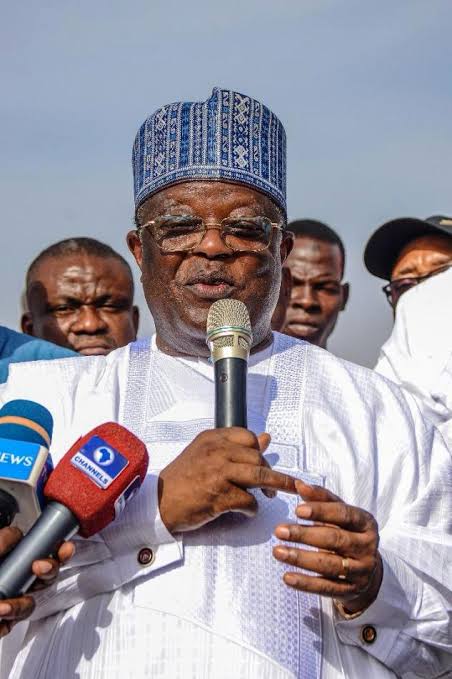


ABUJA — Minister of Works, David Umahi, has stoutly defended the pricing of the ongoing Lagos-Calabar Coastal Highway project, asserting that a standard kilometre of the road costs ₦7.5 billion (approximately $5.5 million) and represents genuine value for money given its complex engineering specifications and difficult terrain.
Speaking during an interview on Arise Television, Umahi pushed back against public criticism, arguing that critics have miscalculated the project’s actual cost by simply dividing the total contract sum by its physical length without accounting for its multi-lane, six-carriageway design.
“Compare Apples to Apples”
Detailing the financial breakdown for Section One—a 47.47-kilometre stretch running from Victoria Island to Eleko Village in Lagos State—Umahi confirmed the contract value stands at approximately ₦1.067 trillion. While a direct division yields roughly ₦22.5 billion per physical kilometre, the minister clarified that normalizing the project to a standard two-lane federal highway structure brings the baseline cost down to ₦7.5 billion per kilometre.
Addressing concerns over earlier figures quoted in April 2024 of around ₦4 billion per kilometre—which prompted accusations of cost inflation—Umahi insisted he deserves commendation rather than censure.
“You have to compare apple to apple,” Umahi said during the broadcast, stressing that road width, pavement specifications, drainage, and surrounding terrain must be factored into cost evaluations.
Terrain Demands and Material Costs
The minister highlighted the extreme engineering requirements necessitated by the coastal swamp conditions. According to Umahi, contractors on a 30-kilometre stretch in Lagos had to excavate soft, unsuitable soil to an average depth of 10 metres, replacing it with sand filling up to 20 metres deep to elevate the road by 5 metres.
He listed several major infrastructural elements embedded within the ₦7.5 billion per-kilometre figure, including:
- Durability: A 100-year design life utilizing reinforced concrete pavement rather than conventional asphalt.
- Infrastructural Features: Continuous shore protection, retaining walls, flyovers, underpasses, 2-metre walkways, underground drainage, solar-powered street lighting, and tree planting.
- Future Transit Corridor: A designated center lane reserved for a high-speed railway line.
Umahi also noted that despite significant macro-economic pressures—such as the price of concrete jumping from ₦350,000 to ₦460,000 per cubic metre since construction began—the original contract price has remained unchanged.
Project Financing and Master Estimate
Defending the cost against international benchmarks, Umahi pointed to a similar 47km coastal project in the neighboring Benin Republic executed for ₦1.06 trillion. He revealed that Deutsche Bank, which led the international financing for Section One, independently audited the project’s bill of quantities, found it competitively priced, and subsequently oversubscribed its financing round by $100 million.
Regarding widespread claims that the overall 750-kilometre highway will cost a total of ₦15 trillion, Umahi dismissed the figure as speculative. He disclosed that the project is being executed and priced incrementally section by section, meaning no single engineering design or fixed grand total currently exists for the entire corridor.
“Who fixed this ₦15 trillion that people are just brandishing everywhere?” Umahi asked. “Nobody has the right to do an average cost and multiply by 750.”