


247ureports Investigative Desk
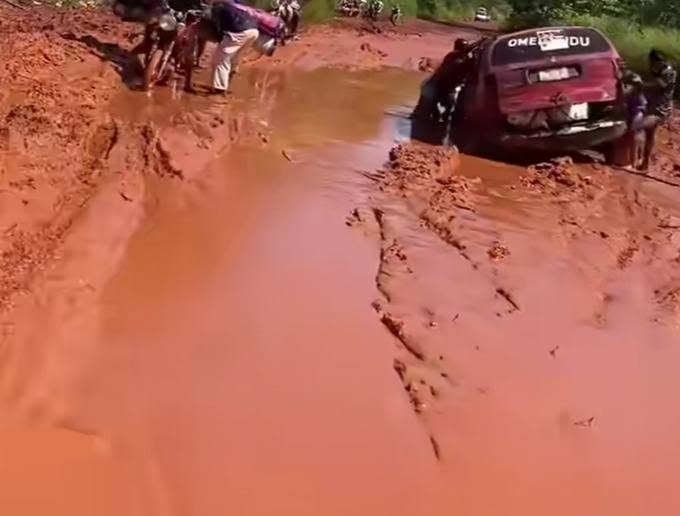
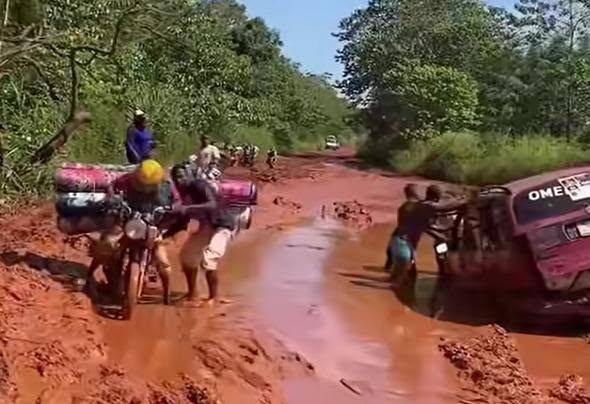
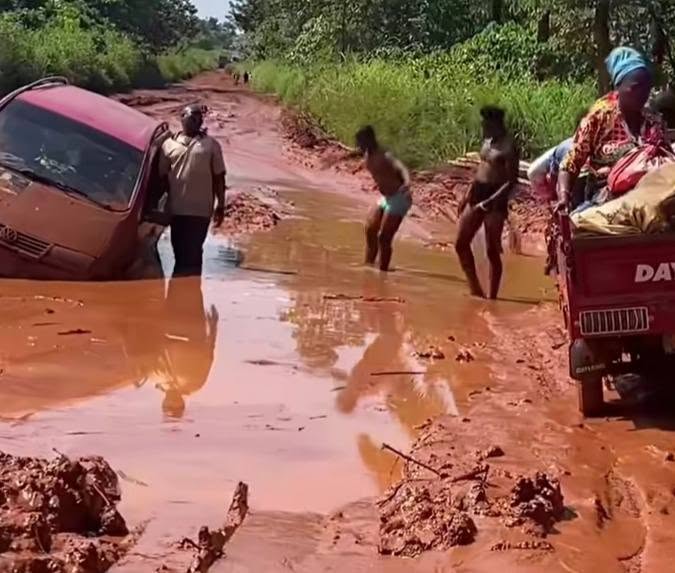
ENUGU STATE — Photos and video circulating from Eha-Amufu, a major town in Isi-Uzo Local Government Area of Enugu State, show a scene that has become depressingly familiar to residents there: a passenger bus sunk axle-deep in a churning red-mud swamp where a federal road should be, stranded travelers wading barefoot through the sludge, and motorcyclists forced to portage their own cargo around the wreckage of a road that has effectively ceased to function as one.
The images are consistent with years of documented reporting on the same stretch of road, and they land at an awkward moment for Enugu State’s government — barely months after Governor Peter Mbah’s administration unveiled its third consecutive record-breaking budget, this time topping ₦1.6 trillion, built explicitly around the promise of transforming the state’s infrastructure.
A Road With a Long, Well-Documented History of Failure
Eha-Amufu is not an obscure backwater. It is one of the larger communities in Isi-Uzo LGA, historically known as a gateway town linking Enugu State to the north via Obollo-Afor, and it sits along a federal road corridor — the Nkalagu-Eha-Amufu-Ikem-Obollo-Afor highway — that serves as the primary commercial artery for a farming population numbering well into the tens of thousands across the wider area.
The road’s deterioration is not new. Reporting on its poor condition stretches back to at least 2020, when residents and local officials described the Ikem-to-Eha-Amufu stretch as needing urgent intervention. By 2022, a local official representing the area was publicly begging the state governor to address what he called the total absence of usable road or security in Isi-Uzo LGA, warning that the bad road conditions were compounding a wave of kidnappings along the same corridor. That year alone, the area recorded at least ten abduction incidents involving twenty-three people, with residents paying millions of naira in ransom and at least three people killed by armed gangs operating along the same stretch of failed road. More recently, women in Eha-Amufu staged protests that shut down local markets and blockaded the federal highway entirely, citing killings blamed on herdsmen in the area.
In other words: for the better part of five years, and across two gubernatorial administrations, Eha-Amufu’s road crisis and the insecurity that has fed on it have been a matter of public record, not a secret failure suddenly exposed by a viral video.
The Budget Numbers Tell a Story of Their Own
What makes the persistence of that failure harder to explain away is the sheer scale of the road-infrastructure money the Enugu State government says it has been spending.
In 2024, Governor Mbah’s administration approved ₦183 billion specifically for the construction and reconstruction of 141 urban roads across Enugu metropolis and 20 rural roads spanning the state’s three senatorial zones — part of a ₦521.5 billion total budget the governor described at the time as unprecedented in the state’s history.
The following year, the number grew again. The 2025 budget — titled, without apparent irony, the “Budget of Exponential Growth and Inclusive Prosperity” — earmarked ₦213.12 billion specifically for road infrastructure, within a record ₦971.84 billion total budget with an extraordinary 86 percent of spending classified as capital expenditure.
By 2026, the state’s total budget had ballooned further still, to ₦1.617 trillion under the banner “Budget of Renewed Momentum,” with ₦1.296 trillion earmarked for capital projects — a budget size larger than that of some sovereign African nations. Enugu State’s government has pointed to a matching surge in internally generated revenue, reportedly reaching close to ₦400 billion in 2025, as evidence the spending is sustainable and not merely aspirational.
Add the two years with clearly disclosed, distinct road-infrastructure line items together, and the state has publicly committed at least ₦396.1 billion to road construction and rehabilitation across 2024 and 2025 alone — before accounting for whatever portion of the 2026 capital budget is ultimately directed at roads, a figure the state has not broken out as clearly as it did in the prior two years.
Where Did the Money Go?
None of this, on its own, proves wrongdoing or explains why Eha-Amufu’s road remains, by all visual evidence, a seasonal swamp. Enugu State’s road program has been geographically extensive — spanning dozens of named projects from Obuofia-Obeagu-Akegbe Ugwu Road to the Amagunze-Ihuokpara-Ugbawka corridor, and Isi-Uzo LGA itself has not been entirely absent from state road-commissioning activity in years past, including sections of the Eha-Amufu-Nkalagu road and the Umualor-Eha-Amufu road named in earlier state infrastructure updates.
But that is precisely what makes the current images so pointed. A state government that has, on paper, allocated hundreds of billions of naira to road construction over just two budget cycles — and which has publicized specific named projects inside Isi-Uzo LGA as part of that spending — has not produced a passable road on one of its most economically important rural corridors. Either the money allocated to that corridor was insufficient relative to the scale of the problem, the specific Eha-Amufu stretch was not prioritized within the broader program despite years of documented need, or funds nominally directed at road infrastructure in the area have not translated into completed, durable work. Enugu State’s government has not, as of this report, offered a public accounting that distinguishes between those explanations.
The Cost of the Gap
For residents, the distinction between those explanations matters less than the daily reality: a farming community cut off from markets, commuters wading through mud beside their own vehicles, and a road corridor that has doubled, according to residents’ own accounts in past years, as a corridor for kidnappers preying on a population with no alternative route.
Enugu State’s leadership has built its political brand substantially around fiscal ambition — the promise to grow the state’s economy from an estimated $4.4 billion to $30 billion within Governor Mbah’s tenure, funded by budgets that have nearly tripled in size in just two years. Whether that ambition is reaching communities like Eha-Amufu, or is being absorbed disproportionately by higher-profile urban projects in Enugu metropolis, is a question the state’s own disclosed figures do not yet answer — and one its residents, stranded again in the mud, are still waiting to have addressed.