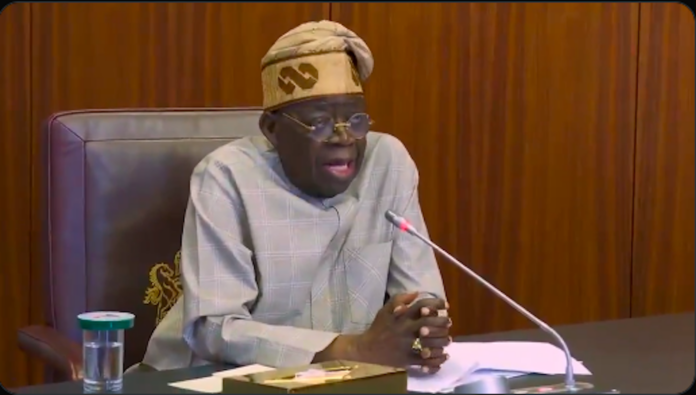

ABUJA — Renewed public and political debate has erupted across social media platforms following the circulation of certified true copies of President Bola Ahmed Tinubu’s 1999 gubernatorial candidate filings, contrasting them sharply with his recent electoral submissions for the 2023 and 2027 presidential polls.
Commentators on platform X (formerly Twitter) highlight that while President Tinubu’s 1999 filing with the Independent National Electoral Commission (INEC) contained detailed listings of primary and secondary schools, subsequent filings have omitted basic education entries, relying exclusively on his tertiary qualification.
The 1999 Document Filings vs. Recent Disclosures
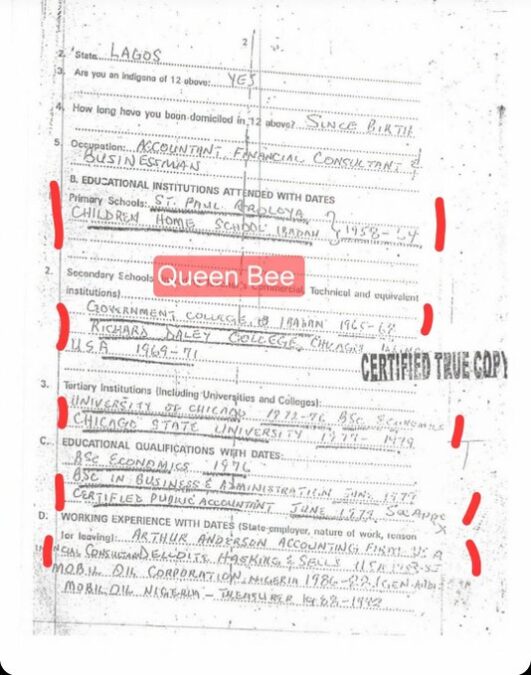
The resurfaced document, marked as a certified true copy from his 1999 Lagos State governorship entry form, reveals explicit details under his educational and professional history:
- Primary & Secondary Education (1999 Filing): Listed St. Paul Aroloya, Children Home School Ibadan (1958–1964), Government College Ibadan (1965–1968), and Richard Daley College, Chicago, USA (1969–1971).
- Tertiary & Professional Entries (1999 Filing): Recorded studies at the University of Chicago (1972–1976), Chicago State University (1977–1979), and work experience with Arthur Andersen, Deloitte Haskins & Sells, and Mobil Oil Nigeria.
- Modern Filings (2023 / 2027 Forms): In contrast, recent submissions leave the primary and secondary school sections blank, listing only his B.Sc. degree from Chicago State University.
The Public & Political Reaction
Critics argue that the discrepancy between earlier detailed submissions and stripped-back modern forms points to strategic omissions aimed at avoiding scrutiny over basic school records.
Conversely, defenders of the administration and legal analysts maintain that submitting higher education credentials fully satisfies Section 131(d) of the 1999 Constitution (as amended), which mandates a minimum of a Secondary School Certificate or its equivalent, rendering basic school listings legally redundant under Nigerian electoral law.
Comparison Matrix: Electoral Disclosure Evolution
  DOCUMENT SOURCE:     Certified True Copy (1999 INEC Governorship Form) vs. Form EC9 (2023/2027)
  BASIC EDUCATION:     1999: Detailed (St. Paul Aroloya, Govt College Ibadan, Richard Daley) | 2023/2027: Left Blank
  TERTIARY ENTRY:      1999: Univ. of Chicago & Chicago State Univ. | 2023/2027: Chicago State University (B.Sc.)
  LEGAL STATUS:        Upheld as constitutionally valid under Section 131(d) by Supreme Court precedents
  CIVIC CONTENTION:    Opponents cite discrepancy as opacity; Supporters frame it as legal optimization
Ongoing Public Oversight
As civic groups and political opponents continue to dissect electoral disclosures ahead of the upcoming election cycles, the debate highlights persistent calls for comprehensive transparency, even where judicial standards deem partial submissions legally sufficient.