


WASHINGTON — U.S. government affairs firm Von Batten-Montague-York, L.C. has disclosed that it has begun providing over 60 pages of U.S. Department of Justice (DOJ) court documents and investigative filings to the Donald Trump administration and key congressional committees, detailing historical allegations surrounding Nigerian President Bola Ahmed Tinubu’s ties to a 1990s heroin trafficking investigation.
The lobbying firm announced the development across social media channels, releasing an executive chronology summarizing federal court documents, affidavits, and ongoing Freedom of Information Act (FOIA) litigation involving U.S. law enforcement agencies.
According to the firm, the briefing packet includes certified court filings from the 1993 civil forfeiture case United States v. Funds in Account No. 263226700 et al., as well as recent federal court rulings compelling U.S. intelligence and law enforcement components to process investigative dossiers concerning the Nigerian leader.
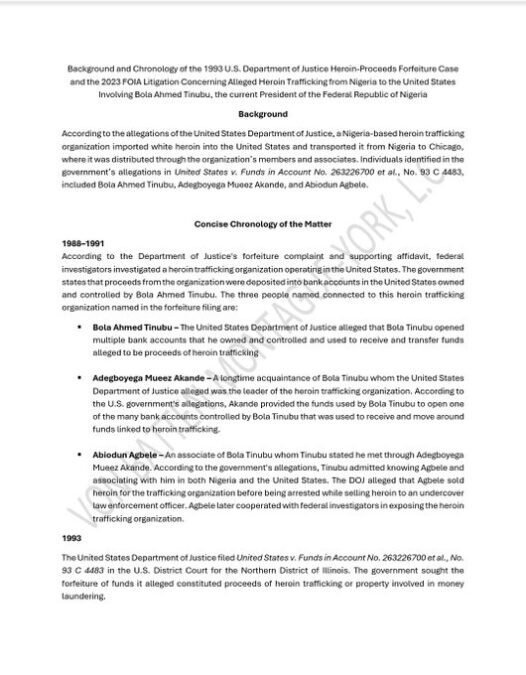
Dossier Outlines Historical Forfeiture and Key Associates
The chronology released by the firm details the DOJ’s late-1980s and early-1990s narcotics investigation into a Chicago-based heroin distribution network led by Adegboyega Mueez Akande and Abiodun Agbele.
According to affidavits authored by Internal Revenue Service (IRS) Special Agent Kevin Moss during the 1993 proceedings, federal investigators established that funds derived from heroin sales were deposited into several U.S. bank accounts owned and controlled by Bola Ahmed Tinubu.
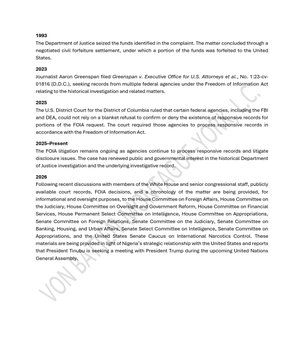
The matter concluded in 1993 through a negotiated civil forfeiture settlement in the U.S. District Court for the Northern District of Illinois, under which Tinubu agreed to forfeit $460,000 to the U.S. Treasury. While Tinubu was never criminally indicted or convicted, U.S. prosecutors maintained that the seized funds constituted proceeds of narcotics trafficking and property involved in money laundering.

Ongoing FOIA Litigation and Congressional Notification
The firm noted that its submission to Washington lawmakers builds upon recent judicial developments in Greenspan v. Executive Office for U.S. Attorneys et al.
In that case, District Judge Beryl A. Howell of the U.S. District Court for the District of Columbia ruled that major law enforcement agencies—including the Federal Bureau of Investigation (FBI) and the Drug Enforcement Administration (DEA)—could no longer issue blanket “Glomar” responses to refuse confirming or denying the existence of investigative records on Tinubu. The court ordered the agencies to process non-exempt investigative files for public disclosure under the Freedom of Information Act.
Von Batten-Montague-York stated that the dossier has been transmitted to multiple legislative panels, including:
- Senate Committee on Foreign Relations and House Committee on Foreign Affairs
- House and Senate Committees on the Judiciary
- Senate Select Committee on Intelligence and House Permanent Select Committee on Intelligence
- United States Senate Caucus on International Narcotics Control
Political Context Surrounding U.S. Engagement
The lobbying firm emphasized that it is bringing the historical DOJ record to the direct attention of the Trump White House and congressional leadership ahead of anticipated bilateral discussions and upcoming diplomatic engagements, including the United Nations General Assembly.
The move marks an escalation in diplomatic and public relations maneuvering around the Nigerian presidency in Washington, as opposition figures and civic advocacy groups continue to press U.S. authorities for full disclosure of archived federal investigative dossiers.
Neither the Nigerian State House nor the Ministry of Information has issued an official statement regarding the firm’s submission to the U.S. Congress, though presidential spokespersons have previously maintained that the 1993 civil settlement contained no criminal indictment and remains a closed legal matter.