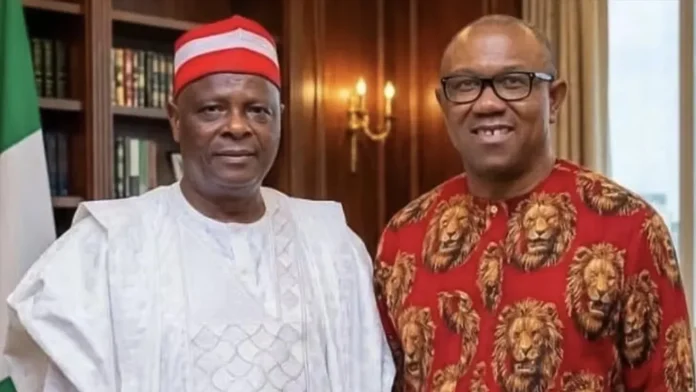

ABUJA — Fresh internal friction and leadership tussles have hit the Obi-Kwankwaso (OK) Movement—the joint political initiative uniting former Labour Party presidential candidate Peter Obi and former Kano State Governor Rabiu Musa Kwankwaso—threatening the stability of the coalition ahead of the 2027 general elections.
Reports emerging from political circles indicate that Peter Obi is increasingly dissatisfied with the current organizational structure and leadership direction of the OK Movement, raising fears of a premature breach in the joint political vehicle.
Spokesman Pushes Back: “External Saboteurs and Internal Elements at Play”
Dismissing claims that the coalition is collapsing from within, Barrister Ladipo Johnson, spokesperson for Rabiu Musa Kwankwaso, insisted that no genuine internal conflict exists between the two principals.
However, Johnson acknowledged that specific political interests are actively working to undermine the coalition’s momentum:
- Factions Pushing for a Split: Johnson revealed that certain individuals within the “Obidient” ecosystem are actively advocating for the OK Movement to break apart, citing ideological purity and administrative differences.
- External Political Interference: The spokesman noted that rival political actors across the wider national landscape are heavily invested in seeing the OK Movement fail before it can fully consolidate its grassroots structures ahead of 2027.
- Confidence in Leadership: Reaffirming trust in the movement’s operational framework, Johnson emphasized that the executive leadership—including the Director-General of the OK Movement, Dr. John Ughulu—remains highly competent and fully capable of steering the coalition through external sabotage and organizational friction.
Key Points Driving the Leadership Tension
Despite reassurances from campaign aides, political insiders point to lingering friction surrounding the administration of the alliance:
- Obi’s Dissatisfaction with Movement Structure: Sources close to the former Anambra State governor reveal that Obi’s team harbors strong reservations over operational control, campaign machinery, and messaging, which is perceived by some as leaning heavily toward Kwankwasiyya structures over the broader Obidient framework.
- Clash of Control: While forged to consolidate opposition votes across the South-East, North-West, and urban youth demographics, tension has flared over executive appointments, campaign funding control, and decision-making authority within the central working committee.
- The Question of Ticket Supremacy: Underlying friction remains over regional power balancing and ticket positioning, with rival supporter bases pushing competing narratives regarding the leadership hierarchy.
Overview of Coalition Dynamics
  ALLIANCE:            Obi-Kwankwaso (OK) Movement
  KEY LEADERS:         Peter Obi (Obidient Movement) & Sen. Rabiu Musa Kwankwaso (Kwankwasiyya)
  KWANKWASO SPOKESMAN: Barr. Ladipo Johnson
  MOVEMENT DG:         Dr. John Ughulu
  CORE CONFLICT:       Alleged leadership dissatisfaction vs. accusations of external sabotage
Implications for the 2027 Opposition Front
The emerging cracks present a major test for opposition efforts seeking to build a formidable, unified front.
With both political figures commanding disciplined, highly devoted follower bases, analysts warn that the OK Movement’s leadership must swiftly harmonize its administrative operations and neutralize external interference if it hopes to survive as a credible alternative in the lead-up to 2027.
With both political figures commanding significant, highly disciplined follower bases, analysts warn that failure by Obi and Kwankwaso to swiftly resolve executive leadership disputes and establish a transparent governance model could derail the coalition before formal electioneering commences.