By Izunna Okafor, Awka
Calls for expedited action on creation of State Police, improved support for local vigilante groups, faster police response to distress calls, and deeper community participation in crime fighting took centre stage on Tuesday as security stakeholders converged in Awka, the Anambra State capital for a strategic conversation on the state’s security situation.
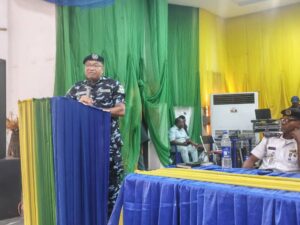
The event, tagged “Together for a Safer Anambra”, held at the Prof. Dora Akunyili Women Development Centre and formed part of the operational tour of the South-East by the Deputy Inspector-General of Police overseeing the zone, DIG Kenechukwu Onwuemelie.

The gathering brought together traditional rulers, community leaders, security agencies, transport unions, civil society organisations, persons living with disabilities, government officials and media practitioners to deliberate on emerging security concerns and possible solutions.
Delivering the keynote address, DIG Onwuemelie explained that the engagement was in line with the directive of the Inspector-General of Police for similar stakeholder conversations to be held across the various geopolitical zones of the country.

According to him, the initiative is anchored on four major pillars — listening, collaboration, prevention and trust-building — which he described as essential ingredients for effective crime prevention and public safety.
The DIG observed that security challenges in Anambra and the wider South-East remain complex and evolving, requiring continuous engagement with stakeholders and innovative responses from security agencies.

Speaking extensively on cult-related violence, he argued that the term “cultism” often fails to adequately describe the nature of crimes committed by violent groups. He noted that many of such organisations are even registered entities and that focusing solely on their names could sometimes undermine effective prosecution.
Citing the recent incident involving members of the Kegite group in the state, the DIG advised that rather than concentrating on group affiliations, security agencies should focus on the specific crimes committed by suspects, such as murder, armed robbery, kidnapping and other violent offences, stressing that such an approach would strengthen legal processes and accountability.
“Violent offences such as murder, armed robbery, kidnapping and extortion should remain the primary focus of investigators and prosecutors, irrespective of any cult affiliation claimed by suspects,” he advised.

The DIG also called on stakeholders to support security agencies through timely information sharing, youth engagement initiatives, victim support mechanisms and community-based crime prevention efforts. He further reassured assured participants that the Nigeria Police Force would continue to improve response time to distress calls, strengthen professionalism among officers, deepen community policing and enhance public confidence in law enforcement.
Earlier in his address of welcome, the Commissioner of Police in Anambra State, CP Ikioye Orutugu, represented by the Deputy Commissioner of Police in charge of Operations, DCP Ibrahim Ezekiel, stressed that security cannot be achieved by security agencies alone, but requires active collaboration from all segments of society.

He appreciated residents of the state for the support and cooperation they have continued to extend to security agencies, noting that such collaboration has contributed significantly to the reduction of violent crimes and other security threats across Anambra; even as he urged them not to relent in supporting the collaboration, support and intelligence sharing.
Also speaking, the Anambra State Commandant of the Nigeria Security and Civil Defence Corps (NSCDC), DC Maku Olatunde, represented by DCC Akacha Godwin, commended the Police for organising the engagement and advocated regular interactions of such nature.

He highlighted the growing challenge of vandalism and sabotage of critical national assets, warning that such criminal activities negatively affect government revenue, public infrastructure and socio-economic development. He further appealed to communities to provide intelligence that would help security agencies tackle the menace.
The event also featured interactive sessions during which several stakeholders raised several concerns over specific and general issues affecting security situations in the state and charted pathways forward towards a safer Anambra.
Speaking, the Traditional Ruler of Umueri, Igwe Ben Emeka (Oke Ebo II), commended Governor Chukwuma Soludo and the Anambra State House of Assembly for establishing the Agụnechemba security outfit, which he said had contributed greatly to ongoing efforts to tackle insecurity in the state.

The monarch, however, renewed the call for the creation of State Police, insisting that localised policing remains one of the most effective ways of addressing peculiar security challenges.
Also speaking, the President-General of Igbariam Community, Chief Ifesinachi Anthony, advocated greater support for and well-resourcing of local vigilante groups in the state, including improved training, welfare and equipment, arguing that community-based security structures remain critical to intelligence gathering and crime prevention.
Similarly, the Chairman of the Anambra Keke Drivers Forum, Comrade Osita Obi, observed that most communities already know individuals involved in criminal activities within their areas and stressed the need for stronger collaboration between community leaders and security agencies to expose such elements.

Responding, the DIG explained that the establishment of State Police remains a constitutional matter that can only be achieved through legislative processes and constitutional amendment.
In his contribution, Mr. Ikenna Chibuike, First Vice President of Obosi and representative of the community’s President-General, clarified that the recent kidnap of a medical doctor widely reported in some quarters as occurring in Obosi actually happened in neighbouring Umuoji. He also raised concerns over alleged destruction of farmlands by roaming cattle, warning that unresolved grievances could trigger avoidable conflicts within affected communities.
Reacting, DIG Onwuemelie advised communities to focus on the specific offences committed rather than ethnic profiling, noting that destruction of crops and property constitutes malicious damage under the law and should be treated as such irrespective of the ethnic identity of the offender.
Also speaking, a security researcher, Dr. Chris Chikwelu Jnr., urged security agencies to become more proactive than reactive, establish effective feedback mechanisms and exercise caution when discussing operational strategies in public spaces.
Other stakeholders and traditional rulers who spoke at the event, including Igwe Chika Uchime of Ufuma; HRM Igwe Dr. Joel M. Egwuonwu of Umuawulu; HRH Igwe Raymond Omoja of Owelle and the Secretary of the Anambra State Traditional Rulers Council, Igwe Surv. Charles Agbala of Uke, raised concerns ranging from delayed police response to distress calls, prolonged investigations, jurisdictional conflicts in cases, excessive petitions against traditional institutions and the need for more sophisticated crime-fighting technologies such as drones and aerial surveillance.
The speakers also advocated improved training for officers and stronger institutional support for traditional rulers in maintaining peace and order within their communities.
Similarly, former Chairman of the Police Community Relations Committee (PCRC), Chief Sir I.K. Ezenwankwo, expressed concern over alleged interference by influential individuals in criminal investigations and prosecutions, while the immediate-past President of Ohanaeze Ndigbo, Chief Chukwuemeka Udodeme, called for greater consultation with communities after suspects arrested through local intelligence are handed over to security agencies.
The DIG, in further response to several concerns raised, assured participants that the Inspector-General of Police had continued to emphasise professionalism, accountability and adherence to due process across all police formations, which also noting that the various observations made have been duly noted for action.
Speaking in an interview with journalists, the Chairman of Miyetti Allah Cattle Breeders Association in Anambra State, Gideon Siddiki, condemned ethnic profiling and generalisation against cattle breeders.

While acknowledging that some individuals may engage in unlawful activities, he maintained that the majority of herders are law-abiding citizens. He commended the open grazing policy and advocated more enlightenment programmes and town hall meetings to educate cattle breeders on ranching practices and compliance with existing laws.
The stakeholders’ conversation, which ended with a special vote of thanks by the Anambra State Chairman of National Association of Women Journalists (NAWOJ), Comrade Toochukwu Ifejirika, signified commitments from both security agencies, community leaders and other participants to strengthen cooperation, promote information sharing and work collectively towards sustaining peace, security and development across Anambra State.