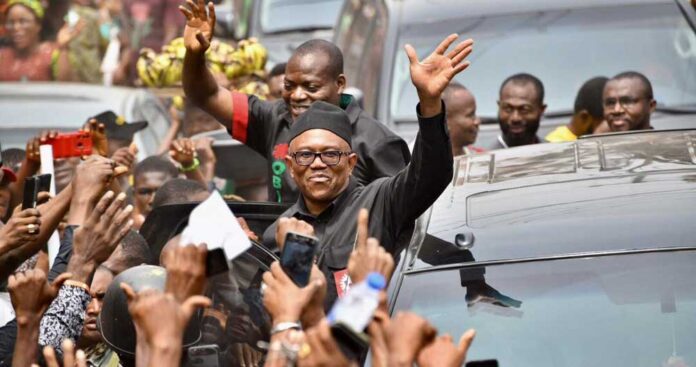


ABAKALIKI, NIGERIA — The political landscape has been thrown into intense debate following the viral footage of an unannounced visit by the presidential candidate of the Nigeria Democratic Congress (NDC), Peter Obi, to Abakaliki, the Ebonyi State capital.
The chaotic, high-energy reception by everyday citizens in local markets and streets has reignited discussions on the power of organic political followings ahead of the 2027 general elections.
The Reality of the Organic Crowd
Eyewitness accounts and video clips circulating heavily online show hundreds of traders, youth, and passersby abandoning their businesses to swamp Obi’s convoy the moment he was recognized. Crucially, local coordinators confirmed that the visit was entirely unadvertised, leaving no room for advance mobilization.
Political commentators have quickly contrasted the scene with the typical operational style of the Nigerian ruling class.
“This is completely unlike certain politicians who arrange for paid crowds to wear matching uniforms and wait at airports to simulate a popularity that does not exist,” a local political analyst remarked.
The ‘OK’ Alliance: The Establishment’s Nightmare
The spontaneous uproar in Abakaliki has re-focused national attention on the formidable structural fusion within the newly registered NDC—popularly dubbed the “OK Ticket” (the Peter Obi and Rabiu Kwankwaso alliance).
Political strategists widely concede that within the current Nigerian democratic framework, only two individual politicians command a fiercely loyal, self-mobilizing grassroots base that requires no financial inducement:
- Peter Obi: Who retains a massive, fiercely protective hold over southern urban youth, Christian demographics, and professionals.
- Engr. Rabiu Musa Kwankwaso: Who commands the highly disciplined, millions-strong “Kwankwasiyya” red-cap movement across Kano and the North-West geopolitical zone.
By combining these two distinct, fanatical bases into a singular progressive platform, the NDC has engineered an electoral blueprint that directly challenges the traditional multi-billion naira deployment strategies of both the ruling All Progressives Congress (APC) and the fractured Peoples Democratic Party (PDP).
Panic in the Power Corridors
The rapid expansion of this cross-regional alliance is reportedly causing deep anxieties within the state apparatus. With opposition parties like the ADC simultaneously carving out alternative northern caucuses, the ruling party find its traditional electoral math severely threatened.
While state propagandists continue to downplay the momentum of the NDC as a social media phenomenon, the raw, unfiltered crowd dynamics witnessed on the ground in Ebonyi State demonstrate that public anger over the high cost of living is translating into a powerful, uncontrollable desire for a clean break from the old political guard.