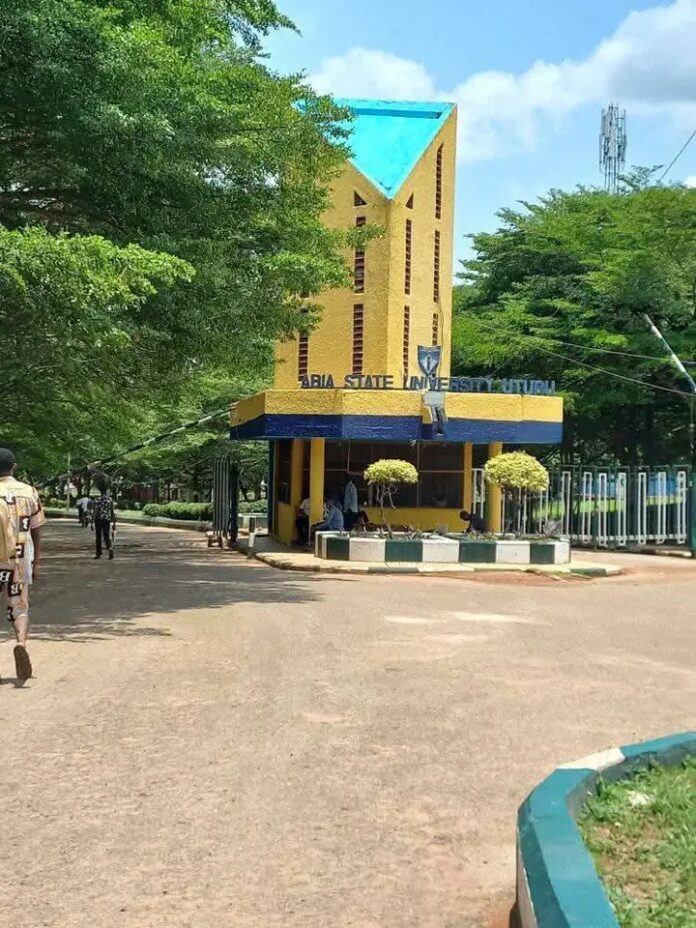

UTURU — A disturbing wave of allegations has emerged from Abia State University (ABSU), where students are raising an urgent alarm over a systematic extortion ring allegedly operated by a senior lecturer.
The outcry centers on Dr. KC Izuogo of the Mass Communication department, who is accused of turning his “Introduction to Advertising” course into a mandatory toll gate for students.

The ABSU “Sorting” Protocol
According to multiple student accounts, the path to a passing grade in Dr. Izuogo’s class requires two distinct payments: a N5,000 fee for a course handout and a N20,000 “sorting” fee to guarantee exam success.
Students allege that failure to comply with these financial demands results in an automatic “F,” regardless of their academic performance.
While ABSU management has previously dismissed such claims as “blackmail” intended to tarnish the institution’s image, the sheer volume of testimonies from the current 2025/2026 academic session has triggered calls for a forensic audit of the department’s grading records.
EBSU and the “Sex-for-Grades” Culture
The rot extends beyond Abia. At Ebonyi State University (EBSU), students describe a “lawless” environment, particularly within the Faculty of Law and the Computer Science department. The allegations there suggest a darker trend: “sex-for-grades” is reportedly treated as a transactional privilege by predatory lecturers.
“EBSU has become a den for lecturers who feel untouchable,” one student claimed, echoing sentiments that the university’s oversight mechanisms have failed. This follows the institution’s 2018 mass purge of 63 staff for similar misconduct, indicating that the culture of exploitation has proven difficult to uproot.
Institutional Complicity or Negligence?
The crisis is not limited to state schools; even private institutions like Bingham University have been called out by former students over the “terror” tactics used by 100-level lecturers in core courses like Communication in English.
The common thread across these institutions is the perceived leverage lecturers hold over students’ futures. Analysts warn that without visible, high-level sackings and criminal prosecutions, academic extortion will continue to thrive in the shadows.
How to Fight Back
Anti-corruption bodies like the ICPC and its Sexual Harassment Response Team (SHART) are currently encouraging victims to bypass school authorities, who may be complicit, and report directly to federal investigators. They advise students to keep bank transfer receipts to lecturers’ “proxy” accounts and save all digital communications as evidence.
–