Find below the Official Statement from The family –
It has come to our notice that some journalists who have no respect for the ethics of Journalism have gone print with false information that The Family of the Late Cynthia Osokogu have been reluctant to claim her corpse from the Police. This is totally false.
The question of abandonment does not arise in the first place. The Police have not called the family in respect to picking the corpse. The case is still at d Magistrate level, magistrate is just a holding court, and cannot try murder, d 2nd hearing is fixed for 3rd October 2012, which we believe that the case would be transferred to the high court and afterwards the police can seek for permission to release the corpse for burial.
We are not in a haste to bury her as Justice must take its full course. My dad just spoke to the police in charge and his response was that we should not mind unprofessional journalists.. The police only got clearance from the pathologist 2 days ago and the pathologist isn’t around, he traveled, so the post mortem report has not been collected.
However, the family has resolved to fix the new date for Friday 5th October, If all goes as planned. The family advises the press to seek info from the police or any family member before publishing, we are always open and would provide any information we seek if we have the power to do so. Thank you.
–
Flight Lieutenant Kenneth Uche Chukwu Osokogu for the family
Governor Adams Oshiomhole of Edo State and Hon Justice Cromwell Idahosa, Chief Judge of Edo State at the unveiling of the Edo State High Court (Civil Procedure) Rules 2012, in Benin City
Edo State Government is to set up a Public Defender Unit to provide free legal aid to victims of human rights abuses.
Governor Adams Oshiomhole who stated this yesterday at the unveiling of Edo State High Court (Civil Procedure) Rules said too many people are being victimised and intimidated but are unable to fight for their rights.
According to the governor “just recently, the police in the state arrested an innocent man and charged him for murder without any convincing evidence. I have now decided to set up a public defender unit that will provide free legal aid to all those who are victims of police abuse of power or by any functionary of the state.
“Government may not be able to deliver food to all the citizens but government must not tamper with the citizens’ right. I have directed the Ministry of Justice not to assist the police to detain innocent citizens. My task in Edo State is not only to build roads, hospitals and other physical infrastructure but also have the responsibility to ensure that the freedom and rights of citizens are not trampled upon.”
He noted that “everybody is equal before eyes of God and everybody is special in the eyes of God. That one is richer than the other cannot be a yardstick to think that one is more special than the other. The attitude of the court should be that before the law all men are equal.
“In the past, many Nigerians used to believe that those who are powerful are above the law.”
He lamented that a man was convicted and sent to prison for years for stealing a rabbit while those who embezzle public funds running into billions of naira are left off the hook.
He urged the Bar to take special interest in gross abuse of judicial powers, adding that the court should not aid and abet the security agencies when they go about victimizing innocent citizens.
On his part, the chairman of the occasion and first executive of Edo State, Chief John Odigie-Oyegun said the legal Profession is one of the most conservative professions, adding that the system is in dire need of modernization.
Chief Oyegun noted “our judicial system in Nigeria is under pressure a lot still needs to be done’’. As of today, most of the institutions of the state have been undermined and the judiciary is the last hope of the common man’’, he said.
In a address of welcome, the Chief Judge of Edo State, Hon Justice Cromwell Idahosa said the review of the rules have become imperative because over the years the rules had become obsolete.
The year 2012 has again achieved an infamous first in the annals and sequence of existential events in Nigeria -the country with arguably the largest black population Worldwide.
The year 2012 has brought with it the worst weather calender in the history of Nigeria’s existence as a geographical and/or geopolitical territory since the amalgation of the Southern and Northern Protectorates by the then British colonial masters in 1914 led by the late Lord Lugard.
Still smarting from the unfortunate realisation that the year 2012 is one in which the largest number of innocent Nigerians have so far been killed in the most gruesome of fashions by armed Islamic extremists waging a war of attrition against the Nigerian State and perceived religious enemies made up essentially of innocent Christians and moderate Moslems, Nigeria’s weather has become so inclement and vicious in fatalities so much so that at the last count over one thousand persons have lost their lives from massive floods that are said to have emanated from the South Eastern Nigerian neighboring country of Cameroon when the dam was reportedly opened by the Government of Cameroon to ease up the excessive water threatening the integrity of the dam.
The release of the dam water from Cameroon has resulted in the dangerous massive overflow of the River Niger in Nigeria thereby creating weather nighmares and flash floodings across the communities that border both the River Niger and the Benue River.
Hundreds of thousands of farmlands have been submerged in places like Lokoja and other adjourning communities in Kogi Sate, several communities in Anambra, Adamawa, Benue States have also suffered and millions of Nigerians mainly farmers and travelers are now passing through the horrific and horrendous ordeals of being swept away by the massive floods.
Another equally dangerous and potentially damaging effect of the current massive submerging of farmlands from the floods is that sooner rather than later, Nigerians may be subjected to the untold hardship of food insecurity because, according to experts, a lot of the crops planted by the affected farmers all across the country do not have the capacity to withstand the massive overflow of water from the Cameroon dam.
There is also widely circulated report that 40 communities near the Sokoto Dam in Sokoto State would surely experience submerging of their communal farmlands when eventually water is released from the dam as is the usual practice every year because the Nigerian Government has not thought it wise to build dry dams all across Nigeria especially around riverine communities bordering River Niger and Benue to absorb the overflow of flood water from the Cameroon dam when ever the Cameroonian authority releases water from that dam or from the Sokoto dam. Last year, thousands of persons lost their lives in Sokoto because of flood waters from the release of dam water. The philanthropist Alhaji Aliko Dangote was seen on national television sharing relief materials to affected Nigerians in the last year’s Sokoto floods and even the devastating flash floods in Ibadan, Oyo State same year.
The natural outcome of the ongoing flooding all across Nigeria is that the National Emergency Management Agency of Nigeria [NEMA] is currently over burdened and since this very proactive and very vibrant agency of the Federal Government is not assisted by any existing emergency management agencies of the thirty six states and the over seven hundred local Government areas in a large nation like Nigeria, the National Emergency Management Agency [NEMA] understandably can not humanly speaking handle the enormous challenges occasioned by these spectacular natural and unnatural disastesr that have befallen our great nation.
I will return to the strategic role being played by the National Emergency Management Agency[NEMA] and the need for the State Governments and the Local Council administrations in Nigeria to quickly complement the effort of this workoholic Federal Agency by establishing and funding proactive and viable disaster/emergency management and rescue agencies in their areas of jurisdiction to control disaster at their local areas.
But first let me point the attention of my readers to the present and clear dangers posed to Nigeria and Nigerians by the monumental and massive floods all across the six geopolitical areas of the Nigerian nation and to try to suggest some workably longstanding and sustainable palliatives and measures through which Nigeria and Nigerians can competently be prepared to face these kinds of challenges in the nearest future.
There is a global fact that scientists and weather scholars have fingered Nigeria as one of the places whereby the effects and consequences of climate change would be severe because of the comprehensive indiscipline and lack of compliance to both urban/town planning and good sanitation attitudes by Nigerians and the poor implementation and/or enforcement of urban/regional and town planning laws and statutes that are articulated and promulgated by the Nigerian legislatures at the National and State levels to guide against natural and unnatural/man-made disasters.
Paul Shaba Marley, a Professor of Crop Production and the Managing Director of the Upper Niger River Basin Development Authority recently predicted that Nigeria could face imminent food insecurity and crisis occasioned by the perennial flooding being experienced across Nigeria this year.
His words; “Flooding is a threat to national food security programme of the Federal Government and the signal to possible food scarcity next year due to washing away of many farmlands, especially in the North of Nigeria.”
According to this erudite scholar, the current volume of flood water in the submerged farmlands is inimical to the growth of cereal crops and crop production generally and except the water levels rescinds in those affected submeged farmlands, especially in places where cereals were grown in the Northern Nigerian region, the nation will inevitably experience grave food shortage because according to him, cereals have low water tolerance.
The Professor of Crop Science spoke with media workers in Minna, Niger State.
The Nigerian press quoted Professor Marley as stating thus; “There is no doubting the fact that flooding is a threat to the food security of Nigeria. Except for Rice that is highly tolerant of water, other cereals are not”.
The Agricultural crop expert further stated thus; “Horticultural crops and other food crops in the flood affected areas are being lost and these will cause big problems in food production next year because it may take long for the water to rescind”.
Experts say that flood defined as the overflow of water that submerges land may be controlled effectively by flood control reservations and dry dams. Experts say that in many countries, rivers are exposed to the dangers of floods and are often carefully managed.
From Wikipedia the online Encyclopedia we can learn that defences such as levees, bunds, reservoirs, and weirs are used to prevent rivers from bursting their banks. When these defences fail, experts are of the knowledgeable opinion that emergency measures such as sandbags or portable inflatable tubes are used.
Experts say that a weir also known as a lowhead dam is most often used to create millpounds.
But in Nigeria with ‘fire brigade’ and very poor emergency preparedness and infrastucture, it is not known how many of these flood control measures have been deployed by the Federal and Governments of the thirty six states of the Federation and the many unviable and dysfunctional local council areas. President Jonathan recently jetted out of the country to attend the United Nations sessions amidst the widening threats to lives and property of Nigerians caused by the massive flood waters that have effectively blocked a major national road network that connects the political apital of Nigeria with the rest of the country in the Southern segments of the large landmass that make up Nigeria.
Experts in Nigeria have also attributed the floods across Nigeria to poor town/urban and regional planning and the lack of readiness of Government agencies to transparently enforce laws against building houses on water ways. Why for instance are the Universities in Nigeria not sufficiently funded to set up research centers on urban/regional and town plannings and why are the Federal ministry of Justice and the state ministries of justice not in the forefront of the fight against abuses of the laws promulgated to safeguard the health of our environment?
Why for instance is the Federal Capital Territory Administration under the current Minister going ahead with the deliberate abuse of the Green Areas by allocating Green Areas to some influential business executives under the guise of attracting developers to open up new satelite districts?
Another question is why most Nigerians would build their living structures on water ways and why the respective State Government never take remedial and preventive actions to relocate their people in these dangerous water ways before the flood waters arrived even with the widespread announcement in popular mass media by the National Emergency Management Agency?
Writing under the theme of what is flood?, the writers of the article in Wikipedia stated thus; “While flood damage can be virtually eliminated by moving away from rivers and other bodies of water, since time out of mind, people have lived and worked by the water to seek sustenance and capitalize on the gains of cheap and easy travel and commerce by being near water. That humans continue to inhabit areas threatened by flood damage is evidence that the perceive value of living near the water exceeds the cost of the repeated periodic flooding”.
I doubt however whether most Nigerians that have lost loved ones and property due to floodings made worst by the absence of emergency control measures, will forget the monumental damage suffered by them this year alone.
For the first time in recent recorded history, the ever busy Abuja-Lokoja Road which is a major link road from the Northern Nigeria to Southern Nigeria has been cut off by the floods that have submerged major towns and cities in Kogi State forcing the Federal Roads Safety Commission [FRSC] to ask motorists coming from both ends of the divide to switch over to other routes that would take longer period of time to get to their desired destination from and to Abuja and other parts of the country.
Many locals in Kogi State are said to have taken refuge on tree tops even as the state and Federal Government have done nothing tangible to resolve this dangerous national emergency.
What the Federal Government has done is to take the easy and unviable solution of constituting a national emergency committee made up of relevant Federal agencies charged with emergency and rescue mandates such as the National Emergency management Agency to assess the extent of damage caused by the floods but the affected populace are left to their unfortunate fate. What a country?
This tepid and illiterate measure adopted by the Federal Government of Nigeria is unworkable and at best is cosmetic. Worst still, because of the collapse of Federal Road infrastructure all across Nigeria and especially in the South East, the problems occasioned by the flood waters have become ever more complex due to absence of alternative viable roads whereby travelers could follow.
Nigerian Government at all levels need to immediately activate workable mechanism for emergency and disaster management strategies and to immediatelly commence the establishment of functional disaster management agencies in the states and local Government areas.
Government needs to adequatelly fund the National Emergency Management Agency [NEMA] to double her activities towards setting up functional national emergency/disaster volunteers’ corps to teach Nigerian youths the different ramifications of disaster management in Nigeria.
The National and State legislatures should also introduce legal and legislative framework for the setting up of state emergency/disaster management volunteer corps to recruit hundreds of thousands of unemployed school leavers and graduates to carry out the national assignment of enlightening Nigerians on how best to prevent man-made disasters and strategies to protect their lives and property from the deadly consequences of disasters/emergency situation and these large army of youth can be deployed to plant economic trees all across Nigeria to protect our naion from the notorious consequences of climate change.
Multinational companies and other corporate bodies should be encouraged to contribute certain percetage of their profits as corporate social responsibility towards the funding of the proposed National disaster/emergency management vlunteers’ corps to be coordinated by the National Emergency Management Agency [NEMA].
Again, technical ministries and agencies like the Federal and state ministries of Environment and the Nigerian Meteorological Agency must be staffed with competent and qualifies Nigerian experts to properly carry out their constitutional mandate because the Federal Ministry of Environment with a career politician as minister has failed to play active role in the control of the ongoing massive floods all aross Nigeria thereby leaving the burden to be carried alone by the National Emergency Management Agency.
Broadcasting outfits and the print media should also focus more airtime and print space on weather reports to keep Nigerians abreast of the current weather situation. Civil society organizations, Community based bodies and faith based bodies also have critical roles to play in this regard.
Nigerian youths should also be sponsored to study weather related courses n the Universities so that Nigeria will be ready in the future with the required manpower to withstand the threats pose by climate change.
+Emmanuel Onwubiko, Head, Human Rights Writers’ Association of Nigeria, blogs @www.huriwa.blogspot.com.
In less than four hours, l have received over five hundred mails & phone calls on Farooq Kperogi’s unkind comments on me. Well wishers, friends, professional collagues, political associates & family members have joined in expressing concern & surprise. Consequently, l wish to use this opportunity to thank them for their kind words of encouragement. ln line with the advise of many people that contacted me, l would have opted to ignore Farooq because they seem to know and understand his character but l have considered it expedient to state that as much as l agree that at such a time & under the strange circumstance which l have been thrust into by Farooq’s unguided remarks, silence is the best form of eloquence. However, from the contents of Farooq’s unbridled insults and half-truths, my silence may be misconstrued as truth.
Already, l have consulted many knowledgeable persons on the issue of the purported plagarism and their views show a sharp contrast with the wild assumptions of ‘Prof’ Farooq. Any logical mind would easily appreciate that from the contents of Farooq’s unbridled insults, it is obvious that his grudge against me is not on the issue of alleged plagarism. l have also discussed with my lawyers and their position is that l should not waste tons of newsprint in creating unnecessary relevance for Farooq given that it is most appropriate to meet him in court in line with his expressed desire to sue.
For the avoidance of the doubt, l am Phrank Shaibu and l do not represent the person Farooq tried to describe. Therefore, l will continue to resist the natural urge to join issues with ‘Prof’ Farook now. Furthermore, as much as l acknowledge Farooq’s antics to use me to draw readers to his column & blog, however, l consider his write up as a distraction as well as a weak attempt to divert my focused attention from my various important commitments & purposeful engagements that advance humanity. For emphasis. most of the remarks by Farooq about me are shocking and nothing but figments of his skewed imagination. l hope that time and reason will reveal the real motive of Farooq Kperogi on Phrank Shaibu and perhaps expose all those behind the scene on this devious, obliquitous, guileful and sly agenda
I recall a recent publication, authored by T.A. Orji on the stimulating role of infrastructure in driving investment. He pledged his determination to religiously pursue same in Abia state.
As the governor’s resolution constantly, resonates the disclosure is that he has not derailed. The utmost importance of flushing out human headaches propelled the onslaught on kidnapping and every semblance of crime in Abia State.
Abia has comparatively become a safe haven for investment, having refused to tolerate and or allow a relapse to the frightening Somali past, which traumatized the people and business. Scarcely had the people exhausted the consummation of that security vista when the gubernatorial stewardship of T.A. Orji landed them light. Let there be light and the lingering mystery of Ohiya Power Station was demystified to evacuate power to the people. Hotels of prestigious class and relaxation spots of note are sprouting like mushrooms in strategic corners of the state.
I can say for the umpteenth time and without fear of contradiction that T.A Orji inherited a rather hollow state lacking in identity. The reliable measures instituted by government are rapidly correcting the sorry past of the state, and Abia has T.A Orji to appreciate for this paradigm shift.
The attendant success story of Abia State Specialist Hospital Aba & Umuahia provided the magnetic referral, which the state is flaunting to accommodate others. The Specialist Hospital and Diagnostic Centre is about to surpass its current and essential capacity to diagnose and treat delicate health situations to the treatment of eye related ailments and administration of kidney dialysis. The Amachara annex is playing host to new and modernized buildings preparatory to the commencement of Child Care Center. Me-Cure Health Services of India, partnered in the success story of the Specialist Hospital through the provision of facilities for a Comprehensive Diagnosis, obtainable any where in the world. The State of Abia, had earlier partnered with Millennium Development Goals (MDGs) for the construction and dedication of Health Centres exceeding 210 located in all the nooks and crannies of the three geo-political zones of the state.
With the recent desire of Americare U.S.A to build an International Hospital at Obuaku in Ukwa west local Government Area in Liaison with Abians in diaspora, Abia will soon become an International destination in the treatment of varied health situations. Beyond the health care sector, the receptive and convivial environment prevalent in Abia state is attracting other blue-chip investors’ majority of who have signed a memorandum of understanding with the state government. Strategic sectors necessary for stimulating the economy will essentially benefit in this regard.
In the petroleum sector, Alkamali Petroleum of Dubai triumphed over fellow competitors to secure government’s nod in the signing of Memorandum Of Understanding (M.O.U) to facilitate their genuine desire to build a Petroleum Refinery at Owaza the oil enclave of Abia State located in Ukwa-west local Government area.
The mass employing capacity of this sector will essentially depopulate the labour market in Abia State when Alkamali comes on stream.
In something similar to that, the return of Nigerian National Petroleum Corporation (N.N.P.C) Osisioma depot is praise worthy development. Activities have since picked up and comatose allied businesses are springing back to life. These healthy developments will positively rub-off on the concerted war against crime and social vices. Banks are streaming back to the depot, the consequent of which is that more hands will be conscripted to manage money and facilities.
Beyond the petroleum sector, the government of Abia state is encouraging investment in the huge and mass-employing cement sector. Juno-hermes is pioneering that initiative and is poised to tap from the abundant presence of lime stone at Arochukwu in actualizing that dream.
I am particularly glad to reveal that the deceptive and lackluster approach of elf riel in the quest to re-build Abia palm at Ohambele in Ukwa-east Local government Area has been halted. Government is aware of the inherent potentials prevalent in the Palm Oil Business. To that effect, the new services of a Malaysian firm will hopefully restore the palm oil bliss of the State instituted decades ago by the legendry Michael Okpara of blessed memory. Government is racing to reverse the largely un-tapped quarry deposit at Lokpa in Umunneochi Local Government Area. Consequently an Irish firm is leading the pact to stimulate the extraction of chippings for several construction initiatives.
The housing sector is evidently not left alone, given that several mortgage firms are already pitching their tents in the State. Aso Savings and Loans are powering the on-going Ochendo Housing Estate, located at Ohiya neighbourhood in Umuahia South Local Government Area. Slogani properties had earlier kick started the construction of Diamond Estate at Umuobia in association with Federal Mortgage Bank of Nigeria.
The Management of Daar Communications Plc, Operators of Ray Power F.M and African Independent Television were on hand to Parley with the government of Abia state. The result of that overtures, is that Ray Power F.M is already on the airwaves of Abia State testing their transmission stations.
Pall Mall is driving Shop Rite to Abia State. To that effect, the South-African giant in chain stores has consented to the strategic suitability of Old Garki which government provided for a first class shopping mall.
This investment traffic will positively rub off on the political and socio-economic indices of the state in the long run. Abia under T.A Orji is beginning to feel the real taste of focused leadership.
Iyke Ogbonnaya, a current affairs analyst, wrote in from Umuahia.
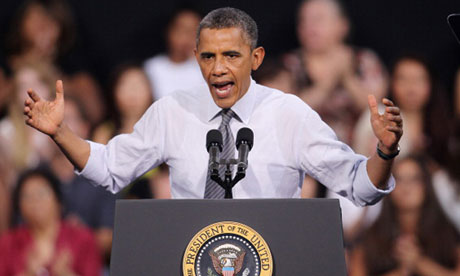
Barack Obama: agent of change. Photograph: Brendan Smialowski/AFP/Getty
In 2008, Obama swept to victory on a promise of hope. But his lofty rhetoric has been sapped by a grim economic picture, and voters feel let down. Is he still the change they can believe in?
“You want to run for president?” asked the New York Times columnist Frank Bruni in his book Ambling into History. “Here’s what you need to do.
“Have someone write you a lovely speech that stakes out popular positions in unwavering language – and less popular positions in fuzzier terms. Better yet, if it bows to God and country at every turn: that’s called uplift. Make it rife with optimism, a trumpet blast not just about morning in America but about a perpetual dazzling dawn. Avoid talk of hard choices and daunting challenges; nobody wants those. Nod to people on all points of the political spectrum … Add a soupcon of alliteration. Sprinkle with a few personal observations or stories: it humanises you. Stir with enthusiasm.”
So it was at the beginning of the year, as the Republicans competed to see who could paint the gloomiest picture of Barack Obama‘s America, that Obama reached back for the signature theme of his 2008 campaign: hope. Seeking to channel Ronald Reagan’s re-election theme of 1984, when the nation was emerging from economic crisis, he used his state of the union speech in January to claim: “America is back”. “Anyone who tells you that America is in decline, or that our influence has waned, doesn’t know what they’re talking about,” he said.
He test-drove the phrase in a range of settings. “I placed my bet on the American worker,” he told a union conference in DC a month later. “The American auto industry is back.” A month after that, at a fundraiser in Houston, he told donors: “The recovery is accelerating. America is coming back.”
This was by no means an absurd claim. By February there had been three straight months of employment growth; the final quarter of 2011 showed a spike in consumer borrowing, signalling more consumption and more lending. In the spring, many felt they witnessed the green shoots of economic recovery. And electorally it seemed like a smart claim, too. American voters may want politicians to ponder their fragility, but they’ve never been particularly keen on them actually reflecting it. The country was emerging from two failed wars and the most severe recession since the Great Depression. Confidence in America’s political and financial classes was shattered; assumptions about its military supremacy were dented. According to Gallup, the last time most Americans were satisfied with the direction the country was heading in was January 2004 – and that stint of optimism lasted less than a week. The Republicans were wedded to the notion that under Obama America was in decline. Rick Santorum claimed it was an election “to save the soul of America” – prompting the question: well, then, who had lost it? – while Mitt Romney insisted he’d return the nation to a day when “each of us could walk a little taller and stand a little straighter”. Obama’s message was: “Walk tall. We’re on our way.”
There was only one problem. People did not believe it. In February, Greenberg, Quinlan, Rosner Research focus-grouped four different ways of framing the nation’s economic trajectory. Two concentrated on the enduring struggles of American middle-class families, and two claimed recovery was under way. The two that did best argued: “This is a make-or-break time for the middle class, and for all those trying to get into it.” The one that tested worst, by a considerable margin, claimed: “America is back”.
“America is not back,” Stanley Greenberg, GQR’s chief executive, told the New York Times. “We have long-term fundamental problems. If you look at our data and history, it takes a long time before job numbers translate into accepting at a personal level that things are better.”
Indeed, if anything, Americans felt they were going backwards. Most believe young people will have a worse life than their parents, and a third think the country’s best days are behind it. It’s not difficult to see why. For 90% of Americans, wages have been effectively stagnant for the last 40 years, while median house prices have slumped 20% since 2006. Over the past decade, the cost of tuition has risen 32%, and the average healthcare premiums have rocketed 113%. A report earlier this year revealed that between 2007 and 2010, the median American family lost a generation of wealth. With figures like that, insisting that America is back sounds more like happy talk than fighting talk.
Herein lies the central dilemma for Obama’s re-election. In 2008 he ran, with considerable rhetorical force, on a promise of hope and change in the midst of an economic crisis – and on his ability to bring consensus to a divided political class. But, for many, things have changed for the worse, and the country is even more polarised than when he started.
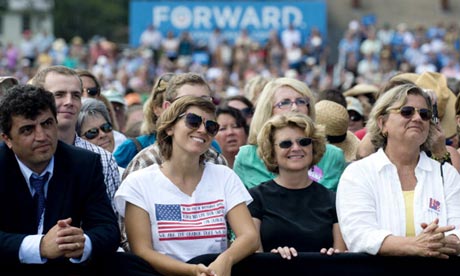
So the substantial benefits of his presidency are not fully apparent – particularly to those most likely to have voted for him. Meanwhile, the symbolic significance of his candidacy is largely spent. You can only be elected the first black president once. His presence remains a source of great pride to many, particularly African Americans and the young. People will still travel halfway across the country on their own dime to hear him speak, and hawkers still sell T-shirts at his events. When he went to Fort Myers in Florida to speak in July, people started lining up for tickets the night before.
But this time he’s not standing on his promise, but on his record. Shortly after his inauguration, he told NBC: “Look, I’m at the start of my administration. One nice thing about the situation I find myself in is that I will be held accountable. You know, I’ve got four years. And a year from now I think people are going to see that we’re starting to make some progress.
“But there’s still going to be some pain out there. If I don’t have this done in three years, there’s going to be a one-term proposition.”
The pain is still out there, and that is precisely the proposition the Republicans are now making.
***
There are several ways Obama can counter this. When he first ran, few understood the depth of the economic crisis, and few could have predicted the implosion of the eurozone and the subsequent drag on the world economy. Roughly two-thirds of the country still blame Bush for the state of the economy, while only half hold Obama responsible. Republicans have been both obdurate and obtuse in Congress, where approval ratings have rarely scraped 20%. The trouble is, to a sceptical ear, these sound more like justifications for why he has failed to deliver than explanations as to how he might succeed if given more time.
Bill Clinton conceded as much during his convention speech in Charlotte. “Here’s the challenge he faces,” he said. “A lot of Americans are still angry and frustrated about this economy. If you look at the numbers, you know employment is growing, banks are beginning to lend again, and in a lot of places, housing prices have even began to pick up.
“But too many people do not feel it yet. I had this same thing happen in 1994 and early ’95. But the difference this time is purely in the circumstances. President Obama started with a much weaker economy than I did. Listen to me now: no president could have fully repaired all the damage that he found in just four years. If you will renew the president’s contract, you will feel it. You will feel it. Folks, whether the American people believe what I just said or not may be the whole election. I just want you to know that I believe it. With all my heart, I believe it.”
The trouble for Obama is that not enough Americans do believe it. Stewardship of the economy is the one area where Romney has been generally outpolling him (although it has been slipping since the conventions). It is also by far the most important issue in the election. In the nine states Obama won from Republicans last time, his approval ratings are below 50; in six they are 45 or less. Unemployment is higher in six of them today than it was when he was inaugurated. In the midterms, Republicans took more than 20% of the House seats from Democrats in those states. His defeat is not just plausible; it’s possible. Indeed, given the metrics of unemployment, approval ratings, real disposable personal income growth per capita (what the average person has left after tax and inflation) he should lose.
And if that weren’t enough, Republicans will have far more money. In 2008, Obama outspent McCain by more than two to one. He has also outspent Romney so far, although that is largely because Romney had to wait until he was formally nominated before dipping into reserves of cash. But thanks to changes in the fundraising laws that allow unlimited donations from anonymous sources, Democrats fear being massively outspent by Republicans and their supporters this time. Obama donors at the convention were asked to open their wallets with the message: “If they outspend us by two or three times we’re OK. But if it goes much beyond that we’re in trouble.” After a successful convention they came back thrilled by the speeches and daunted by the prospects.
“If the economy is doing great then any leader looks great,” says one of Washington’s premier electoral analysts, Charlie Cook. “And if the economy is doing lousy I think almost any leader looks bad.” The day the Democratic convention opened, a poll showed that most Americans believe the country is worse off than it was when Obama was nominated four years ago, and that he does not deserve a second term. The day after it ended, the Treasury released a weak jobs report signalling a feeble recovery that’s close to stalling.
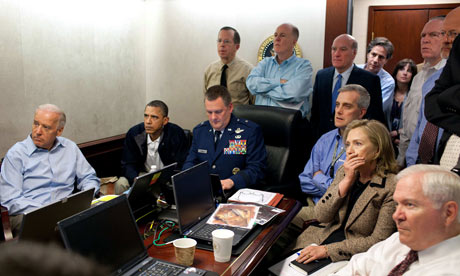
The problem is not that he doesn’t have a record. He can point to significant achievements that would or should satisfy his base and arguably credit him with the most progressive term since Lyndon Johnson. He has appointed two women – including the first Hispanic – to the supreme court, implemented a version of healthcare reform, ended don’t ask, don’t tell, withdrawn combat troops from Iraq and presented a timetable for withdrawing forces from Afghanistan. He authorised the killing of Osama bin Laden, and the US’s standing in the world has greatly improved since he took over among both allies and enemies alike.
The problem is that the record Obama has does not include the single most important achievement he could hope for – improving the economic lot of the broad swathe of middle America. And the various things it does include do not add up to a narrative. (It doesn’t help that the main advantages to his principle achievement – healthcare – do not kick in for another two years). This was evident at the convention, where the same laundry list of Obama’s achievements (the Lilly Ledbetter Act, which protects equal pay for equal work for women; the repeal of don’t ask, don’t tell; Bin Laden’s killing; healthcare; his executive order on young immigrants) were aired each night less as a theme than an incantation.
It is a flaw best illustrated in Joe Biden’s claim to donors in Fort Worth, Texas, that: “The best way to sum up the job the president has done if you need a real shorthand: Osama bin Laden is dead and General Motors is alive.” Among other problems, such a summary links a single military operation and a particular economic achievement, both of which mark progress that is both episodic and partial. A counter-summary could just as easily read: “Al-Qaida is alive and the economy is dying.” Moreover, it falls well short of “We’re back,” (which is what people want to hear), let alone “hope” and “change” (which is what they heard last time).
The greatest case for Obama’s presidency so far can be summed up thus: things were terrible when I came to power, are much better than they would have been were I not in power, and will deteriorate if I am removed from power. Even if one accepts these claims as true, and understands them as important, they’re a long way from the uplifting message of four years ago. Not so much “Yes we can,” as “Could be worse”.
The problem with Obama trying to echo Reagan’s lines of 1984 is that Republicans can and do counter with Reagan’s line from 1980, when, concluding a debate with Jimmy Carter, he asked: “Are you better off than you were four years ago? Is it easier for you to go and buy things in the store than it was four years ago? Is there more or less unemployment in the country than there was four years ago?”
At the Republican convention in Tampa, this was evoked as the game-changing line gifted to Romney by history. But it only works if Reagan’s quote is hacked in half. For the Gipper immediately went on to ask: “Is America as respected throughout the world as it was? Do you feel that our security is as safe, that we’re as strong as we were four years ago?” Even with American embassies under siege, most here would give him credit for that.
It is rare for a president to recover from this level of protracted economic distress, particularly when they brought such high hopes with them. But the last year handed Obama two crucial, mutually reinforcing tools with which he could start to build an electoral revival. The first was Occupy Wall Street, which sprouted offshoots in every state in the country, burning brightly before fading into smaller more grassroots campaigns. The occupations had no specific demands, and had no organic connection to the Democratic party. But by concentrating their ire on the inequities of the financial system and the greed of financial elites – two things Obama had failed to do anything about – they shifted the target of national frustration from government to inequality.
Polls showed a significant portion of the country agreed with its aims, with 77% believing there is too much power in the hands of a few rich people and corporations. Even as rightwing pundits and politicians mocked the protests (“Get a job right after you take a bath,” said Republican contender Newt Gingrich), conservative analysts noted that they had struck a chord. When rightwing pollster Frank Luntz addressed the Republican Governors Association in December, he told them: “The public still prefers capitalism to socialism, but they think capitalism is immoral. And if we’re seen as defenders of Wall Street, we’ve got a problem.”
Obama had clearly got the message. In the same state of the union speech in which he proclaimed the US to be back, he appealed directly to the 98% of the country that earns less than $250,000. “Let’s never forget,” he said: “Millions of Americans who work hard and play by the rules every day deserve a government and a financial system that does the same. It’s time to apply the same rules from top to bottom: no bailouts, no handouts, and no cop-outs.”
And while there is no narrative in which to couch his first term, there is a theme for his second: fairness. Like a mantra at Charlotte, speakers argued for the middle class to have a “fair shot” and the rich to give their “fair share” as they carefully made it clear that inequality of outcome and income were tolerable so long as equality of opportunity was available. Massachusetts Senate candidate Elizabeth Warren received a huge cheer when she said: “People feel like the system is rigged against them. And here’s the painful part: they’re right. The system is rigged. Look around. Oil companies guzzle down billions in subsidies. Billionaires pay lower tax rates than their secretaries. Wall Street CEOs – the same ones who wrecked our economy and destroyed millions of jobs – still strut around Congress, no shame, demanding favours, and acting like we should thank them.”
The second gift has been Romney: a wooden candidate whose personal wealth amounts to double the combined wealth of the last eight presidents going back to Richard Nixon and yet only pays 14% tax. For if Occupy Wall Street reframed the debate, then it also provided the basis to depict Romney as out-of-touch magnate with a tin ear for the travails of the common man. Most of the Democratic attacks over the summer, over the firings and outsourcings at Bain Capital – the firm that Romney once ran – and over demands for his tax records, or about his wealthy donors, fit that mould. This rich guy doesn’t understand you or what you’re going through, and now he wants to buy the election.
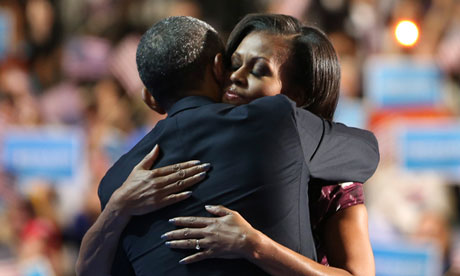
By contrast, Obama has put his less fortunate roots front and centre, running not on a narrative of racial breakthrough but of class mobility. “Barack knows the American dream because he’s lived it,” said Michelle Obama in her convention speech. “And he wants everyone in this country to have that same opportunity, no matter who we are, or where we’re from, or what we look like, or who we love.”
So this is the central strategy of the Obama campaign: not to lift people with lofty rhetoric, but hit them with a hard choice between him and Romney, and characterise it as a choice for either greater fairness or less; for the country to go backwards or forwards; someone who understands you or someone who doesn’t. That tack seems to be paying off. Polls show that in swing states, where people are more likely to have seen the ads, they are twice as likely to see Romney’s time at Bain as a reason to vote against him. Elsewhere the nation is evenly split.
In the crucial swing states of Ohio, Pennsylvania and Florida, where voters were asked the question: “Would you say that Mitt Romney cares about the needs and problems of people like you, or not?”, most said “not”. The poll showed that 54% of likely voters in Pennsylvania, 55% in Ohio, and 49% in Florida felt that Romney did not care about their problems. The Republican convention was dedicated in no small part turning that perception around. Arguably, it didn’t work.
So while Obama is vulnerable, he is nonetheless ahead. In national polls his lead is narrow – within the margin of error – but has widened since the convention. In the swing states he is performing better. Last time around he took nine states that Republicans had won in 2004; New Mexico, Nevada, Colorado, Iowa, Indiana, Ohio, Virginia, North Carolina and Florida. But according to Real Clear Politics’ average of polls, he leads in seven of them and trails in just two (Indiana and North Carolina). The New York Times’ Nate Silver, a well-respected statistician, psephologist and author of the Five Thirty Eight blog, currently gives Obama a 75% chance of winning. And 59% of voters now believe Obama will win – although this is far more than will actually vote for him.
So the president has plenty of wriggle room as he seeks a path to victory this time around. He could lose the marquee states of Ohio and Florida, as well as the smaller states of New Hampshire, Iowa and Indiana, and still get his second term.
But it may not even come to that. Republicans were supposed to have picked much of the low hanging fruit clean by summer’s end. But only in Indiana is Romney truly secure, while in North Carolina he is only now pulling away. Of the states Democrats won in 2004, only in Wisconsin is Obama really vulnerable. In some previously closely contested states, such as New Mexico and Pennsylvania, Romney is barely in contention. In the rest, Obama’s lead is narrow (within the margin of error) but consistent and growing. A poll late last week showed Romney trailing Obama by at least five points in Florida, Virginia and Ohio. Although Romney wouldn’t have to shift the needle very far to win, he’d have to shift a lot of needles in the same direction to stand a chance. Obama has precious little reason to be complacent, but every reason to be optimistic at this stage. His response to events like the riots across the Muslim world could still shift the trajectory, as could Republicans’ cash advantage.
In a race where there will be few undecideds and a lot of cash sloshing around, Obama’s challenge is to rally his base. This will be no simple task. Obama has considerable work to do on this front. Unlike four years ago, Republican voters are more likely to say it really matters who wins this election, to say they have given quite a lot of thought to the election and to have paid close attention to news about the election. Their base – white, wealthy, older people – is also more likely to turn out. The good news for the Democrats is that voters are more enthusiastic about their candidate. The percentage of people who said they strongly supported Obama was both higher than any Democratic candidate since 1988, including himself in 2008, and almost double those who strongly support Mitt Romney. The only candidate who’s ever scored higher was George Bush in 2004.
Democrat supporters also appear more engaged. A survey of web and social media usage by Pew found that the Obama campaign posted nearly four times as much content as the Romney campaign on the web, was active on nearly twice as many platforms and prompted twice the number of shares, views and comments.
In 2008, Obama’s victory was due, in no small part, to his ability to expand the electorate by attracting constituencies that had previously been under-represented at the polls – particularly young, black and Latino voters. He did not just win them by huge margins, but managed to amplify their electoral clout by motivating them to turn out in huge numbers.
But those are the very groups who have suffered most under his presidency. Unemployment for 18- to 19-year-olds is 23.5%; for those 20 to 24 it’s lower at 12.9%, but still significantly higher than the national rate of 8.2%. Black unemployment is at 14.1% – a 10% increase on when he was inaugurated. While Hispanic unemployment has remained steady, Obama has deported more undocumented immigrants than any president since the 1950s.
Polls show Obama still holds a significant advantage among all three groups, attracting 89% of the black vote and 60% of both the Latino vote and the 18-to-29 age group. The issue is less whether those people will vote for him but how many will show up, since all three groups are less reliable voters. “We haven’t seen much of the stimulus trickle down to our people here,” Mark Allen, a Chicago-based community organiser who used to work alongside Obama, told the Washington Post. “I liked the community organizer Obama better than President Obama … Democrats say Barack has got 90% or whatever of the black vote wrapped up. What they don’t tell you is it’s 90% of those who actually come out and vote. What if it’s 90% of just 30 or 40% who vote?”
In fact, the black turnout is the one part of his base that remains solid, but Democrats are less certain of Latinos and the young. In a base election, enthusiasm is key. Since black, Latino and young people live everywhere, there is not a single swing state where this is not an issue, and arguably only New Hampshire and Iowa – two of the whitest states in the country – where it is not key. This in no small part explains his decision to use the power of his office in June to halt the deportation of thousands of young undocumented immigrants – something he could have done at any time during his presidency. In an executive order he ruled that young immigrants who arrived in the US illegally before age 16 and spent at least five continuous years here would be allowed to stay and apply for work permits, providing they had no criminal history and met other criteria, such as graduating from high school or serving honorably in the military.
This time around, he is also seeking to make inroads among white women, many of whom are turned off by Republican views on abortion and contraception, pensioners, who may be nervous about Republican plans for Medicare (both of which he lost by 53-45 in 2008), and gay voters, buoyed by his support for gay marriage and motivated by Republican opposition to it. If there is any volatility in this race, it is not about the breadth of his support but the depth of it. National polls of registered voters may mostly show him with a narrow lead; but polls of likely voters often show him trailing.
The one thing that hasn’t changed since 2008 is the Democrats’ emphasis on the “ground game” – sending volunteers out to collect information, persuade and, ultimately, ferry people to the polls. One Washington Post survey showed 20% of registered voters had been contacted by the Obama campaign, compared to 13% who’d been contacted by Mitt Romney’s campaign. And Democrats had been particularly effective at reaching their base. Forty-two percent of liberal Democrats said they’d been contacted, as well as 24% non-whites and 31% of the people who voted for Obama last time.
“This is light years ahead of where we were in 2008,” said Obama’s campaign manager, Jim Messina, during a forum in Charlotte. “We are going to make 2008, on the ground, look like Jurassic Park.” They plan to knock on more than twice as many doors and register twice as many voters as they did last time. In North Carolina they have twice as many field offices as the Romney campaign. In Ohio they have three times as many.
If Obama were only running against Romney, his victory would be all but assured by this stage. But he isn’t. He’s running against the economy, and on his promise to be a transformative president in tough times. To the extent that a second-term election is a referendum on the incumbent, Obama is losing. Too many voters think he’s not done enough. To the degree, however, to which any election is a choice between at least two candidates, he is winning. Enough voters feel he is better than his opponent. For now, at least, he is not so much the change they can believe in as the change agent they most believe in. And while the semantic difference is minimal, the rhetorical difference could hardly be greater.
Interview with James Bawa Magaji – former deputy governor of Kaduna state during Dabo Lere era
–
Some have suggested that a sovereign national conference be convened as a way out of what the country is facing? What is your opinion?
National conference is not the best way and will not give an answer to the numerous problems we are facing. We have a sitting National Assembly and this call is a direct indictment of the National Assembly. Anybody that is calling for a sovereign national conference is simply saying that he or she is not satisfied with the performance of the National Assembly. Every local government, or in most cases two local governments have representatives in the House of Representatives and every state has three senators.
I believe people could channel their complaints and grievances through their representatives in the National Assembly. If you want to have a national conference, how will the participants emerge? Are you going to use the same process you elect the National Assembly members? If that is what you are going to do, don’t you think that will be duplication of efforts? If people are not satisfied with their representatives, there are ways to wake them up from sleep. So why not channel the greivances through the representative?
Some northern states have made claims about oil discovery in their domain. What should they do to boost their revenue generation?
Well, this is a claim and there is government department, DPR, that is responsible for checks and verification and am not in a position to ascertain the Sokoto State government’s claim.
But what the northern governors must do is to find a way of engaging the federal government so that some percentage of revenue for exploration and development of other mineral resources will be set aside. South Africa does not have oil, but it has been able to grow through the development of solid minerals and we have mineral resources all over the north. If we have solid mineral from the north, it will complement the oil from the South.
Many say that the only comparative advantage the north has is agriculture. Do you think going into agric will make the northern states compete favourably with their southern counterparts in terms of development?
Of course, wealth is in the ground. Don’t forget that before the discovery of oil, agriculture was the mainstay of our economy. Even as at today, agriculture contributes 90 percent of the GDP. Our People are farmers and they depend on agric either on sustenance basis or commercial basis not oil. What we need to do, even though the federal government has set up some task force on groundnut, cocoa production, cotton and some others agricultural products, the north should concentrate on agric and get some resources that they will use to exploit the mineral resources in the region.
As a former deputy governor, what is your reaction toward calls for state creation?
If a state cannot pay salaries and maintain its infrastructure from internally generated revenue, it ought not to be a state. One can encourage the state to create programmes and avenues to improve on their internally generated revenue so that every state within some years to come should be able to pay salaries before the arrival of the statutory allocation. On the issue of creation of states, there are some states that definitely need to be created. You have to create a state where there is grotesque and complex composition. For political stability and security definitely, there should be state creation in the constitution amendment. But some of the demands are unnecessary.
I’ve seen some states that are less than 3 million in population, and are even homogeneous yet are asking for more states, but I wonder why. First of all, they are not big in terms of land mass, they are not big in population and the composition is homogeneous, such cases should be treated as not viable. But there are states with people that are not homogeneous and there are too much diversity that have affected security and development. If there are such situations, a state should be created.
Several groups have been calling for creation of an additional state in Kaduna. What is your suggestion?
If you want to create a state in this country, Kaduna state is qualified for consideration because of the tensed security nature coupled with the fact that Kaduna is a mini country that comprises every component of Nigeria.
That’s why each time there is crises in Kaduna, it spills over other states and most of the factors that led to crises if you look at it, are more of political even though some places of worship used to be burnt. Kaduna state is too diverse, it’s in the North West zone and some other sections especially the southern part that are very marginal as a group within the whole North West zone and as it is now, can hardly make any meaning within the present geo-political setting. Am aware from the literature written by the Southern Kaduna people that the state if created, will belong within the north central geo-political zone where they fit better and can have a voice.
So, if a state will be created based on substantial evidence, a state will be created in Kaduna State. But some states are homogeneous and 90 percent one religion but are still calling for split. People who are calling for state creation for comfort and to enable them have more senators, reps and ministers, should be disregarded.
But those with genuine requests with substantial explanation like what the Kaduna State stands for, should be considered with open mind for greater peace and stability. If there are two others with similar problems again, they should also be considered. Creating two or four states will help douse tension and increase peace and security and bring development.
Some say state creation will not reduce the crises in Kaduna. What is your take on that?
Nationalities compete for scarce resources and power is what is used in distributing resources and its only when you are in power, that you are enabled to get these resources that is why even in Kaduna there is always struggle over who should be in power. There has been political rivalry where we have had crises in Kaduna. If a state is created in Kaduna, it will reduce frictions.
Do you see the Yakowa’s administration as being fair to all sections of Kaduna State?
He has been fair to all the sections in Kaduna state. From my assessment, Governor Yakowa has religiously taken every part along. I know him as a man who fears God and knows what God can do. Power belongs to God and God gives power to whom he wills and if you did not do justice, he takes it away. The governor of the state is very conversant with this. God loves justice and the way and manner Yakowa is going, people in the state will be happy to have him as governor.
How will you assess President Jonathan administration?
Well, I think he has done well within the time frame considering the security challenges. Power supply has improved and some credit most go to the power minister that resigned, Barth Nnaji, he did well. His style of leadership is something that helped in the successes recorded. Most of the ministers have been given free hands to operate. The minister of agriculture has done well too. So, if many ministries continue like this, at the end of the day, they will have something to show.
The Olusola Oke Campaign team and the Peoples Democratic Party in Ondo state said a plot by the state governor Olusegun Mimiko to clamp down some members of the party in the state has been discovered.
The Campaign group alleged the state governor of planning to implicate some leaders of the party in the state with unfounded charges to be levelled against them.
The Special Adviser, Media & Publicity. Kunle Adebayo stated this in a press statement saying that some security operatives have been commissioned to cook up unfounded reports against the governor political opponents in the state.
Adebayo said some of plots include planting incriminating materials inside the vehicles, homes and persons of some of the party leaders.
But he said the plot is not a surprise to the PDP governorship candidate, Olusola Oke and the party saying ” the Labour Party and its outgoing governor could no longer endure under the heavy weight of the rising profile of the PDP.
He said the alarm becomes imperative to alert the public of the conspiracy and to call on the police not to treat the allegation with kid gloves.
He pointed out that the Labour Party thugs have on many occasion unleashed violence on its members at Owo, Idanre, Okitipupa and Ijare in Ifedore Local Government Area.
He however said that PDP will continue to carry out its campaign activities in accordance with lay down rules and regulations prescribed by the law enforcement agencies and the Independent National Electoral Commission.
He said “As a party, we detest in absolute term, any act of brigandage and political violence but will do all that is required within the law to resist this criminal plot of the Labour Party.
“We want to assure the people of the state that Olusola Oke is ready to rescue the state from its state of economic doldrums and has resolved that no amount of conspiracy from any quarter will make him look back.
Hey, Obama Lovers, now that our Ambassador is dead, our Benghazi consulate is a smoldering ruin, and its top secret documents have been snatched by Al Qaeda, do you still think your hero’s Libyan war is a smashing success?
Because I sure do. Not from America’s point of view, of course; it’s a nightmare for our national security.
But from the perspective of Obama’s biggest donor, the convicted felon and renowned Israel-hater George Soros, the Libyan War is a triumph. Why? Because Obama waged it illegally and without the consent of Congress. And he did it in the name of the political philosophy that Soros bought and paid for: Responsibility to Protect, or, as it’s so zippily dubbed by our global elites, R2P.
Let’s lay the big facts on the table: Soros paid a flame-haired foreign policy vixen named Samantha Power to develop and popularize Responsibility to Protect (R2P) as a catchy tool to invade countries that he feels like invading.
See for yourself: Soros’s Open Society Institute is a major donor of the Global Centre for the Responsibility to Protect, a terribly high-minded international institute of terribly high-minded people pledging terribly high-minded interventions with our military.
Despite her busy schedule of posing provocatively for Men’s Vogue, Samantha Power found the time to serve as Obama’s top policy advisor on Libya. And in that glorious capacity, she persuaded him to send our military to Libya for the first self-proclaimed R2P intervention.
Samantha Power doesn’t like Jews very much, and she really doesn’t like Israel, probably because so many Jews live there. Like Stephen Walt, her anti-Semitic colleague at Harvard’s Kennedy School of Government, Power regards American Jews as a subversive element pushing America to side with its enemy, Israel.
Chillingly, in 2002, Ms. Power told a television interviewerthat America should use its military to invade Israel to protect the Palestinians. Alas, said Ms. Power with a rueful chuckle, that would require “alienating a domestic constituency of tremendous political and financial import” – i.e., Jews.
You see where this is going, right? Ms. Power proposes that America invade Israel on humanitarian grounds. Soros then pays her to develop this insanity into the benign-sounding “Responsibility to Protect,” and creates a lofty international institute to promote it. Obama then hires Power to try out R2P in Libya and, thereby get everybody desensitized to the concept.
Here are the monumentally terrifying words that Obama said, as he sent our forces to Libya:
“And that’s why building this international coalition has been so important because it means that the United States is not bearing all the cost. It means that we have confidence that we are not going in alone, and it is our military that is being volunteered by others to carry out missions that are important not only to us, but are important internationally.”
Dear George Washington, will you ever forgive us? In her infinite wisdom, America elected Commander-in-Chief Barack Hussein Obama, who offers up our best and bravest to be “volunteered by others.” And Obama got away with it.
Sure, a few editorials squawked about Obama waging war illegally, on the basis of a United Nations Security Council Resolution, instead of a Congressional vote. The New York Times even scolded him for “legal machinations” that “set a troubling precedent that could allow future administrations to wage war at their convenience — free of legislative checks and balances.”
I’m sure Obama was quaking in his golf shoes when he read those words — not. He was too busy plunging ahead in the next phase of his attack on Israel: unleashing his bare-fanged, unconcealed hatred.
Nobody can accuse Obama of pandering for Jewish seniors’ votes in Florida this time round. He refuses to meet with Israeli Prime Minister Netanyahu, and denigrates Israel’s concerns about Iranian threats of nuclear annihilation as “noise.” (Perhaps Obama and Ahmadinejad share the same press agent, because, oddly, that’s what the Nazi dwarf called it, too.)
Obama’s Chairman of the Joint Chiefs of Staff Martin Dempsey even proclaimed he doesn’t want to be “complicit” in an Israeli strike on Iran, equating Israel’s potential self-defense against genocide with a crime.
Meanwhile, the “international community,” of which Obama is so fond, continues its ceaseless work of demonizing Israel. If Obama gets a second term with “more flexibility,” it’s not much of a stretch to imagine the day when the United Nations and its assorted culture warriors screech that the poor Palestinians need R2P! And whether the American people want it or not, Obama will eagerly offer up our military “to be volunteered by others” to attack Israel.
As the “catastrophic intelligence loss” of our Benghazi assets reverberates, it’s clear that Obama wasn’t defending American interests in Libya. His “responsibility to protect” didn’t even extend to our Ambassador. Even now, two weeks after the attacks, Obama hasn’t bothered to secure the consulate.
But, Allah be praised, Obama still scored big in Libya. He and Soros are significantly closer to creating a United States of Islam to encircle Israel, and they’re armed with a proven doctrine to get America in for the kill.
Libyan authorities moved to absorb militias into the security forces, appointing military commanders to head Islamist armed groups in an effort to cement central government control.
The new leadership for the Benghazi Islamist militias, Rafallah al-Sahati and the February 17 Brigades, announced yesterday by the military, came at the tail-end of a 48-hour deadline for militias to disarm, the Libyan News Agency reported. The push followed mass weekend protests against the groups in Benghazi — demonstrations sparked by outrage over the killing of U.S. Ambassador Chris Stevens and three other Americans in the city during Sept. 11 protests.
The demonstrations and the decree to disarm reflect a paradox confronting the yet-to-be formed government of Prime Minister-elect Mustafa Abushagur. The new administration has said it is committed to dealing with the militias, even though many played a key role in last year’s uprising against Muammar Qaddafi and were called upon by the former transitional government to provide interim security at a time when government forces and police were largely ineffective.
The 48-hour deadline, issued by Mohamed Magarief, the head of the newly elected National Congress, “was meant to show the intent and seriousness of the Libyan government in disarming the armed brigades,” Mohamad Al-Akari, a spokesman for Abushagur, said in interview in Tripoli. “It is quite clear that we cannot disarm everyone in two days, and this deadline should not be seen as a timeframe, but as a demonstration of authority.”
Protester Arrests
“We are now in a process of democracy,” he said. “The brigades that are voluntarily disarming will receive training and integration into the police and army.”
Mass protests that started on Sept. 21 forced two Islamist militias in Benghazi to disband. One, Ansar al-Shariah, was accused by the government of links to the killing of Stevens.
Rafallah al-Sahati, which was among those targeted by mobs of protesters over the weekend, initially appeared to push back against the marchers and the government warning, arresting more than 100 people it and other groups said were behind the demonstrations against them. Even so, they said in an interview yesterday they’d accept an army-appointed leadership.
The Rafallah brigade defended the arrests, with Ishmael Salabi, who described himself as an assistant commander, saying many were former military under the deposed Qaddafi regime.
“These people have been trying to get power,” he said late yesterday in an interview. “They were in power under Qaddafi and now they have nothing.”
It’s a delicate time for Libya, which is struggling to revive its economy and lure back investors to the country, site of Africa’s largest proven oil reserves.
Militia Security
The militias, many of which were licensed by the interim National Transitional Council and whose loyalties are either Islamist or tribal, have at times challenged the central government’s authority even as they provided security for key installations such as airports and hospitals. The new government, however, cannot sit idle and will require international support, said Khalil al-Anani, a political analyst at Durham University in the U.K.
“At some point, you have to challenge them,” al-Anani said in a phone interview, referring to the militias. “It’s an issue of legitimacy.
‘‘Any attempt to compromise or give military concessions to the militias will encourage them to challenge the state,’’ he said.
The consulate attack ‘‘wasn’t just a mob action,’’President Barack Obama said in an interview for ABC Television’s daytime talk show ‘‘The View’’ scheduled for broadcast today, though he declined to call it an act of terrorism before an investigation is complete.
Libyan officials have pledged to work closely with U.S. investigators, with Magarief, the head of the legislature, saying yesterday in New York the attack ‘‘did not reflect in any way’’ the views of the Libyan people, the state-run LNA said.
–
To contact the reporters on this story: Brigitte Scheffer in Tripoli at bscheffer@bloomberg.net; Christopher Stephen in Benghazi at cstephen9@bloomberg.net
To contact the editor responsible for this story: Andrew J. Barden at barden@bloomberg.net