


.
.
.
Makurdi, Nigeria — September 12, 2026
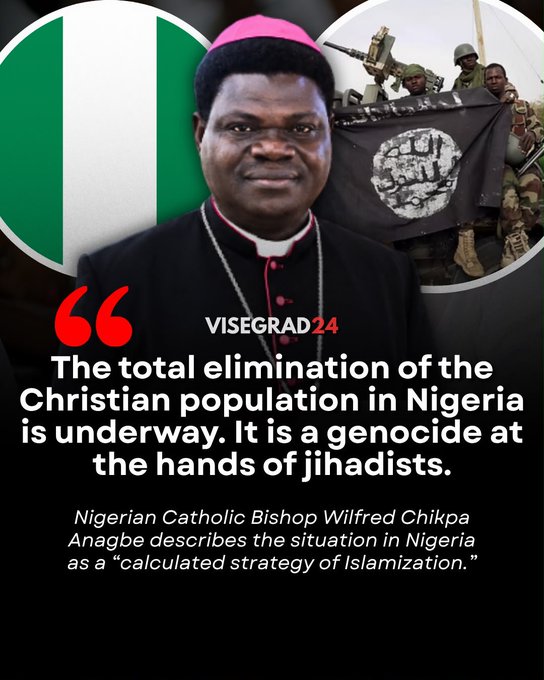
The Catholic Bishop of Makurdi, Most Rev. Wilfred Chikpa Anagbe, has again accused jihadist groups of carrying out a “genocide” against Christians in Benue State, warning that the “total elimination of the Christian population is underway.”
“The total elimination of the Christian population is underway. A genocide at the hands of jihadists,” Anagbe said, describing the state — where he says Christians make up roughly 98% of the population — as one of Nigeria’s most dangerous areas.
The bishop said attackers follow a recurring pattern: killing civilians, destroying churches, burning farmland, and driving entire communities from their villages before occupying the abandoned land. He characterized the pattern as a “calculated strategy of Islamization.”
Anagbe pointed to the 2025 Yelewata massacre as an example, saying attackers set fire to a room containing civilians and burned everyone inside alive, including two babies aged three and five months. Reported death tolls from the Yelewata attack have varied across outlets, with estimates ranging from roughly 150 to over 200 people killed.
Disputed casualty figures
Anagbe’s remarks echo broader claims, widely circulated in Catholic and Christian-advocacy media, that some 52,000 Christians have been killed in Nigeria since 2009, alongside the destruction of 18,000 churches and 2,200 Christian schools. Those figures originate from a 2023 report by Intersociety, a Nigerian Catholic-linked civil liberties organization, rather than from a European Parliament resolution, as they are sometimes attributed. Separate European Parliament resolutions on Nigeria — most recently in 2024 and again in 2026 — have cited different, generally lower tolls tied to specific attacks, including roughly 195 people killed in Plateau State over the 2023 Christmas period.
Other organizations have published broadly similar but not identical figures. Open Doors’ 2025 World Watch List found that 3,490 of the 4,849 Christians killed worldwide for their faith in the year to September 2025 were killed in Nigeria, and the Observatory for Religious Freedom in Africa has previously reported roughly 56,000 people killed and 21,000 abducted by terrorist groups in Nigeria between late 2019 and late 2023.
A contested framing
The characterization of the violence as a targeted religious genocide is disputed by the Nigerian government and by some analysts. Nigerian officials have rejected the genocide label, and have pointed to declining monthly terrorism-related deaths nationwide as evidence of security gains. Some commentators, including a recent Al Jazeera opinion piece responding to similar claims made by U.S. broadcaster Bill Maher, argue that the conflict is more accurately described as a decades-long, multi-causal struggle between farming and herding communities over land and resources, compounded by jihadist insurgency, and note that Boko Haram and its offshoots have also killed large numbers of Muslim civilians in Nigeria’s northeast.
Anagbe, who has testified before the U.S. Congress on the issue on multiple occasions, has consistently rejected that framing, telling lawmakers there is “no other explanation” for the pattern of attacks beyond a deliberate jihadist campaign to occupy Christian-majority territory. He has also accused the Nigerian federal government of complicity through inaction.
The Nigerian government has not yet issued a public response to Anagbe’s latest remarks.







