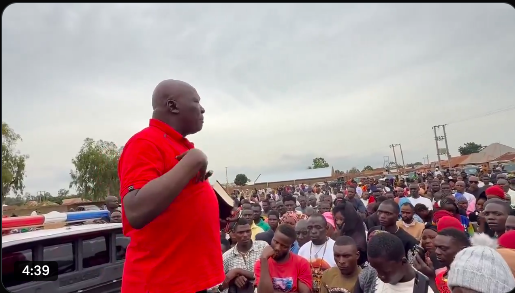

JOS, NIGERIA — The volatile security parameters across Plateau State’s northern senatorial district have completely fractured following an extraordinary public declaration by prominent Christian cleric and human rights advocate, Reverend Ezekiel Dachomo.
Reacting to a devastating wave of coordinated weekend massacres across Riyom and Barkin Ladi Local Government Areas, the outspoken Regional Chairman of the Church of Christ in Nations (COCIN) announced that local communities will immediately begin mobilizing independent self-defense militias, explicitly declaring that citizens can no longer rely on the federally controlled Nigerian Armed Forces for protection.
The fiery rhetoric follows a bloody 48-hour siege between Saturday, July 4, and Sunday, July 5, 2026, during which armed factions—identified by local groups as suspected Fulani extremist militias—simultaneously overran farming settlements in Ta-Hoss, Sabon Layi, and Kwi, leaving dozens dead and forcing entire villages to flee.
A Weekend of Coordinated Siege
According to regional security tracking networks and indigenous youth organizations, the offensive began late Saturday night, July 4, when heavily armed tactical units launched a synchronized raid on the Sabon Layi community in the Gwol District of Barkin Ladi. Despite attempts by local volunteer watchmen to mount a defensive perimeter, three vigilantes were instantly outgunned and neutralized by attackers carrying military-grade automatic weapons.
Simultaneously, a parallel strike force assaulted the Bindi community within the Ta-Hoss axis of Riyom LGA. Survivors reported that the attackers moved systematically from house to house under the cover of darkness, opening fire on sleeping families and setting agricultural stores ablaze.
The bloodshed extended into the early hours of Sunday, July 5, when the attackers shifted their operational trajectory to the neighboring Kwi community in Riyom, triggering a massive humanitarian panic as thousands of displaced peasant farmers scrambled into the difficult rocky terrain toward Jos South.
“Our Military Has Been Compromised”
Reverend Dachomo—who has achieved widespread national prominence for documenting and conducting mass burials for victims of Middle Belt violence—unleashed a scathing assessment of the national defense infrastructure.
Expressing the deep frustration of regional leaders, the cleric asserted that the consistent failure of nearby military checkpoints to intercept the attackers, despite early warning indicators, points to systematic institutional sabotage.
“Enough is enough,” Dachomo declared in an emotional reaction to the weekend massacres. “We’re going to form our own militia to protect our people and our land because we can no longer trust the Nigerian Armed Forces to safeguard our lives. The reason American soldiers left is because our military has been compromised. It has been infiltrated by Boko Haram and ISIS terrorists!”
Dachomo’s reference to international military re-alignments highlights a growing perception among Middle Belt leaders that domestic security agencies have failed to contain the territorial expansion of extremist factions, which now include the Islamic State West Africa Province (ISWAP) and rogue militia cells operating along the state’s internal borders.
The Legality and Danger of Self-Defense Formations
While the Plateau State Government, under Governor Caleb Mutfwang, has previously utilized the state-backed Platau Operation Rainbow to augment federal troops, Dachomo’s call for independent, non-state militias represents a major escalation. Under Nigerian statutory law, the formation of private armed groups remains strictly illegal, and federal authorities have routinely warned that the proliferation of ethnic militias risks plunging the country into an uncontrollable civil war.
However, socio-cultural groups like the Berom Youth Moulders-Association (BYMA) argue that local farmers are left with no choice. They point out that although communities repeatedly provide intelligence on the exact forest hideouts and staging camps utilized by the militants, tactical units rarely launch proactive clearance operations, leaving rural populations completely vulnerable during the peak cultivation season.
As of the time of filing this report, the Headquarters of the Special Military Task Force, Operation Safe Haven (OPSH), has reinforced its presence in Riyom and Barkin Ladi to restore relative stability. However, with religious and traditional leaders actively backing calls for armed resistance, the center faces an immediate crisis of legitimacy across the agrarian food belt.