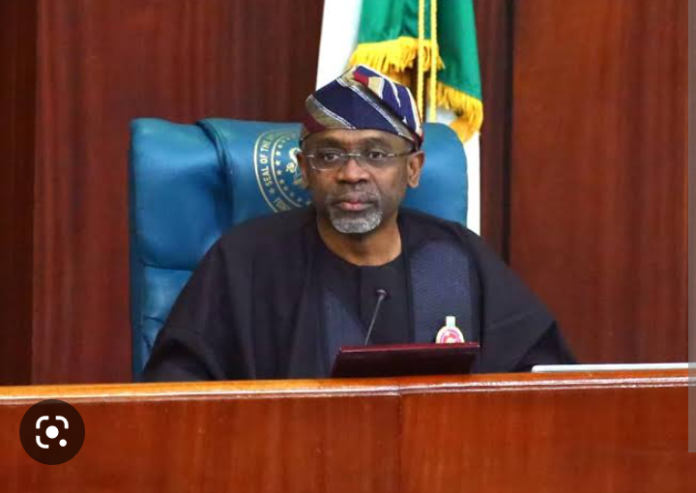


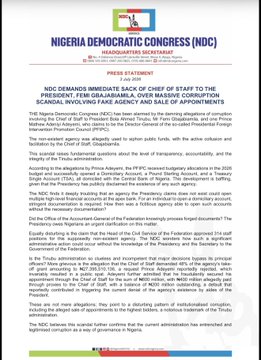
ABUJA — The escalating institutional scandal surrounding the Office of the Chief of Staff to the President has assumed a heavy partisan dimension, following a fiery press statement issued by the National Democratic Congress (NDC). The opposition party has formally demanded the immediate sack and prosecution of the Chief of Staff, Rt. Hon. Femi Gbajabiamila, over a massive corruption scandal involving a disowned federal agency and the alleged sale of executive appointments for cash.
The crisis centres around the activities of Prince Adeniyi Adeyemi Matthew and a controversial entity known as the Presidential Foreign Intervention Promotion Council (PFIPC). The scandal broke wide open after Adeyemi publicly alleged that he had fallen out with Gbajabiamila after refusing to part with a 48% kickback from a ₦27.39 billion take-off grant earmarked for the council, having already allegedly remitted ₦400 million through proxies to secure the directorial appointment.
The NDC’s Ultimatum: A Systemic Failure at the Apex of Power
In its sweeping indictment of the administration’s internal anti-corruption mechanisms, the NDC characterized the unfolding revelations as a symptom of deep structural decay within the Presidential Villa. The party argued that the sheer scale of the financial allocations involved—and the audacity of the actors—renders the Presidency’s absolute denials highly untenable to a sophisticated public.
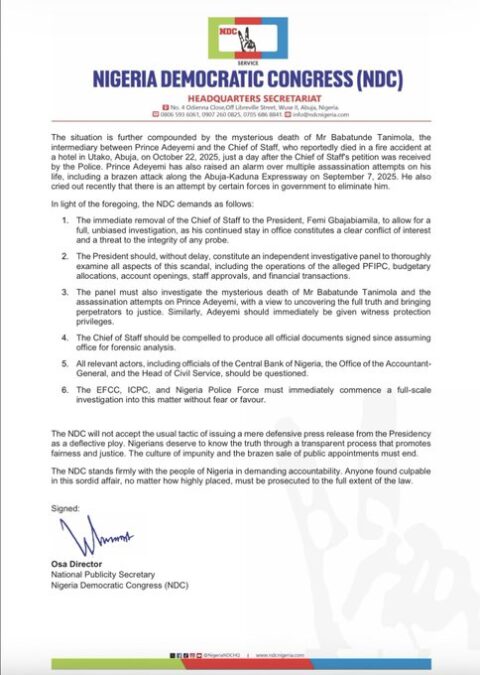
The opposition demand focuses on two core tenets:
- Administrative Accountability: The NDC maintains that a high-ranking public official whose office is directly linked to an active ₦400 million cash-for-appointment investigation cannot ethically remain in custody of state power.
- Independent Inquiry: The party asserted that the Department of State Services (DSS) and the Economic and Financial Crimes Commission (EFCC) must be allowed to conduct an unhindered probe without the protective umbrella of executive immunity shielding the Chief of Staff.
The 2026 Budget Paradox: The Document Trail
For analytical observers and legal scholars, the core of the controversy rests on a profound administrative anomaly that the Presidency has yet to fully clarify. While the Office of the Chief of Staff issued a public disclaimer asserting that the PFIPC is completely fictitious and has no legal status, investigative reviews of the 2026 Appropriation Act tell a vastly different story.
The PFIPC is explicitly listed in the federal budget alongside established Ministries, Departments, and Agencies (MDAs), complete with a statutory capital allocation exceeding ₦1.3 billion across 10 distinct projects, including global logistics and international summits. The NDC seized upon this contradiction, questioning how a supposedly non-existent, “fake” agency could successfully pass through multiple layers of executive vetting, the Budget Office, and National Assembly defense sessions to be codified into federal law if high-ranking presidency officials were not actively backing it behind the scenes.
The Presidency’s Defense: Counter-Charges of Forgery and Impersonation
In a swift pushback, the Presidency, through a statement by the Special Adviser to the President on Information and Strategy, Bayo Onanuga, completely cleared Gbajabiamila of any complicity, dismissing the bribery allegations as a fabricated smear campaign.
According to the State House, it was actually Gbajabiamila who originally blew the whistle on the illegal operation as far back as October 2025, petitioning the DSS and the police after discovering that the group was forging presidential letters and misleading foreign diplomats. Government investigators report that Adeyemi allegedly operated 34 bank accounts linked to fictitious government agencies and used forged official seals to execute the fraud. The suspect was subsequently arraigned before the Federal High Court in Abuja in November 2025 on an eight-count criminal charge bordering on forgery and impersonation.
A High-Stakes Judicial Confrontation
With the criminal trial of the alleged impostor scheduled for continuation on July 27, 2026, the political fallout is rapidly outpacing the legal timeline.
Political analysts warn that the budget discrepancies have left a gaping hole in the administration’s institutional defense. By turning this into a frontline battle for transparency, the NDC has successfully escalated a complex administrative forgery case into a defining test of executive accountability ahead of the next electoral cycle. Whether the Presidency can reconcile its public disclaimers with its own signed budget documents remains the critical question hanging over the State House.
National Assembly Demands Answers Over Oversight Failure
The escalating demands by the opposition have triggered intense administrative panic within the National Assembly. Lawmakers from both chambers have expressed deep embarrassment over how the “Presidential Economic Advisory Council/Presidential Foreign Intervention Promotion Council” (listed under code 0111062001) successfully bypassed statutory legislative scrutiny.
Constitutional analysts note that for an agency to appear in the final 2026 Appropriation Act with an active budget line—including ₦802.9 million for personnel, ₦200 million for overhead, and ₦300 million for capital expenditure—it had to pass through rigorous mandatory defense sessions before the relevant Senate and House Committees on Appropriations.
Several legislators, speaking on the condition of anonymity, described the development as a monumental institutional failure of parliament’s power of the purse.
“An illegal structure does not become legal merely because it appears in some official-looking corner. A questionable entity does not become a lawful agency because it wrangled its way into a budget document,” a joint coalition of civil society groups and legislative watchdogs noted in a briefing to lawmakers. They have formally petitioned parliament to investigate possible insider manipulation of the final budget compilation process.
The focus of the upcoming legislative inquiry is expected to center on the Budget Office of the Federation and the Office of the Accountant-General of the Federation. Lawmakers want to ascertain whether institutional actors knowingly processed forged executive instruments or if administrative cost centers were deliberately duplicated by powerful syndicates inside the State House to siphon public funds under the guise of an unestablished presidential council.