


ABUJA — Minister of the Federal Capital Territory (FCT) and former Governor of Rivers State, Nyesom Wike, is facing severe public condemnation after political commentator and activist Hon. Henry Shield publicly called him out over perceived hypocrisy regarding overseas education.
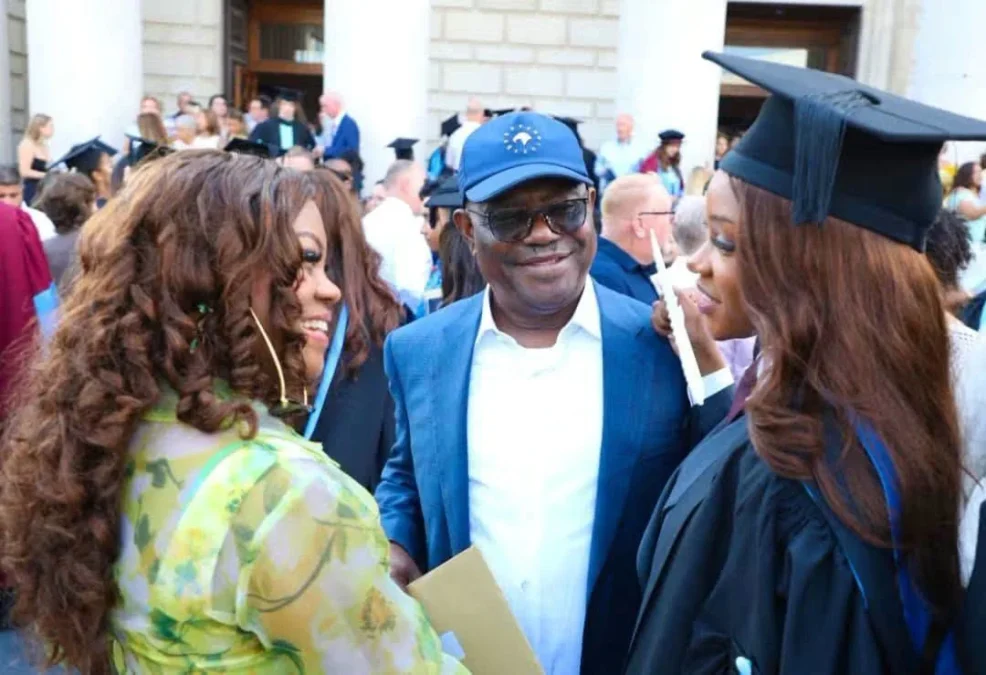
The outrage erupted following high-profile celebrations surrounding Wike’s daughter, Jazmyne Wike, who recently graduated with a Bachelor of Laws (LL.B. Upper Second-Class) degree from the University of Southampton in the United Kingdom.
Reacting to photos of the lavish graduation ceremony attended by serving governors, political figures, and federal lawmakers in Southampton, Shield slammed the minister for funding his children’s overseas law degrees while having unilaterally terminated the Rivers State foreign scholarship scheme that stranded hundreds of undergraduate and medical students studying abroad.
“Wike, you stopped paying for Rivers State students who were studying abroad because, according to you, any course being offered in Nigeria shouldn’t be studied abroad,” Shield posted on X (formerly Twitter). “Left hundreds of children stranded in foreign countries. But here we are today, you’re celebrating your own daughter for studying Law abroad. Nyesom, God will judge you. And He will judge you with anger!”
The RSSDA Overseas Scholarship Cancellation Debacle
Shield’s sharp rebuke highlights a painful chapter for hundreds of Rivers State families. Shortly after assuming office as Governor in 2015, Wike discontinued funding for the overseas scholarship program managed by the Rivers State Sustainable Development Agency (RSSDA)—a scheme initiated under his predecessor, Chibuike Rotimi Amaechi.
The sudden withdrawal of state support left over 300 Rivers State scholars stranded across various foreign institutions, primarily in the United Kingdom, Eastern Europe, and Asia:
- UK University Evictions and Deportations: Scores of Rivers students faced eviction from student accommodation and threat of deportation after tuition payments lapsed.
- Stranded Medical Students: Final-year medical students at the University of Debrecen in Hungary and other European institutions were denied transcripts and certificates due to accumulated debt.
- Forced Recalls: The Wike administration insisted that state resources could not sustain foreign education for discipline paths available locally, ordering non-final year scholars to return home and enroll in local institutions like Rivers State University.
At the time, Wike defended the suspension on fiscal grounds and famously argued in television interviews that sending Nigerian youths abroad to study courses like Law, Economics, or Communications was a wasteful drain on state resources, asserting that Nigerian faculties possessed sufficient capacity to teach those subjects.
“Double Standards for the Political Elite”
The resurfacing of those historical statements alongside images of high-society celebrations in the UK has drawn sharp condemnation from youth groups, civil society organizations, and former RSSDA beneficiaries.
Critics point out the stark contrast between public policy positions enforced on ordinary citizens and the private choices of the political elite:
- In early 2025, Wike faced similar public backlash when he celebrated his son’s graduation with a Master’s degree in Law from King’s College London.
- The July 2026 Southampton graduation of his daughter Jazmyne—attended by Adamawa State Governor Ahmadu Fintiri and several National Assembly members—reignited accusations of elitist double standards.
“It is a complete injustice to have deprived children of ordinary Rivers people from finishing their foreign degrees—claiming law and medicine could be studied locally—while sending your own children to elite British law schools,” stated Port Harcourt-based civic activist Charles Jaja in response to the controversy. “The pain inflicted on those scholars whose careers were disrupted remains a lingering stain.”
Calls for Accountability in Public Leadership
Neither the FCT Minister nor his media team has issued an official response to Hon. Henry Shield’s statement.
However, public finance analysts and educational rights advocates maintain that the incident underscores the urgent need to hold public officers accountable to the same institutional standards they impose on the citizenry—particularly regarding public trust, state-sponsored educational access, and confidence in Nigeria’s tertiary education sector.