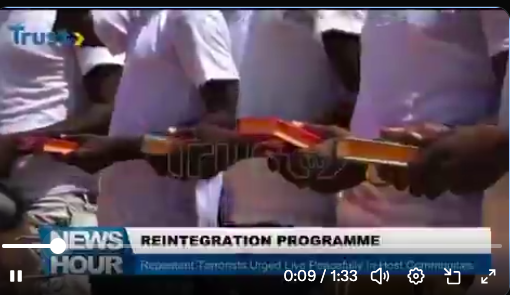


MAIDUGURI, NIGERIA – A high-ranking Borno State government official has announced the formal forgiveness and social reintegration of a fresh batch of repentant Boko Haram and Islamic State West Africa Province terrorists. The decision was finalized after the ex-combatants participated in a religious de-radicalization ceremony where they swore oaths on the Holy Quran to permanently renounce terrorism.
The announcement represents the latest phase of the state’s controversial mass surrender program, which seeks to end the long-running insurgency through community-based reconciliation alongside ongoing military operations.
Forgiveness and the Quranic Oath
The declaration of amnesty was delivered during an official profiling and reintegration exercise in Maiduguri, the state capital. Speaking on the strategic shift toward non-kinetic resolution, the government representative emphasized that the state is acting in the collective interest of regional stability.
“On behalf of the good people of Borno State and Nigeria, we have forgiven them,” the official announced. “And they have sworn by the Quran not to go back to any form of violence.”
Under the protocol, the repentant fighters underwent basic psychological evaluation, religious re-education by Islamic scholars, and vocational training before taking the binding spiritual oath, which local administrators believe acts as a powerful cultural deterrent against recidivism.
The Local Model Under Scrutiny
The Borno State government has aggressively defended its amnesty approach, arguing that the voluntary surrender of over one hundred thousand insurgents and their family members has severely depleted the fighting strength of active terrorist enclaves in the Sambisa Forest and Lake Chad regions.
According to state administrators, providing a safe exit pathway for low-risk collaborators and conscripts encourages remaining fighters to lay down their arms, speeding up the restoration of civil authority in long-abandoned agrarian communities.
Deep Skepticism and Fear of Recidivism
Despite official assurances, the announcement has sparked widespread anxiety among counter-insurgency analysts, military veterans, and local victims of terror. Critics have raised serious questions regarding the strategic reliability of a spiritual oath when dealing with deeply indoctrinated fighters.
The primary concerns among stakeholders include intense fear among internally displaced persons over living alongside individuals who may have participated in the destruction of their villages. Intelligence reports have also occasionally flagged incidents where surrendered elements acted as double agents, supplying logistics back to active terrorist cells. Furthermore, human rights advocates argue that granting blanket forgiveness without formal judicial accountability or a comprehensive victim-compensation framework deeply undermines the rule of law.
As the state pushes forward with its reintegration timeline, local security agencies maintain that post-release surveillance and community monitoring mechanisms will be deployed to ensure the resettled individuals honor their oaths of peace.