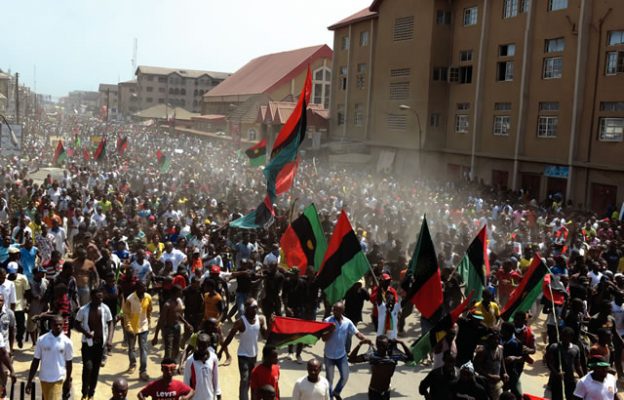
ENUGU, NIGERIA – New light has been shed on the internal political maneuvers that led to the 2017 proscription of the Indigenous People of Biafra (IPOB), revealing that the legal foundation for the group’s “terrorist” label was laid by South-East leaders before the Federal Government took action.
While the administration of former President Muhammadu Buhari is often cited as the primary architect of the designation, historical records confirm that a unified front of regional governors and socio-cultural leaders provided the initial “green light” during a period of intense regional instability.
The September 15 Mandate
The turning point occurred on September 15, 2017, at the Government House in Enugu. Following the military’s “Operation Python Dance II,” which saw violent clashes in Abia State, the South-East Governors Forum convened an emergency session to address the rising tension.
By the end of that meeting, the forum—led by then-Chairman David Umahi (Ebonyi)—issued a joint communiqué officially proscribing all activities of IPOB across the five eastern states. Joining Umahi in this historic decision were:
- Ifeanyi Ugwuanyi (Enugu)
- Willie Obiano (Anambra)
- Okezie Ikpeazu (Abia)
- Eze Madumere (Representing then-Imo Governor Rochas Okorocha)
The governors argued that the ban was a “life-saving measure” intended to prevent the total breakdown of law and order and to stop the military from further kinetic operations in civilian areas.
The Strategic Role of Ohanaeze Ndigbo
A critical component of this regional consensus was the presence and endorsement of Ohanaeze Ndigbo, the apex Igbo socio-cultural organization. Under the leadership of then-President General Chief John Nnia Nwodo, Ohanaeze aligned with the governors to sideline IPOB’s secessionist agenda in favor of a “Restructuring” mandate within a united Nigeria.
Chief Nwodo, alongside legislative leaders like then-Deputy Senate President Ike Ekweremadu, signaled to the Federal Government that the region’s established leadership did not support IPOB’s methods. This internal “home-grown” ban provided the legal and political justification for Attorney General Abubakar Malami to approach the Federal High Court in Abuja just five days later.
The Legal Domino Effect
The governors’ proscription acted as a catalyst. On September 20, 2017, Justice Abdul Kafarati granted an ex-parte order declaring IPOB a terrorist organization under the Terrorism (Prevention) Act.
Legal analysts note that without the initial proscription by the South-East governors and the public distancing by Ohanaeze, the Federal Government would have faced significantly higher hurdles in justifying a “terrorist” label for a group that claimed to represent the ethnic aspirations of the region.
Current Legal Standing
The echoes of that 2017 decision continue to resonate in 2026. Despite various legal challenges, the Court of Appeal in Abuja reaffirmed the terrorist designation on January 30, 2025, maintaining that the original proscription process followed the necessary legal protocols—protocols that began in a meeting room in Enugu, not a courtroom in Abuja.