
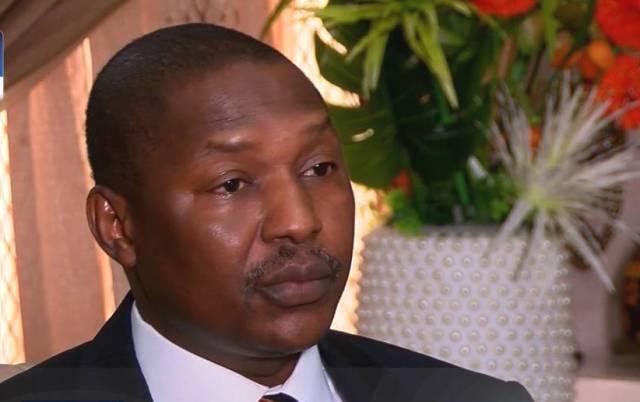

ABUJA, FCT – The high-profile money laundering trials of former Attorney-General of the Federation (AGF) and Minister of Justice, Abubakar Malami, have taken a fresh turn following their reassignment to a new judge.
In a directive issued by Justice John Tsoho, the Chief Judge of the Federal High Court, the two separate cases filed by the Economic and Financial Crimes Commission (EFCC) against the former AGF have been transferred to Justice Joyce Abdulmalik. Following the handover, the new presiding judge has fixed February 27, 2026, for the commencement of proceedings.
The Case Against the Former AGF
The EFCC’s charges against Malami center on allegations of money laundering and the diversion of public funds during his tenure as the nation’s chief law officer. While the specific details of the two cases remain under wraps, insiders suggest they involve a complex web of financial transactions and property acquisitions that the anti-graft agency claims are “proceeds of crime.”
Malami, who served as AGF throughout the eight-year administration of former President Muhammadu Buhari, has consistently maintained his innocence, describing the investigations as a politically motivated “witch-hunt” designed to tarnish his public service record.
Judicial Reshuffle and Timing
The reassignment by the Chief Judge is a procedural move often intended to ensure the accelerated hearing of sensitive cases. Justice Abdulmalik is known for a strict adherence to judicial timelines, and the February 27 date suggests the court is looking to avoid the prolonged delays that often plague high-profile corruption trials in Nigeria.
The move comes at a time of intense scrutiny for Nigeria’s anti-graft agencies. While the EFCC pursues Malami, the ICPC is facing internal leaks suggesting a lack of evidence in the ongoing detention of former Kaduna Governor Nasir El-Rufai. This has led to broader public debates about whether these high-stakes arrests are driven by legal merit or “political containment” ahead of the 2027 general elections.
Wider Political Context
The scheduled court appearance for Malami coincides with a period of significant political activity in the FCT. President Bola Tinubu recently declared that Nigeria is finally “out of the woods” economically, even as opposition voices like Rufai Oseni have flagged massive irregularities in the recent FCT Area Council polls—most notably a unit in AMAC recording 1,219 votes despite having only 213 accredited voters.
As the legal battle for Malami begins under Justice Abdulmalik, observers are watching closely to see if the prosecution can present a “smoking gun” or if the case will follow the pattern of other high-profile probes that have struggled to reach a conviction.