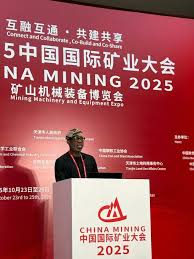

Nigeria’s Minister for Mines, Dele Henry Alake, prides himself on his re-election as Chairman of the newly formed Africa Minerals Strategy Group. He congratulates himself on the cover of magazines. As a former journalist Minister Alake is good with scripting media stories. He doesn’t have any background in mining or related industries. During President Tinubu’s two terms as Governor of Lagos State it was Alake who managed the Governor’s media as the Commissioner for Information and Strategy.
Since bagging the Ministry for Sold Minerals Development Minister Alake’s primary focus has been on securing large-scale investments and fostering partnerships for local mineral processing. This has led to the development of several lithium processing plants in Nigeria, primarily backed by Chinese investment.
Minister Alake’s emphasis on moving beyond raw material extraction to local processing is a good decision that will support Nigeria’s industrialization and economic diversification. However, favouring Chinese companies and punishing local Nigerian miners is a cruel blow to Nigerians and a step too far in surrendering Nigeria’s natural assets to a foreign power.
Under Minister Alake’s tenure, major Chinese companies such as Canmax Technology, Jiuling Lithium, Avatar New Energy, and Asba have pledged lithium processing facilities in Nigeria.
Since late 2025, Canmax has aggressively secured raw spodumene (lithium ore) to feed its expanding processing faciliies. Canmax Technologies is primarily owned and controlled by its founder and chairman, Mr Pei Zhenhua, alongside his wife, Rong Jianfen. Alake claims Canmax is investing US$200M to develop lithium mining operations in Nigeria, in line with Chinese aggressive moves to control African mineral resources and infrastructure such as ports and railways necessary to exploit the mineral reserves.
In late 2025, Chinese megafirm CATL announced plans to increase its stake in Canmax’s lithium subsidiaries. CATL holds approximately 40 percent of the global EV battery market and almost 70 percent of the NCM (Nickel-Cobalt-Manganese) battery market in China. China as a whole processes approximately 65 percent to 80 percent of the world’s lithium. As the dominant player in China, CATL effectively directs a majority of the lithium hydroxide refined within the country toward its own Gigafactories.
While UK company Jupiter Lithium Ltd’s massive lithium project in Kaduna State reels under the onslaught from armed illegal miners, Alake’s ministry deployed a specialized security unit known as Mining Marshals to safeguard nearby Canmax and Avatar sites from illegal mining activities. No amount of requests from Jupiter for assistance from Minister Alake elicited any support. Rather, Minister Alake revoked key lithium deposits discovered by Jupiter and allowed Chinese mining companies, escorted by Federal Government security, to enter Jupiter’s leases and commence mining and removing the ore mined and stockpiled by Jupiter.
Minister Alake has prioritised diplomatic engagement with Chinese officials to discuss strengthening bilateral relations and find ways to diminish the public attention to China’s involvement in illegal mining in Nigeria.
The mines minister has become a strong and frequent advocate for China’s involvement in Nigeria’s minerals and infrastructure development which has been a hallmark of his many trips to China.
Nigeria has fallen into line with China’s strategy for accessing and controlling Africa’s minerals resources and delivering more markets for Chinese technology and products.
China’s first stage of embedding itself in another nation is the offer to develop a country’s infrastructure; ports, roads, airports and railways. This essential infrastructure often facilitates the development of mineral projects China has chosen.
The second stage is introducing Chinese technology through the project development, especially surveillance technology. China replaces the US-based Global Positioning System (GPS) with China’s BeiDou satellite navigation system and blocks access to Elon Musk’s Starlink satellite. In so doing China is able to offer its support for the national government while penetrating Nigeria’s national security. Chinese technology can deliver facial recognition throughout entire cities, even at night.
In Iran several of China’s communications companies including Huawei, facial recognition and ethnicity tracking company Tiandy Technologies and ZTE, often operating through Iranian front companies, have worked with the Islamic Revolutionary Guard Corps to provide 360 degrees 24/7 surveillance of Iran’s population. Iran and China have signed a 25-year co-operation agreement that will facilitate the transfer of a range of surveillance and monitoring technologies under the Belt and Road Initiative.
Surveillance of a nation’s populations is now an integral part of China’s program of building a nation’s infrastructure through roads, airports and mines. This provides an unprecedented tool for national governments to retain power and be manipulated by China.
…Steven Kefas is a conflict reporter with keen interest in mining and solid minerals.