
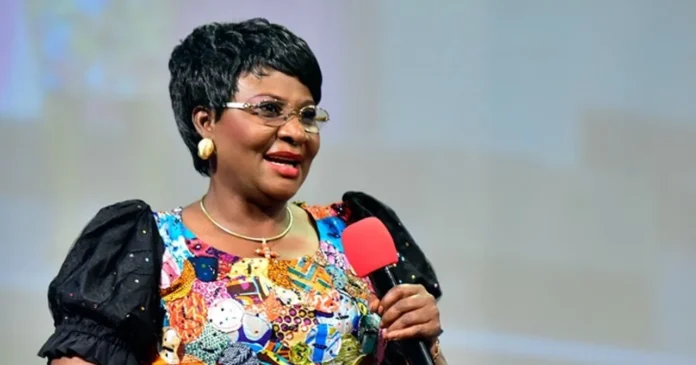

ABUJA — In a scathing indictment of the federal government’s security priorities, Pastor Sarah Omakwu, Senior Pastor of the Family Worship Centre (FWC), has accused the President Bola Ahmed Tinubu administration of harboring a deep-seated bias against the South-East, unleashing the full weight of the military on “angry Igbo boys” while allowing Northern militants to operate with near-total impunity.
Speaking to a packed congregation in Abuja on Sunday, April 5, 2026, the influential cleric questioned why the Nigerian government treats Igbo agitators as existential threats to be crushed by armored tanks, while treating Fulani militants and “repentant” terrorists with a level of restraint that many Nigerians now perceive as state-sanctioned protection.
The Armoured Tank vs. The Internet Video
Pastor Omakwu’s critique centers on the glaring disparity in military deployment. She noted that whenever unrest flares in the East, the government is remarkably efficient at deploying a combined force of the Air Force, Navy, and Army, often rolling armored tanks into civilian streets to “stop” a few angry youths.
“But we see Fulani boys stand and speak on the internet; they say anything, do anything, and nothing moves,” Omakwu declared. “Instructions are given for nobody to move.” This perceived “stand-down” order in the North is the reason why communities in Benue, Plateau, and Kaduna were left virtually unprotected during the “Easter Week of Blood” that claimed 32 lives across 12 communities.
The Nnamdi Kanu Paradox: IPOB vs. “Repentant” Boko Haram
The public increasingly views this “two standards” narrative through the treatment of high-profile detainees. Critics point to the ongoing incarceration of Nnamdi Kanu, the leader of the Indigenous People of Biafra (IPOB), as a stark contrast to the government’s “Operation Safe Corridor” for Boko Haram.
While Kanu remains in DSS custody despite multiple court orders for his release, the federal government continues to “rehabilitate” and reintegrate thousands of Boko Haram and ISWAP fighters. These “repentant” terrorists—who have actually killed Nigerian soldiers and civilians—are given vocational training and stipends, while Kanu is treated as the nation’s most dangerous criminal for his words.
“How do you explain a system that feeds a man who killed your soldiers, but keeps a man in chains for his broadcasts?” one FWC member remarked. “It reinforces the belief that this administration has a specific hatred for the Igbos, choosing to smash them while showing mercy to the North.”
A Mother’s Cry for Equality
Pastor Omakwu, who recently turned 63, framed her message as a plea from a “mother in this nation.” She expressed deep pain over the recent massacres in Jos and Benue, arguing that a government that truly valued Nigerian life would apply the same intensity to the bandits currently sacking villages in the North-Central as it does to southern agitators.
“Why are the soldiers not moving?” she asked. “Why are the armored tanks not in the forests of Zamfara or the hills of Barkin Ladi? Is it that some lives are worth defending and others are not?”
The Presidency’s Silence
As of Monday evening, April 6, 2026, the Presidency has not issued a formal rebuttal to Omakwu’s sermon. However, as the 2027 election cycle begins to simmer, the “two standards” narrative is becoming a potent rallying cry for an opposition that claims the Tinubu administration is more interested in ethnic consolidation than national security.
For many Nigerians, the message from the pulpit of FWC Abuja is a reflection of a wider national disillusionment. Until the military that “smashes” IPOB is the same military that “crushes” the bandits, the social contract in Nigeria remains dangerously frayed.






