
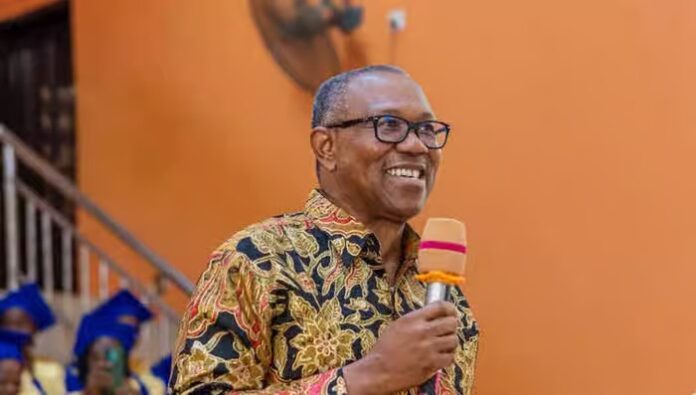

ABUJA — Former presidential candidate Peter Obi has delivered a stinging assessment of Nigeria’s chronic electricity crisis, calling the nation’s failure to exceed 4,000 megawatts “unacceptable.” His critique comes as the federal government announces a massive ₦3.3 trillion injection into the sector—a move the Nigerian masses are widely dismissing as a “white elephant” project designed to bankroll the 2027 presidential elections.
The Presidency confirmed on Sunday, April 5, 2026, the approval of a ₦3.3 trillion payment plan aimed at settling legacy debts to gas suppliers and power generation companies. While the administration frames this as a “rescue mission” for the national grid, the public reaction has been one of deep cynicism. Many Nigerians believe the timing and scale of the fund suggest it is a strategic “siphoning scheme” to build a war chest for the upcoming electoral cycle rather than a genuine attempt to fix the darkness.
The Minister’s Boast and Public Outrage
Adding fuel to the fire is a recent controversial comment attributed to the Minister of Power. The Minister reportedly boasted that he has amassed enough personal wealth during his tenure that he “does not need to work again” for the rest of his life. This statement has triggered fierce condemnation from a public currently grappling with record-high electricity tariffs and a grid that has collapsed multiple times in early 2026 alone.
For many, the Minister’s comments confirm a leadership class that is “feasting while the country fasts,” further eroding any trust in the ₦3.3 trillion “intervention.”
The Egypt Comparison: Why Nigeria Fails
Obi drew a sharp contrast with Egypt, a nation of 100 million people that currently generates 58,000 megawatts. He noted that Egypt added a staggering 30,000 megawatts in just the last five years—nearly eight times Nigeria’s total output—by investing in its own people and home-grown engineers.
“I just went to Egypt,” Obi remarked. “All the people I met at the power plants were engineers trained in Egyptian universities. In Nigeria, there is no production because you have not invested in the people. You cannot have a productive economy when your technical foundations are crumbling.”
A Pattern of Failed Promises
The consensus among the Nigerian masses appears firmly aligned with Obi’s condemnation. Critics point out that despite billions of dollars in “interventions” over the last two decades, the power situation has actually regressed. In 2023, the national supply averaged over 4,000 megawatts; today, it frequently dips below that mark despite consumers being forced to pay significantly higher “Band A” tariffs.
With the 2027 elections looming, the ₦3.3 trillion plan is being viewed not as a light at the end of the tunnel, but as another chapter in a long history of “budget padding” and administrative waste. As Obi noted, until the focus shifts from multi-trillion naira excuses to actual human capital investment, Nigeria will remain a “dark spot” on a continent that is moving forward.






