
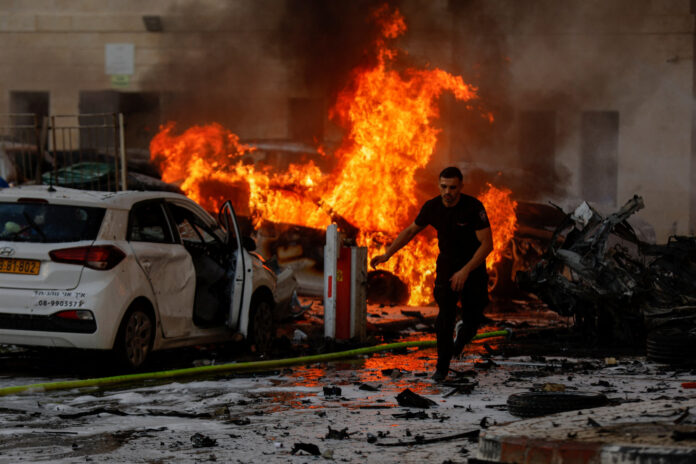
TEL AVIV — A dangerous new reality is unfolding across the Middle East as Israel finds itself besieged not from one, but from multiple directions simultaneously. What began as a localized conflict has rapidly mutated into a full-scale, multi-front confrontation, with rockets and ballistic missiles raining down from Lebanon in the north, Iran from the east, and Yemen in the south.
The strategic shift is unmistakable. Air raid sirens have become a permanent fixture in the lives of millions of Israelis as defense systems like the Iron Dome and Arrow are pushed to their absolute limits. This is no longer a series of isolated skirmishes; it is a coordinated, relentless campaign designed to stretch Israeli defenses to a breaking point. Different regional forces are now synchronizing their strikes with a level of precision and timing never seen before, signaling a grave turning point in the regional power struggle.
A Ring of Fire Intensifies
The pressure is coming from all sides of the compass. In the north, Hezbollah’s sophisticated arsenal keeps the border in a state of constant kinetic warfare. From the south, the Houthis in Yemen have introduced a long-range threat that complicates maritime security and aerial defense. Dominating the entire theater is Iran, whose direct involvement has removed the veil of proxy warfare, placing the entire region into uncharted territory.
For global observers, this moment represents a massive escalation. The battlefield is expanding by the hour, alliances are hardening, and the risk of a conflagration that draws in global superpowers is growing. The “ring of fire” strategy aimed at Israel is testing not just military hardware, but the geopolitical stability of the entire world.
Implications for Global Security
The sustained pressure from all sides is forcing a massive recalculation of defense strategies. Interceptor stockpiles and the fatigue of a nation under constant alert are now major factors. Furthermore, the involvement of Yemen and the persistent threat from Lebanon have already begun to impact global trade routes and oil market stability.
As the tension reaches its highest point in decades, the international community is watching with bated breath. With every passing hour, the stakes climb higher, and the margin for error shrinks. The region has entered a period of extreme volatility where a single miscalculation could ignite a war of catastrophic proportions.