
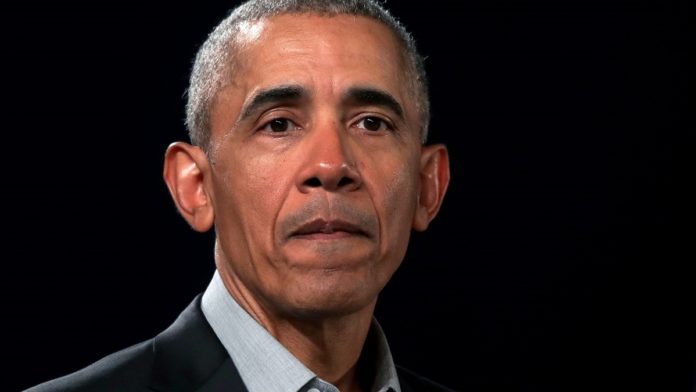

WASHINGTON — Former U.S. President Barack Obama has issued a stern warning against the ongoing military escalation in the Middle East, cautioning that “peace is not built on rubble” as the conflict between the United States, Israel, and Iran enters a second month of high-intensity warfare.
In a formal statement released on Sunday, April 5, 2026, the former president broke his relative silence on the “Operation Persian Thunder” campaign, which began on February 28. Obama argued that the current crisis cannot be solved through “technological or ideological” military operations alone, emphasizing the historical difficulty of ending Middle Eastern conflicts in an orderly fashion once they have been ignited.
The Choice Between Diplomacy and Perpetual War
The former president’s remarks appear to be a direct critique of the current administration’s “maximum pressure” military strategy. “We must choose between difficult and persistent diplomacy, or a perpetual regional war that has no winners, only victims,” Obama stated. He further warned that American leadership is most effective when it leads with principles that bring the world together, rather than through “bullying and mockery masquerading as strength.”
The statement comes at a sensitive time for U.S. foreign policy. Domestically, the war has driven gasoline prices past the $4-per-gallon mark, while internationally, the humanitarian toll is mounting. On April 2, U.S. airstrikes destroyed the B1 suspension bridge in Iran during the Nowruz holiday, an act that resulted in nearly 100 casualties and has drawn sharp criticism from human rights organizations.
Regional Instability and Economic Fallout
The “regional architecture” Obama alluded to in his statement is currently under extreme duress. Tehran has retaliated against the U.S.-led offensive by launching drone and missile strikes on critical infrastructure in Kuwait, the UAE, and Saudi Arabia. Just this morning, Kuwait reported significant damage to its power and water desalination plants, an escalation Iran justifies by claiming these Gulf states are hosting the U.S. military assets used in the strikes against its territory.
While Obama’s supporters have hailed his call for a return to “principled leadership,” his critics argue that the very “regional architecture” he defends—specifically the 2015 nuclear deal—allowed the Iranian regime to build the missile stockpiles currently being used to destabilize the Gulf.
A Message to the Electorate
Beyond the military specifics, Obama’s intervention is being viewed as a significant political moment ahead of the 2026 mid-term cycle. By framing the conflict as a choice between “persistent diplomacy” and “perpetual war,” the former president is signaling a shift in the Democratic Party’s platform, focusing on the human and economic costs of a prolonged engagement in the Persian Gulf.
As of Monday morning, the White House has yet to issue a formal response to the former president’s critique, though senior officials continue to maintain that the military operations are necessary to “permanently degrade” Iran’s ability to threaten global energy corridors.






