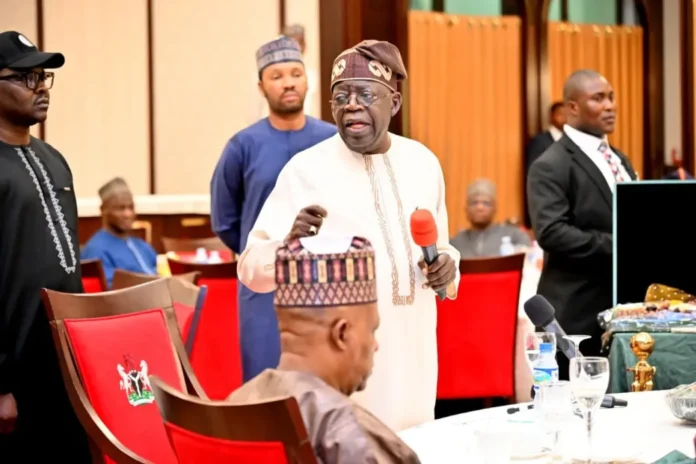
YENAGOA — President Bola Tinubu has ignited a wave of public fury after urging struggling Nigerians to be grateful for their current economic plight, claiming the country is faring better than Kenya and other African nations despite the skyrocketing cost of fuel.
The President made these remarks during a state visit to Bayelsa on Friday, April 10, 2026, where he admitted that the current fuel price is “biting hard” but quickly pivoted to a message of forced optimism. “Look around, let us thank God together, that you are better off than those in Kenya and other African countries,” the President told a crowd in Yenagoa, many of whom have seen their purchasing power erased by his administration’s aggressive fiscal reforms.
The gratitude narrative has been slammed by critics as a tone-deaf attempt to gaslight a population currently enduring the worst inflation in decades. While the President pointed to global market fluctuations and Middle Eastern tensions as the culprits for the ₦1,200-per-liter pump price, many Nigerians hold his administration’s internal choices directly responsible.
Critics and opposition leaders argue that President Tinubu is the primary architect of the current hardship through two catastrophic economic shocks: the abrupt removal of the fuel subsidy on his first day in office and the subsequent devaluation of the naira through the liberalization of the foreign exchange market. These policies have seen fuel prices soar from ₦184 to over ₦1,200, while the naira has lost more than 60% of its value, trading at over ₦1,600 to the dollar.
Economic analysts further argue that comparing Nigeria to Kenya is fundamentally flawed. Nigeria is a major oil-producing nation, yet its citizens pay prices that rival non-producing countries, all while earning a minimum wage that is a mere fraction of Kenya’s. For many, being told to “thank God” while basic transportation and food have become luxuries is seen as a sign of a leadership deeply disconnected from the hunger in the streets.
“He tells us we are better than Kenya, but can he tell us we are better than we were two years ago?” asked one resident in Yenagoa. “You cannot use the suffering of others to justify the hardship you have brought upon your own people. We are not looking at Kenya; we are looking at our empty pots.”
The President’s comments come at a time when the Senate, led by Godswill Akpabio, has consistently affirmed the executive’s controversial economic decisions, leaving many citizens feeling they have no institutional defense against the rising cost of living. Instead of policy relief, the administration’s message has only deepened the sense of helplessness and resentment among an increasingly desperate electorate.