
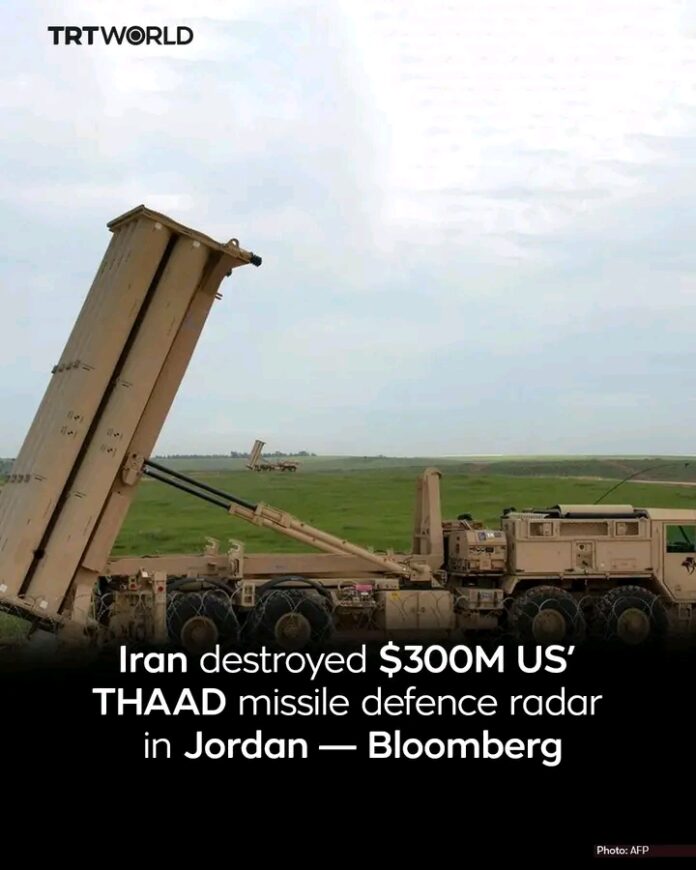

DUBAI — A critical $300 million Terminal High Altitude Area Defense (THAAD) radar system was destroyed in a high-precision Iranian strike late Thursday, Bloomberg reports, marking one of the most significant blows to U.S.-led missile defences in the Middle East to date.
The AN/TPY-2 radar, described by military analysts as the “eyes” of the American anti-missile shield, was reportedly targeted by a swarm of advanced hypersonic missiles and “suicide” drones that overwhelmed local defensive batteries.
A Strategic Blind Spot
The destruction of the radar unit—crucial for detecting and tracking ballistic missiles—has created a massive “blind spot” in the region’s integrated air defence network. Military sources indicate that without this specific radar, multiple THAAD and Patriot missile batteries across the Gulf are effectively rendered blind, leaving key oil installations and military bases vulnerable to follow-up attacks.
“This isn’t just about the $300 million price tag,” a senior defence official told Bloomberg on the condition of anonymity. “The THAAD radar is the backbone of the entire early-warning system. Its loss significantly weakens the U.S. ability to intercept incoming threats before they reach their targets.”
The Iranian Offensive
Tehran has claimed the strike was a “proportional response” to recent joint U.S.-Israeli operations. Revolutionary Guard commanders stated that the mission demonstrated Iran’s capability to pierce the most sophisticated western electronic warfare and interception systems.
Satellite imagery released Friday morning appears to confirm a direct hit on the classified installation, showing a charred crater where the massive mobile radar unit once stood.
Pentagon on High Alert
The Pentagon has not officially confirmed the location of the strike but acknowledged a “significant hardware loss” during the latest exchange of fire. Rapid response teams are reportedly being deployed to airlift a replacement unit from a base in Europe, though experts warn that recalibrating the regional grid could take weeks.
The incident has sent shockwaves through global energy markets, with Brent crude jumping 4% in early trading amid fears that the weakened defensive screen could lead to strikes on major refineries.
Regional Fallout
Allies in the region, including Saudi Arabia and the UAE, have reportedly held emergency security meetings. The loss of the THAAD radar significantly tilts the tactical balance in the ongoing conflict, forcing U.S. Central Command (CENTCOM) to rethink its force posture as tensions reach a breaking point.
As of press time, U.S. carrier groups in the Arabian Sea have moved into “intercept positions,” but the tactical gap left by the destroyed radar remains a primary concern for commanders on the ground.






