By Ipole AMAJAMA
On October 25, 2019, Vladimir Putin, President of the Russian Federation, hosted leaders of 54 African countries in the cold city of Sochi. President of Egypt, Gen. Abdel Fattah Al-Sissi, then as the African Union’s Chairperson, co-chaired the Summit. The theme at the Russia-Africa Summit was: “Russia and Africa: Forging Economic Ties, Creating Joint Projects”. Besides the Heads and leaders of States, there are more than 3,000 other delegates at the summit. The Forum was presented as a strategically important step towards creating favourable conditions for the development of trade and economic relations between Africa and the Russian Federation. Seven years after the touted “historical” meet, the situation speaks differently now.
The Forum was also characterised as moving Russia’s relations from stagnation to growth, from one stage to another, amid geopolitical competition and rivalry. But for foreign policy watchers, it was just a flash in the pan, as history shows that the Kremlin will scupper the outcome through institutional obstacles, including political bureaucracy and a lack of prioritisation of official policies. However, some argue that Russia’s decision to withdraw from the investment landscape could largely be attributed to African leaders’ inability to create a favourable climate and their unpreparedness to change rules and regulations to enable foreign corporate businesses to operate in Africa. But such an argument falls flat in the face of economic indices showing that investment policies and opportunities from the West continue to thrive due to prioritisation.
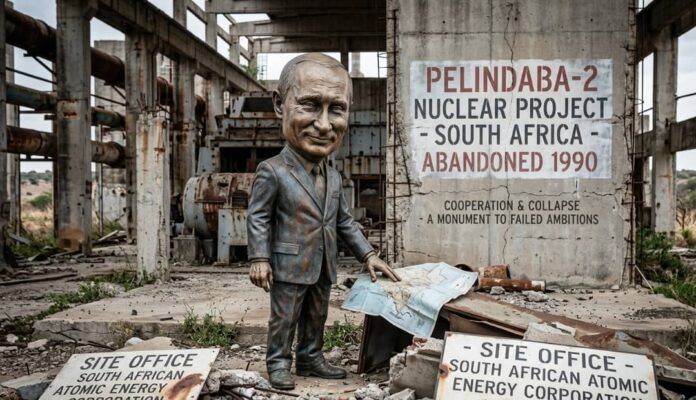
At the Sochi Summit, Russia’s loudest pledge was the planned construction of nuclear energy plants in Burkina Faso and in South Africa. Was the promise simply a public relations stunt? Or that African leaders have come to terms with rhetoric and popular slogans such as ‘international solidarity and friendship’ that bear no commitment? Predictably, the Kremlin serves only its own interests and, like a woman, powders over the cracks in its economic woes to lure and deceive. Take the case of the Russian state bank VTB, which owned the major shareholding in Banco VTB Africa, based in Angola. The VTB voted at a general meeting to approve liquidating Banco VTB, when it held 50% of the market share.
For the Russian VTB, it didn’t matter what fate millions of Angolans suffered; it couldn’t stand with a partner that had yielded itself to it for decades. It wasn’t just in Angola. Despite having historical ties with South Africa, data shows that Russia accounts for a paltry 2% of South Africa’s trade, while the United States, the United Kingdom and the European Union account for a combined 35%, with China around 9%. Even as South Africa battles the worst economic crisis of its history, Russia is terribly missing, and nothing best exemplifies this than its failed planned construction of nuclear power plants.
Burkina Faso and South Africa aren’t isolated. In Zimbabwe, Russia has abandoned its lucrative platinum project contract, signed for US$3 billion. Reasons for the abrupt termination of the bilateral contract have not yet been made public. Still, Zimbabwe’s Centre for Natural Resource Governance pointed to a lack of capital (financing) for the project.
In Nigeria, the stark reminder of Russia’s failure is the Ajaokuta steel plant, which its firms built and has yet to produce a single steel sheet in over four decades. It is easy to point to Nigerians as the architects of the moribund steel complex. Still, for the discerning, the builders of the plant, Messrs Tyazhpromexport, could have envisaged the sabotage and the accompanying decay that the multi-billion-dollar investment has gulped. The enthusiasm of the Russians in penning a new Memorandum of Understanding (MoU) with the Nigerian government in September 2024 for the rehabilitation, completion, and operation of the plant and the National Iron Ore Mining Company could suggest they were in for another kill and dry, as Nigerians would say.
Two years and counting after the MoU was signed in Russia by the Minister of Steel Development, Shuaibu Audu, and a pledge by the President of Metallurgical Holding, “Novostal – M” Demchenko Ivan Ivanovich, of their readiness to submit a detailed proposal for the project after the comprehensive audit of the plant, it has been a no-show.
If anything, what has Nigeria benefited from the Russian Federation but the recruitment of young Nigerians through illegal means to die in a war that is not theirs to fight?
If nothing else, Nigeria and the continent needs to pay heed to Mark-Anthony Johnson who noted in his opinion article of early August 2023, published in Business and Financial Times, that “South Africa risks becoming bankrupt for its relationship with Russia, which adds virtually nothing to the economy, state revenues, economic growth, job creation, socioeconomic stability and investor sentiment.” South Africa has been hit by problems ranging from energy deficits to collapsing industrial production and rising tensions among its large labour force.
“Despite consistent assurances made by high-ranking Russian officials that Africa is “in the mainstream of Russia’s foreign policy,” these assurances have not been substantiated by systematic practical activities, and worse, a serious lack of state support for sustaining effective Russia-African economic ties has necessitated the pulling out of some Russian companies from Africa.”
Amajama, a social affairs commentator, writes from Abuja @ amajamaip@gmail.com