
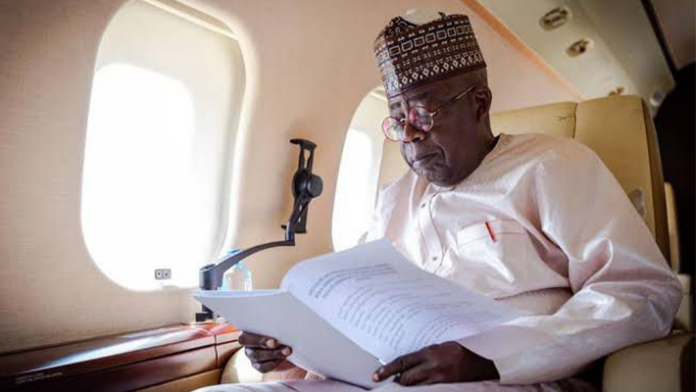

ABUJA — President Bola Ahmed Tinubu is facing a fresh wave of public backlash following reports that the Presidency expended ₦34.39 billion on foreign travel, fuel, and logistics between 2024 and 2025, a figure critics describe as a “stark display of insensitivity” to the plight of ordinary Nigerians.
An investigation by The Punch, utilizing data from the GovSpend platform, revealed that the Presidency, the Presidential Air Fleet, and aides utilized roughly $24 million for international and local movement. The data shows a concentrated spike of ₦29.35 billion in 2024, at a time when the administration was urging Nigerians to “endure” the harsh consequences of fuel subsidy removal and currency flotation.
While the administration saw an 83% drop in travel forex spending to ₦5.04 billion in 2025 as the Naira stabilized, the cumulative figures have reignited allegations of executive profligacy. Civil society groups and opposition figures have condemned the Tinubu administration’s excessive travels, arguing that the frequency of foreign trips shows a blatant disregard for the sufferings of common citizens struggling with record-high food inflation and widespread insecurity.
“It is heartbreaking that while millions of Nigerians can no longer afford three meals a day, the government continues to prioritize expensive foreign junkets,” said a representative from a prominent transparency watchdog. “These numbers reflect a leadership that is disconnected from the reality of the streets.”
In its defense, the Presidency maintains that these trips are strategic diplomatic missions necessary to reposition Nigeria in the global market. Officials claim the engagements have secured over $50 billion in investment pledges. However, Central Bank of Nigeria (CBN) data shows that actual verified foreign direct investment (FDI) inflows for Q3 2025 stood at a more modest $720 million, further fueling skepticism about the “value-for-money” of the President’s frequent air travel.
As the 2026 budget debate continues, calls are intensifying for the National Assembly to slash “non-essential” travel votes and redirect funds toward immediate poverty alleviation and grassroots security.






