
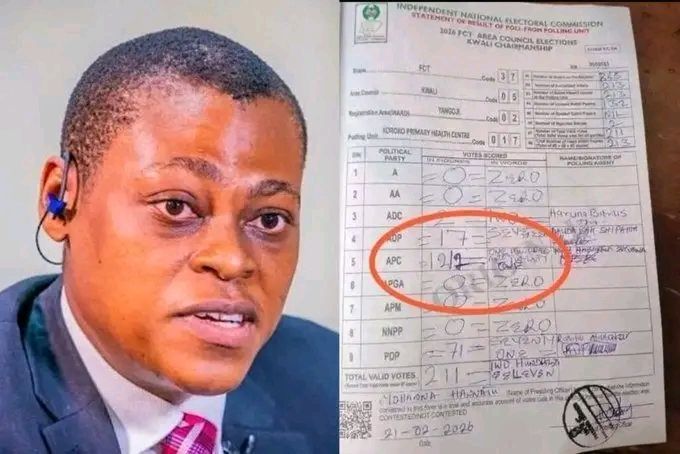

ABUJA, FCT – A major scandal is rocking the Independent National Electoral Commission (INEC) following the conclusion of the FCT Area Council elections, as forensic evidence reveals mathematical impossibilities and blatant data manipulation in the final tallies.
Popular broadcast journalist Rufai Oseni has blown the whistle on a specific polling unit where the All Progressives Congress (APC) was recorded to have polled 1,219 votes—despite the unit having only 345 registered voters and a mere 213 accredited participants.
The Anatomy of a Rigged Result
The discrepancy, which Oseni described as a “brazen assault on democracy,” was discovered on an official INEC result sheet (Form EC8A). The data recorded for the unit presents a chaotic and contradictory picture:
- Total Registered Voters: 345
- Total Accredited Voters: 213
- Total Ballots Issued: 213
- Total Valid Votes: 211
- APC Recorded Score (In Figures): 1,212 (alternatively cited as 1,219 in secondary tallies)
- APC Recorded Score (In Words): “One Hundred and Twenty-one”
The mismatch between the figures and the written words suggests a desperate attempt to inflate the ruling party’s numbers. If the figure of 1,219 is taken as the official record, it means the APC somehow manufactured 1,006 votes out of thin air—nearly six times the total number of people who actually showed up to vote.
“Voodoo Economics” in Abuja Politics
Speaking on the development, Oseni queried how such a result passed through the collation layers without being flagged by INEC officials.
“How did APC record 1,219 votes in a unit with just 345 registered voters?” Oseni asked during a heated broadcast. “This is not just an error; it is a systemic failure and a clear case of manipulation and rigging. INEC owes Nigerians an explanation for this ‘voodoo’ arithmetic.”
The revelation has cast a long shadow over the victory of Christopher Maikalangu (APC), who was declared the winner of the Abuja Municipal Area Council (AMAC) with 40,295 votes. His closest rival, Dr. Moses Paul of the African Democratic Congress (ADC), has already refused to concede, citing widespread irregularities and “manufactured figures” across several wards.
A Pattern of Absurdities
The “1,219-vote” ghost is not the only anomaly flagged in Saturday’s polls. Investigative teams have uncovered a series of logistical and ethical failures that defined the exercise:
- The One-Voter Unit: At PU 065, Garki Geological Garden, INEC deployed a full team of three presiding officers and security for a unit with exactly one registered voter, who ultimately stayed home.
- The Kabusa Arrest: A woman was caught at PU 001, Kabusa Primary School, in possession of over 20 Permanent Voter Cards (PVCs).
- The IReV Blackout: Much like the 2023 General Elections, the INEC Result Viewing Portal (IReV) suffered significant “technical hitches” during the critical hours of collation, leaving party agents in the dark.
Stakeholders Demand Audit
Civil society groups, including the Public and Private Development Centre (PPDC) and Yiaga Africa, have expressed concern over the credibility of the FCT polls. They argue that if a single polling unit can produce such a glaring mathematical impossibility, the entire result for AMAC and other councils must be subjected to a forensic audit.
“This is exactly why voter apathy is at an all-time high,” said one election observer. “When the people see that 213 people vote but 1,219 votes are counted for one party, they lose faith in the entire democratic structure.”
INEC’s Silence
As of Monday morning, INEC has yet to provide a formal rebuttal to the specific figures raised by Rufai Oseni. While the commission has generally described the election as “peaceful,” the growing pile of evidence regarding over-voting and data falsification suggests that the legal battle for the FCT councils is only just beginning.