By Izunna Okafor, Awka
Local Government Chairmen in Anambra State have been charged to embrace accountability, transparency and effective governance as the foundation for improved service delivery and sustainable development at the grassroots.
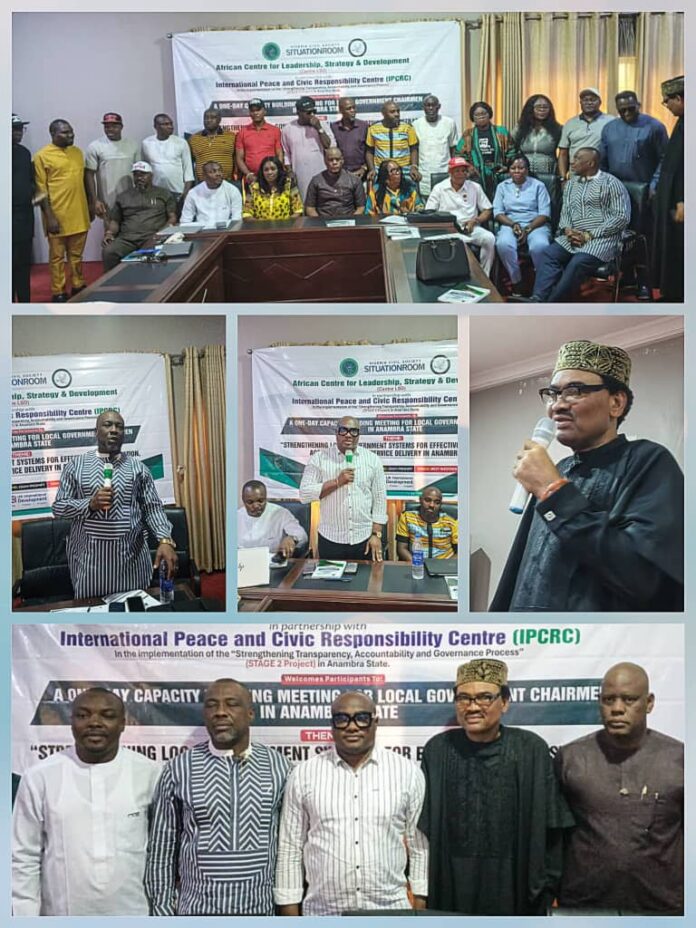
This formed the thrust of deliberations at a one-day capacity building meeting organised for local government chairmen in the state under the Strengthening Transparency, Accountability and Governance Process (STAGE-2) project, by the African Centre for Leadership, Strategy and Development, in partnership with the International Peace and Civic Responsibility Centre (IPCRC), with support from the Nigerian Civil Society Situation Room.

Held in Awka on Tuesday, February 3, the well-attended event brought together elected local government chairmen, senior government officials, labour leaders, civil society actors and development partners to reflect on the state of local government administration in Anambra and chart pathways for institutional strengthening. Themed “Strengthening Local Government Systems for Effective Administration, Accountability and Service Delivery in Anambra State,” the engagement focused on deepening democratic governance at the third tier of government and translating electoral gains into tangible dividends for citizens.


Moderated by journalist and development expert, Alfred Ajayi, the meeting featured highly interactive paper presentations by Dr. Madumelu Madubueze and Dr. Henry Chigozie Duru, who examined the current realities of local government administration in Anambra State and practical approaches for operationalising effectiveness, accountability and service delivery. This saw the participants deliberate on general overview of local government administration in Anambra state, share experiences and explore strategies for institutionalising transparent governance practices that respond to citizens’ needs.


Earlier in his welcome address, the President of the International Peace and Civic Responsibility Centre (IPCRC), Prince Chris Azor, explained that the initiative was born out of concern over the prolonged absence of democratic governance at the local government level despite the existence of democracy at the federal and state tiers. He recalled that for over a decade, grassroots governance structures were largely inactive, prompting civil society organisations to mobilise partnerships aimed at restoring elected local government administration in the state.

Prince Azor traced the evolution of the STAGE project, noting that STAGE-1 focused on reviving democratic processes at the third tier of government, leading to the reconstitution of the Anambra State Independent Electoral Commission (ANSIEC), the enactment of a new legal framework and the eventual conduct of local government elections after more than ten years. He acknowledged the role played by Governor Chukwuma Charles Soludo in responding to advocacy efforts and creating the political will that culminated in the historic polls, while also stressing that STAGE 2 was designed to consolidate those gains by strengthening institutions and building the capacity required for accountable governance.

Delivering his own address, the Executive Director of the African Centre for Leadership, Strategy and Development (Centre LSD), Mr. Monday Osasah FSM, outlined the Centre’s mission of promoting strategic leadership and sustainable development across Africa since its establishment in 2010. He described STAGE 2 as a critical intervention aimed at improving how local governments function, strengthening institutional capacity and encouraging citizen participation in governance and electoral processes.

The Executive Director, whose speech was delivered through his representative, Mr. Itia Otabor, recalled that the first phase of the project mobilised citizens and stakeholders to demand the conduct of local government elections, which were successfully held across the 21 local government areas in September 2024, with elected chairmen sworn in the following month.

He expressed confidence that insights generated from the Awka meeting would serve as a valuable resource for advancing effective administration and accountable service delivery in Anambra State, while also providing a model that could be replicated in other states, and acknowledged the support of the UK Government through the Foreign, Commonwealth and Development Office.
Speaking on behalf of all the local government chairmen in the state, the Chairman of All Mayors in Anambra State and Mayor of Aguata Local Government Area, Dr. Chibueze Ofobuike, described the engagement as timely and highly relevant to the demands of their offices. He noted that the chairmen, being among the first set of elected local government leaders after more than a decade, were conscious of the responsibility to redefine grassroots governance in the state and therefore welcomed every opportunity for capacity building and peer learning.

Dr. Ofobuike commended the organisers for creating a platform for interaction and knowledge sharing, while also acknowledging the support of the state government and the Ministry of Local Government, Chieftaincy and Community Affairs. He praised Governor Soludo for keeping faith with his campaign promise to conduct local government elections within his first term and for providing an enabling environment that allows elected chairmen to function, stressing that the success of grassroots governance in Anambra was tied to continuous learning, accountability and collaboration.

On his own part, the State Commissioner for Local Government, Chieftaincy and Community Affairs, Hon. Tonycollins Nwabunwanne, described the workshop as a unique and strategic intervention that brought critical capacity-building conversations closer to the state, eliminating the challenges associated with attending similar programmes outside Anambra. He noted that the current administration’s emphasis on accountability had placed elected officials at the grassroots on heightened responsibility, making such engagements necessary for strengthening institutional discipline and people-centred leadership.

The Commissioner also emphasised the importance of synergy among mayors, councillors, supervisors and career civil servants, arguing that inclusive participation and adherence to due process were essential for sustainable governance. He observed that competitive development efforts across local governments were already yielding visible results in communities and assured participants that the state government would continue to support local councils through policy guidance, subventions and complementary development initiatives aimed at deepening grassroots transformation.

He also lauded the Governor for prioritizing the affairs of the ministry, while also disclosing that plans and efforts were already on motion towards 4th tier of government in the state, to further strengthen grassroots governance and consolidate the developmental efforts of the local governments at community levels.
Earlier declaring the event open on behalf of the Commissioner, the Permanent Secretary of the Ministry of Local Government, Community and Chieftaincy Affairs, Dr. Nwabufor Nwankwo, noted that effective administration, accountability and service delivery were the core mandates of the local government system as enshrined in the constitution. He stated that since the election of local government chairmen in Anambra State, there had been noticeable improvements in grassroots development, with councils increasingly delivering basic infrastructure and social services to communities.

Dr. Nwabufor attributed the progress recorded to the commitment of elected mayors to replicate the governance philosophy of the state government at the local level. He expressed appreciation to the organisers for the capacity-building initiative and formally declared the meeting open on behalf of the Commissioner, expressing optimism that the engagement would further strengthen local government performance across the state.
Presenting the keynote address on behalf of the Auditor-General for Local Government in Anambra State, Mrs. Josephine Anyaegbunam, Mr. Chibueze Akaogu emphasized the centrality of accountability and transparency to democratic governance and sustainable development. He explained that as the tier of government closest to the people, local councils bear primary responsibility for converting public resources into tangible services that directly impact citizens’ daily lives, making financial prudence and openness non-negotiable.

He highlighted recurring challenges identified through audit exercises, including weak internal controls, poor record-keeping and non-compliance with financial regulations, while stressing that accountability was a shared responsibility involving political office holders, accounting officers and heads of departments. He called for leadership by example, timely financial reporting and strict adherence to audit standards, assuring stakeholders of the Auditor-General’s commitment to capacity building and collaborative reforms that would strengthen public trust.
Contributing, the Acting President of the National Union of Local Government Employees, Comrade Mrs. Uyawune Eucharia, commended the organisers for what she described as a practical and impactful seminar that addressed accountability from the perspective of both leadership and the workforce. She noted that workers remained a critical component of effective local government administration and further expressed concerns over the welfare and motivation of staff under the current crop of mayors.

The event attracted chairmen of the various local government areas across the state, including the Mayor of Idemili South, Iyom Amaka Obi; the Mayor of Nnewi South, Hon. Van George Ezeogidi; and the Mayor of Orumba North, Hon. Barr. Casmir Nwafor, among others. Also in attendance were stakeholders and principal officers of government, alongside representatives of civil society organisations and the media.


More photos from the event: