
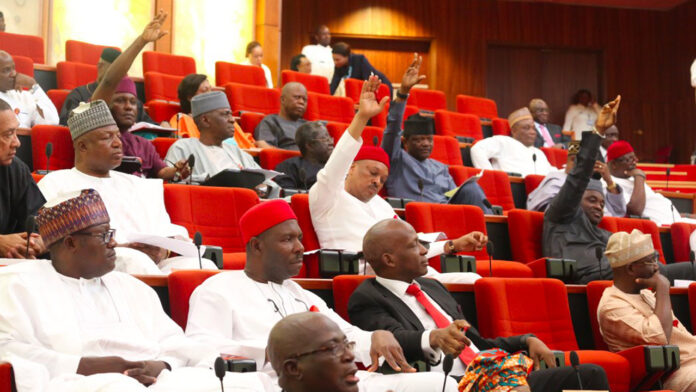
ABUJA — Fresh details have emerged on the behind-the-scenes maneuvering that led the Nigerian Senate to reject the mandatory real-time electronic transmission of election results for the 2027 polls.
In a move that has sparked allegations of a “renewed rigging plan,” sources within the National Assembly have identified three influential Southern Senators as the primary architects of the opposition to the reform. These lawmakers reportedly spearheaded the push to maintain the “status quo,” which gives the Independent National Electoral Commission (INEC) discretionary power rather than a legal mandate to transmit results digitally.
The ‘Network’ Excuse and Procedural Manoeuvres
According to legislative sources, the three Senators—hailing from the South-South and South-East—argued during executive sessions that mandatory electronic transmission was “premature” due to uneven internet coverage in rural areas.
They reportedly mobilised their colleagues to reject the amendment by framing it as a “logistical landmine” that could disenfranchise voters in areas with poor telecommunications infrastructure. This stance directly mirrors the public position of Senate President Godswill Akpabio, who recently came under fire from former Senate President David Mark for “speaking for INEC” instead of letting the electoral body decide its own technical capacity.
‘Majority of Senators Disagreed’
The revelation of this “Southern caucus” involvement adds a layer of complexity to the claims made by Clement Nwankwo, Executive Director of the Policy and Legal Advocacy Centre (PLAC).
Nwankwo has alleged that the resolution was pushed through despite the majority of Senators being in disagreement. “We must ask ourselves how it passed when many senators didn’t agree with what was passed,” Nwankwo stated, calling the outcome “depressing” for the Nigerian electorate.
The 2027 Political Undercurrent
The scuttling of the electronic transmission clause is seen by the opposition as a strategic move by the ruling All Progressives Congress (APC) to preserve old-school manipulation tactics. The African Democratic Congress (ADC) has described the Senate’s action as “legislative tampering” intended to foster malpractice.
This legislative friction coincides with a period of severe national strain:
Security Crisis: While the Senate debates the “network impossibility” of technology, the nation remains a “killing field,” with over 300 Christians massacred in 72 hours across Benue and Katsina.
Economic Hardship: The looming ₦1,000 per litre petrol price and a ₦152 trillion national debt have left the middle class on the verge of collapse.
The Conference Committee Showdown
With the House of Representatives reportedly favouring mandatory e-transmission, the final battle shifts to the Joint Conference Committee.
Civil society groups and senior statesmen like David Mark are now demanding that the committee “overturn the Senate’s submission.” They argue that if the three Southern Senators—whose identities remain a subject of intense speculation in the lobby—succeed in their “sabotage,” the legitimacy of the 2027 “Patriotic Assignment” will be dead on arrival.