
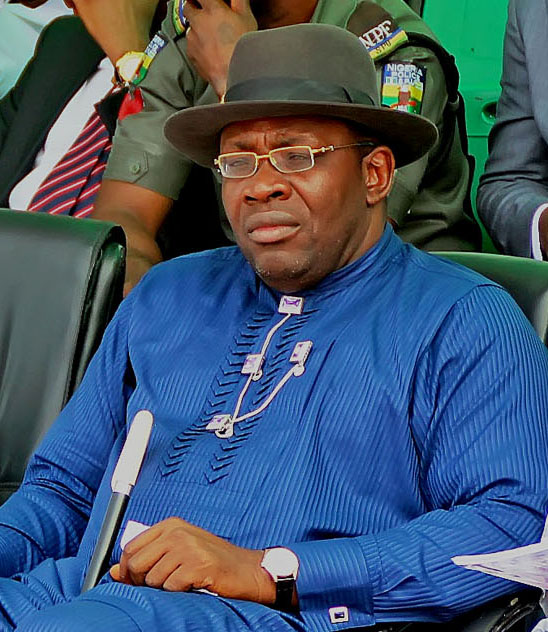

ABUJA — Amidst a firestorm of national criticism, Senator Seriake Dickson, a key member of the Senate Committee on Electoral Matters, has stepped forward to defend the controversial removal of the phrase “real time” from the Electoral Act Amendment Bill, dismissing it as a misunderstood “technological buzzword.”
Speaking on ARISE News on Tuesday, February 10, 2026, the former Bayelsa State Governor argued that the absence of the specific phrase does not weaken the law or provide a loophole for rigging. Instead, he characterized the term as “superfluous,” insisting that the integrity of Nigeria’s elections rests on the physical EC8A result sheets at the polling units rather than a fixation on the speed of digital uploads.
‘We Are Not Voting Electronically’
Dickson’s intervention aimed to de-escalate the tension that has seen opposition leaders and civil society groups besiege the National Assembly gates. He contended that because Nigeria still uses paper ballots, the demand for “real-time” transmission is technically misplaced.
“What is the meaning of real time? We are not voting electronically in Nigeria,” Dickson stated. He maintained that the amended bill still mandates electronic transmission as a general rule, but argued that the exact second a result is uploaded to the IReV portal is less critical than the legal requirement that it must eventually be transmitted.
A Senate of Compromise
While admitting he held personal reservations about the “network failure” proviso—which allows for manual transmission in areas with poor signal—Dickson noted that the parliament must work on the basis of “incremental progress” and majority consensus.
“We should celebrate that the law now makes electronic transfer mandatory for every presiding officer,” he urged, suggesting that the public’s “fixation” on the word ‘real-time’ was distracting from the broader gains of the bill.
The ‘Forest Signal’ vs. The Senate’s View
However, Dickson’s “incremental” logic has done little to soothe a sceptical public. Protesters, emboldened by the presence of Mr Peter Obi and activists like Zekeri Idris, continue to point out the bitter irony of the Senate’s stance.
“If bandits can livestream torture from the forest, why is the Senate telling us that a polling unit in a town has no network?” shouted one protester. This sentiment has led the ADC and SDP to brand the Senate’s compromise as a “Renewed Rigging Plan” for 2027, with Adewole Adebayo warning that the current unrest is merely a “fashion parade” compared to the civil disobedience being planned.
High Stakes at the Conference Committee
The fate of the bill now rests with the Joint Conference Committee, which is under immense pressure to reconcile the House of Representatives’ version—which retains “real-time” mandates—with the Senate’s more flexible language.
As Nigerians grapple with petrol prices nearing ₦1,000 per litre and a ₦152 trillion national debt, the legislative battle over these “buzzwords” has become a proxy for the deeper struggle for trust in the Tinubu-led administration.






