
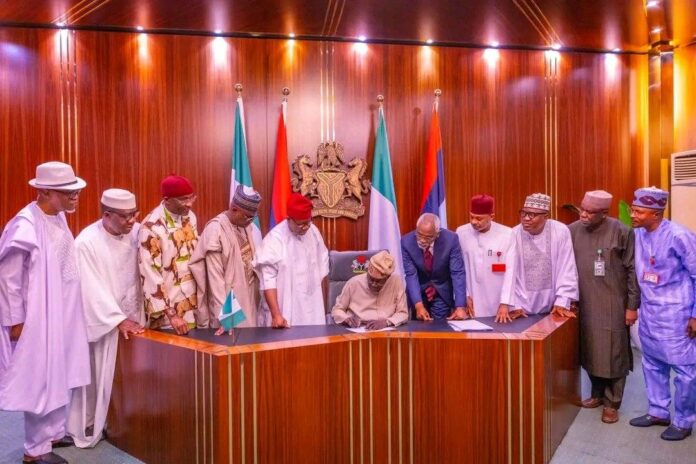

ABUJA — In a move that has swiftly redrawn the battle lines for the 2027 General Elections, President Bola Ahmed Tinubu on Wednesday afternoon, February 18, 2026, officially signed the Electoral Act (Repeal and Re-enactment) Bill 2026 into law.
The signing ceremony, held at the Presidential Villa, was attended by a high-powered delegation including Senate President Godswill Akpabio and Speaker Tajudeen Abbas. While the Presidency hailed the new law as a “giant leap for democratic stability,” the ink was barely dry before a wave of sharp criticism erupted across the federation over what many describe as a “deliberate step backward” for transparency.
The “Optional” Transmission Trap
The most explosive component of the new Act remains Clause 60, which deals with the electronic transmission of results. Despite weeks of protests at the National Assembly gates led by activists like Dr. Oby Ezekwesili, the President signed a version that makes electronic transmission optional rather than mandatory.
Under the new law, if technology “fails” or if the Independent National Electoral Commission (INEC) deems it necessary, the manual Form EC8A—the paper trail often cited in cases of result tampering—remains the primary legal instrument for collation.
“We are closing gaps and strengthening procedures,” President Tinubu stated during the signing. He argued that making the system optional protects the process from “external interference and hacking,” a justification that has done little to calm the nerves of the opposition.
Key Shifts in the 2026 Act
Beyond the transmission row, the new law introduces several major changes:
- Early Voting: In a first for Nigeria, security agents, journalists, and INEC staff on essential duty can now cast their ballots up to 14 days before the general public.
- The 90-Day Rule: Political appointees—including Ministers and Commissioners—must now resign their positions at least 90 days before any party primary they intend to contest.
- BVAS Legalized: The Bimodal Voter Accreditation System (BVAS) has finally received full legislative backing as the only mandatory method for voter accreditation.
“A Tool for Rigging”—Nigerians Blast the New Law
The reaction from the streets and social media has been swift and unforgiving. Many Nigerians view the “optional” nature of result transmission as a “legalized loophole” for electoral fraud in 2027.
- “Back to the Dark Ages”: “We have the technology for instant banking and sports betting in every village, but for our votes, we are told ‘network’ is a problem,” tweeted one popular analyst. “This is not a reform; it is a roadmap for rigging.”
- The “Ramadan” Irony: Critics pointed out that the National Assembly held an “emergency” session to shift election dates to avoid a clash with Ramadan, yet “rushed” through a bill that weakens transparency. “They care about our fasting, but they don’t care about our voices,” a resident in Kano remarked.
- “Rubber Stamp Assembly”: Many Nigerians have blasted the 10th National Assembly, accusing them of being a “branch office of the Presidency.” The chants of “APC Ole!” that echoed during the House walkout on Tuesday have now become a viral slogan, with many citizens feeling the legislative process was “sold to the highest bidder.”
The Road to 2027
With the new law now in force, the focus shifts to INEC. The commission now has the unenviable task of proving that “optional” does not mean “abandoned.”
As opposition leaders like Peter Obi and Atiku Abubakar continue to build their “Mega Party” coalition, the 2026 Electoral Act is expected to be the first major point of litigation. For the average Nigerian, however, the signing of the bill has only deepened the suspicion that the rules of the next game have been written to favour the house.






