
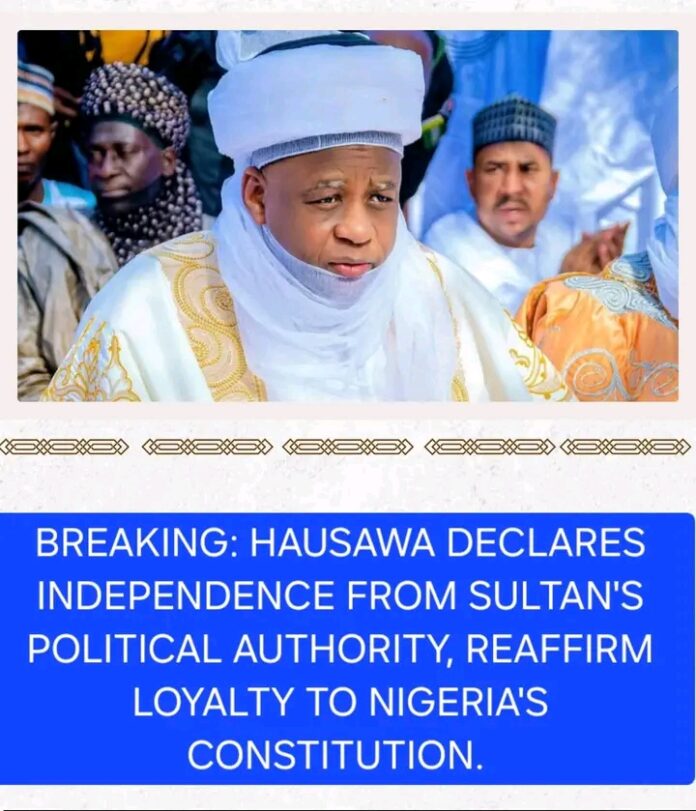

KANO — In a move that has sent shockwaves through Northern Nigeria’s political and traditional establishment, the Hausawa Tsantsa Movement has launched a defiant public rejection of any religious or ethnic political directives attributed to the Sultan of Sokoto.
In a blistering statement titled “Mesa Ta Tashi,” authored by Hajiya Kaltume Alumbe Jitami, the group declared that the millions of Hausa people across the federation are “independent citizens” whose primary and sole allegiance rests with the Constitution of the Federal Republic of Nigeria, not any traditional throne.
“We Are Not Subjects”: A Blow to Traditional Hegemony
The declaration marks a historic fracture in the perceived monolithic political structure of the North. While the office of the Sultan—currently held by His Eminence, Sa’ad Abubakar—is traditionally revered as the spiritual peak of the region, the movement insisted his authority is strictly “moral and historical,” carrying zero executive or legislative weight in a modern democracy.
“No ethnic nationality, including the Hausawa, is legally obligated by any treaty or inherited institution to accept political rulings that fall outside the supremacy of the Nigerian Constitution,” the group asserted.
A Rebirth of Hausa Identity
By invoking the ancient glory of city-states such as Kano, Katsina, Zaria, and Daura, the movement sought to decouple the Hausa identity from the Caliphate’s historical influence. The group argued that in contemporary Nigeria, identity is defined by citizenship under one sovereign order, rather than pre-colonial structures or inherited crowns.
The movement framed its position as a “defense of unity and equality before the law,” drawing a hard line between cultural reverence and political subordination.
Strategic Implications for 2027
Political analysts suggest this “constitutional rebellion” reflects a growing awareness that traditional institutions must remain neutral in matters of state. By publicly distancing themselves from the Sultan’s directives, the Hausawa Tsantsa Movement has signaled a major shift in how the North may navigate future elections and ethnic representation.
“The allegiance of every Hausa man and woman is pledged to the Federal Republic and its constitutional institutions,” the statement concluded, reaffirming that no throne overrides the will of the people.