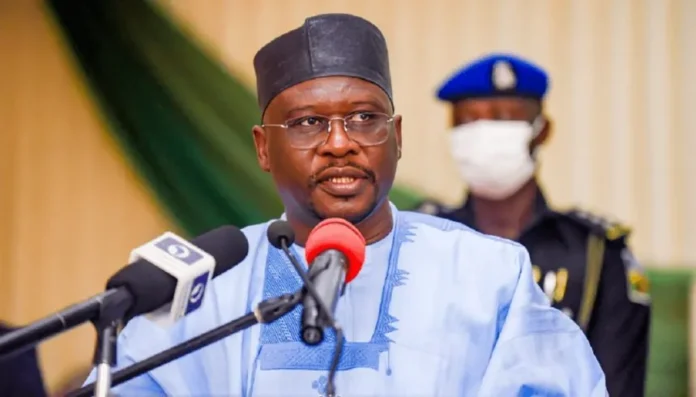
YOLA, ADAMAWA — In a political earthquake that has fundamentally redrawn the map of Northern Nigeria, Adamawa State Governor Ahmadu Umaru Fintiri officially defected from the Peoples Democratic Party (PDP) to the ruling All Progressives Congress (APC) on Friday, February 27, 2026.
The move, announced during a statewide broadcast, marks the end of months of high-level negotiations and leaves the main opposition PDP with only three governors nationwide: Bala Mohammed (Bauchi), Seyi Makinde (Oyo), and Dauda Lawal (Zamfara).
The “Developmental Interest” Narrative
Governor Fintiri, who completed his formal registration at K/Wuro Ngayandi Ward in Madagali Local Government Area (Membership ID: APC021005000480), cited the “overriding developmental interest” of Adamawa as his primary motivation. He emphasized that the state must “move aggressively” to align with federal security and infrastructure projects.
The defection was not a solitary act. In a massive show of force, Fintiri was joined by his entire cabinet and a wave of PDP officials. This follows a legislative coup in the Adamawa State House of Assembly, where Speaker Bathiya Wesley and 14 other lawmakers recently dumped the PDP, handing the APC a supermajority.
A Blow to the “Atiku Factor”
The timing is a devastating blow to former Vice President Atiku Abubakar. Adamawa has long been considered Atiku’s impregnable political fortress; however, with his own governor switching to the ruling party, the Waziri of Adamawa finds his 2027 foundation severely compromised.
This development comes just hours after Atiku expressed “historic regret” for his role in forming the APC back in 2013. Analysts suggest Fintiri’s exit is part of a broader “exit-locking” strategy managed by the Abuja “regency”—specifically Nuhu Ribadu, a native of Adamawa and a key architect of the APC’s Northern consolidation.
The 30th Governor: A Supermajority Established
With Fintiri’s entry, the APC now controls 30 out of 36 states. This unprecedented consolidation of power follows the recent defections of governors in Taraba, Kano, and Plateau.
While the Presidency continues to manage its image through a $9 million U.S. lobbying fund and dismisses health concerns with “carpet, not cancer” defenses, the political reality on the ground is a total APC takeover.
Governance or Politics?
Critics, including Buba Galadima and Ralph Nwosu, argue that these defections are driven by the “weaponisation” of state institutions rather than genuine service. They point to the 10,000 bandits in Bauchi and the Lakurawa massacres in Kebbi as proof that while the party expands, the security of the people is shrinking.
As Governor Fintiri settles into his new political home, the question remains: will this realignment bring the promised “federal dividends” to Adamawa, or is it merely the final nail in the coffin of a once-powerful opposition?