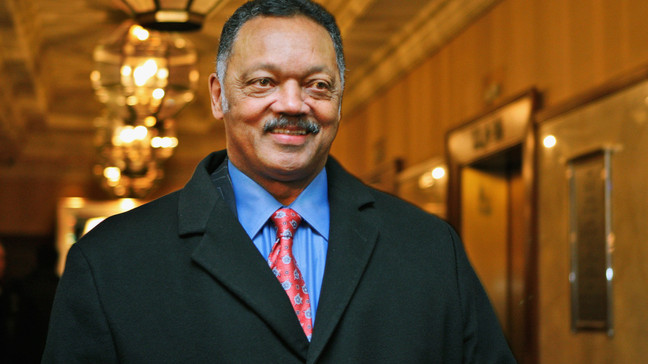

CHICAGO — The world lost a towering figure of the 20th-century struggle for justice on Tuesday morning, February 17, 2026, as the Reverend Jesse Jackson passed away peacefully at the age of 84. His family confirmed the news in a statement, noting that the man who taught generations to chant “I Am Somebody” had finished his earthly race surrounded by loved ones.
Jackson, a protégé of Dr. Martin Luther King Jr., was perhaps the most influential Black political leader in America between the era of the 1960s marches and the 2008 election of Barack Obama.
From the Frontlines to the Ballot Box
Born in the segregated South, Jesse Jackson’s life was a roadmap of the Black American experience. He was at the Selma-to-Montgomery marches in 1965 and stood on the balcony of the Lorraine Motel in Memphis when Dr. King was assassinated in 1968.
However, Jackson’s greatest legacy was arguably his two groundbreaking runs for the U.S. Presidency in 1984 and 1988. At a time when a Black president seemed like an impossible dream, Jackson built a “Rainbow Coalition” of the poor, the working class, and minorities, proving that a person of color could command the national stage.
The African Connection
For many Nigerians and Africans, Rev. Jackson was more than an American activist; he was a bridge-builder. He served as a Presidential Special Envoy to Africa under the Clinton administration and was a vocal opponent of the Apartheid regime in South Africa.
He famously visited Nigeria during the heat of its military transitions, often advocating for a return to democratic rule. His death has triggered a wave of tributes from Lagos to Johannesburg, with many remembering him as a “brother from across the Atlantic” who never forgot his roots.
A Mixed Legacy: Criticisms from Nigerians
Despite the global outpouring of grief, the news of Jackson’s passing has sparked a nuanced conversation among Nigerians, particularly within the diaspora and intellectual circles. While many celebrate his civil rights work, some have been vocal about their grievances regarding his later years in international diplomacy.
- The “Dictator” Criticisms: Some Nigerian critics on social media were quick to point out Jackson’s controversial friendships with various African strongmen. “He fought for rights in America, but sometimes looked the other way when it came to the excesses of African leaders he called friends,” one commentator noted on X.
- The Abacha Era: During the dark days of General Sani Abacha’s regime in the 1990s, Jackson was criticized by some pro-democracy activists for his “soft” diplomatic approach. Critics argued that his interventions sometimes prioritized stability over the immediate restoration of the June 12 mandate.
- Corporate Activism: Others questioned the “Rainbow PUSH” model of corporate diversity, with some Nigerian-Americans arguing that it sometimes felt more like “symbolic representation” rather than the radical structural change Dr. King had envisioned.
The Final Years
Rev. Jackson’s final years were a battle against Parkinson’s disease and a rare neurological condition known as Progressive Supranuclear Palsy (PSP). Despite his fading health, he remained a fixture at social justice rallies, often appearing in a wheelchair but still possessing the sharp, rhythmic oratory that defined his career.
He is survived by his wife, Jacqueline, and their six children, including U.S. Congressman Jonathan Jackson and former Congressman Jesse Jackson Jr.
As the lights go out on a life lived on the frontlines, the world reflects on a man who famously told the marginalized: “Keep Hope Alive.”