
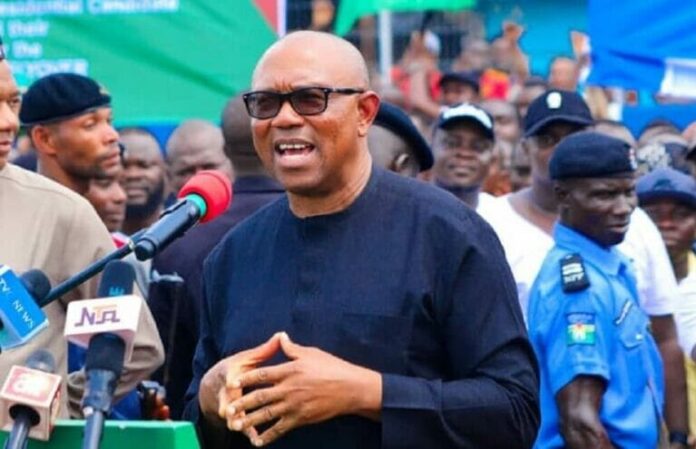

ABUJA — The 2023 Labour Party presidential candidate, Peter Obi, has launched a stinging critique of the Federal Government’s multi-trillion-naira superhighway projects, accusing the political elite of being “out of touch” with the daily suffering of Nigerians on dilapidated federal roads.
In his latest assessment of the nation’s infrastructure, Obi argued that embarking on massive “legacy projects” like the Lagos-Calabar Coastal Highway is a misplaced priority when existing interstate routes have become “unmotorable death traps.”
The ‘Air Travel Elite’ Disconnect
Obi pointedly accused the Minister of Works, David Umahi, and other top officials like Senator Adams Oshiomhole of insulating themselves from the reality of the road network by relying solely on air travel.
“They are building superhighways whereas almost all Federal roads nationwide are dilapidated and unmotorable,” Obi stated. “Umahi is from Ebonyi State! He has never travelled by road from Abuja to Ebonyi, not to talk of Abuja to Lagos. All of them, including Oshiomhole, travel by airplane.”
The former Anambra Governor argued that if leaders were forced to navigate the pothole-ridden Abuja-Lokoja or the decaying South-East corridors themselves, the government would prioritize immediate repairs over long-term concrete highways designed to last 100 years.
Umahi Defends the ‘Renewed Hope’ Strategy
Minister Umahi has hit back at Obi, accusing him of inciting the public and using the infrastructure debate for political mileage. Umahi maintained that the Abuja-Lagos Superhighway and the Coastal Highway are strategic investments that will unlock massive economic potential for generations to come.
However, Umahi also acknowledged the current “painful” state of existing roads, announcing an “aggressive nationwide road intervention program” for 2026. He assured Nigerians that major routes like the Abuja-Kano road and Abuja-Lokoja would see significant progress by the second quarter of the year.
Infrastructure vs. Human Survival
The critique by Obi comes at a time of heightened social sensitivity. With market women threatening protests over hunger and N-Power beneficiaries marching on the National Assembly, the “legacy projects” have become a lightning rod for criticism.
Obi maintains that the funds allocated for these superhighways should be diverted to fixing current highways, enhancing security to stop highway robberies and kidnappings, and supporting local industries that are currently being “crushed” by the high cost of transportation.
As the 2027 political cycle begins to take shape, the debate over whether to build for the next century or fix the problems of today remains one of the most contentious issues in the Nigerian public square.






