
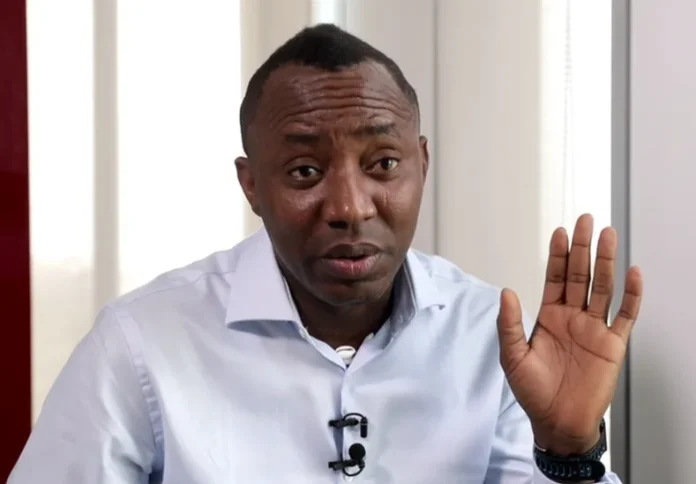

ABUJA, FCT – Amidst the high-stakes fallout of the FCT Area Council elections, prominent activist and former presidential candidate Omoyele Sowore has reignited a fierce debate over political “capture” and the selective enforcement of anti-graft laws in Nigeria.
Sowore, a vocal critic of the current administration, alleged that the “Lagos Model” of governance—pioneered by President Bola Tinubu—has effectively insulated Lagos State officials from federal scrutiny for decades.
The ‘Lagos Immunity’ Allegation
In a viral critique shared across social media platforms, Sowore claimed that the Economic and Financial Crimes Commission (EFCC) has historically operated under a “capture” system since its inception in Lagos.
“EFCC started in Lagos and Tinubu was smart enough to capture them, support them,” Sowore asserted. He pointed to the agency’s caseload as evidence, stating that it is an “unwritten rule” that the EFCC does not touch Lagos State officials despite having what he described as “the worst corruption.”
Sowore further argued that the only notable exception to this rule was the investigation into former Governor Akinwunmi Ambode, which he claimed occurred solely because Ambode “fell out with Tinubu.”
Parallels in the FCT Polls
Sowore’s commentary comes as FCT Minister Nyesom Wike faces similar accusations of “political capture” following the Saturday local government elections. The African Democratic Congress (ADC) and Senator Ireti Kingibe have both slammed Wike for his “meddlesome” tour of polling units and the imposition of movement restrictions.
While the PDP’s Mohammed Kasim secured a decisive victory in Gwagwalada with 22,165 votes, critics like Sowore suggest that the tactics seen in the FCT—ranging from voter apathy to heavy ministerial presence—are a reflection of the “Lagos blueprint” being exported to the nation’s capital.
Transparency and the IReV Hurdle
The debate over political dominance is further complicated by technical failures during the election. According to reports from the Federal Radio Corporation of Nigeria (FRCN), stakeholders are demanding an audit of the INEC Result Viewing Portal (IReV), which remained inaccessible during critical collation hours.
As the APC secures AMAC and the PDP sweeps the satellite councils, Sowore’s remarks have added a layer of systemic critique to the local results, framing the election not just as a contest for councils, but as a struggle against entrenched political “immunity.”






