
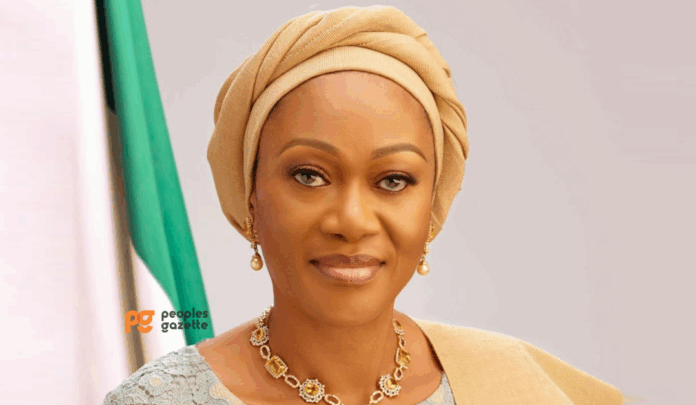

ABUJA — Nigeria’s First Lady, Senator Oluremi Tinubu, has ignited a fresh political firestorm by characterizing the re-election of President Bola Ahmed Tinubu in 2027 as a “patriotic national assignment” for every citizen.
Speaking at a recent forum, the First Lady urged Nigerians to look beyond current challenges and support the administration’s “Renewed Hope” agenda as a matter of national duty. She argued that the President’s reforms, particularly in fiscal policy and national security, are laying the foundation for a prosperous future that requires collective continuity.
However, her comments have drawn sharp rebukes from opposition leaders and civil society groups, who describe the call as insensitive given the prevailing economic climate.
‘A Reckless Distraction’ – Opposition Fires Back
The Peoples Democratic Party (PDP) led the charge against the First Lady’s remarks, asserting that no “patriotic” Nigerian would support an administration they claim has “weaponized poverty.”
“The First Lady’s call is a desperate attempt to equate political loyalty with patriotism,” said a PDP spokesperson. “A truly patriotic citizen is one who demands accountability for the soaring cost of living and the collapse of the naira, not one who blindly endorses another four years of hardship.”
Similarly, the African Democratic Congress (ADC) characterized the focus on 2027 as a “misplaced priority.” ADC National Chairman David Mark noted that while the Presidency focuses on re-election, Nigerians are grappling with “needless vicious policies” that have exposed millions to untold poverty and insecurity.
Specific Criticisms Against the President
Critics of the administration have highlighted several key areas where they believe the President has failed to meet his “Renewed Hope” promises:
- Implementation of Reforms: While the administration defends its policies as necessary “bitter pills,” experts like Professor Franklin Ngwu have criticized the “poor sequencing” of reforms, such as the simultaneous floating of the naira and removal of fuel subsidies, which they say amplified inflation and unemployment.
- Security Concerns: Despite a record ₦5.41 trillion security budget for 2026, opposition parties argue the President lacks a deep strategy to combat the “organized criminal invasion” of banditry and kidnapping in the North.
- “Election Obsession”: The Arewa Consultative Forum (ACF) has expressed alarm over what it calls the administration’s “obsession” with 2027, accusing the President of prioritizing political defections and re-election campaigns over the actual governance required to save lives and the economy.
Presidency Defends Stance
In defense of the administration, pro-government groups such as the Legacy Support Group have pushed back, accusing the opposition of spreading “misinformation” and “campaigns of calumny.” They maintain that the removal of fuel subsidies was essential to end decades of corruption and that the benefits of these reforms will be fully visible by 2026.
As the countdown to 2027 begins, the debate over what constitutes “patriotism” in a time of economic trial looks set to remain the central theme of Nigeria’s political landscape.






