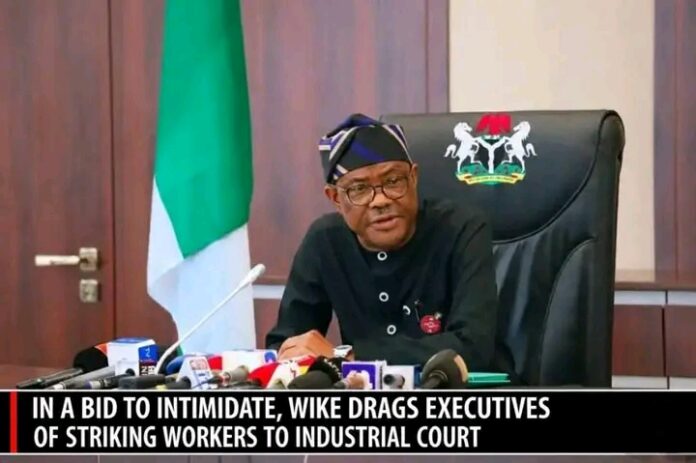

_ABUJA, Nigeria –_ In a development that has sparked sharp criticism from labor groups, the Minister of the Federal Capital Territory (FCT), Nyesom Wike, has instituted legal proceedings against the executive members of the Joint Union Action Committee (JUAC) at the National Industrial Court of Nigeria, Abuja Judicial Division.
The suit, filed on Monday, seeks a court order restraining the union leaders from proceeding with their ongoing industrial action and from any further “unlawful” activities that, according to the minister, disrupt essential services within the FCT. The minister’s legal team argues that the strike, which began on 12 January 2026, has crippled waste management, public transportation, and primary health‑care services, thereby endangering public safety and violating statutory obligations.
However, union officials and civil‑society observers have described the litigation as a calculated attempt to intimidate and harass JUAC’s leadership rather than a genuine effort to resolve the underlying grievances. “This is a classic case of using the judiciary as a weapon to break the resolve of workers who are demanding better wages, improved working conditions, and the implementation of previously agreed‑upon collective bargaining agreements,” said Comrade Aisha Musa, JUAC’s national spokesperson, at a press briefing in Abuja.
JUAC, which represents over 45,000 workers across various FCT agencies, has been on strike for three weeks, citing the government’s failure to honor a 2024 memorandum of understanding that provided for a 25 percent salary adjustment and the provision of protective equipment for sanitation workers. The union maintains that all attempts at dialogue have been rebuffed, leaving legal action as its only recourse.
Legal analysts note that while the National Industrial Court has jurisdiction over labor disputes, it has historically urged parties to pursue alternative dispute‑resolution mechanisms before resorting to litigation. “The court will likely examine whether the minister’s application meets the threshold for granting an injunction, particularly on grounds of public interest and whether the strike constitutes an illegal act under the Trade Disputes Act,” said Barrister Chinedu Okafor, a labor‑law expert based in Abuja.
Human‑rights groups, including the Nigerian Labour Congress (NLC) and the Civil Liberties Organization (CLO), have called on the FCT administration to withdraw the suit and return to the negotiation table. “Intimidation through the courts undermines workers’ rights to peaceful assembly and collective bargaining, which are guaranteed under Nigeria’s Constitution and international labor conventions,” the NLC said in a statement.
As of press time, the National Industrial Court has scheduled a hearing for 5 February 2026 to determine whether to grant the minister’s request for an interlocutory injunction. Meanwhile, JUAC has vowed to continue its strike, warning that any attempt to suppress workers’ voices will only escalate tensions.
The outcome of the case is expected to set a significant precedent for how labor disputes involving government entities are managed in Nigeria, with implications for workers’ rights, public service delivery, and the balance of power between state authorities and organized labor.