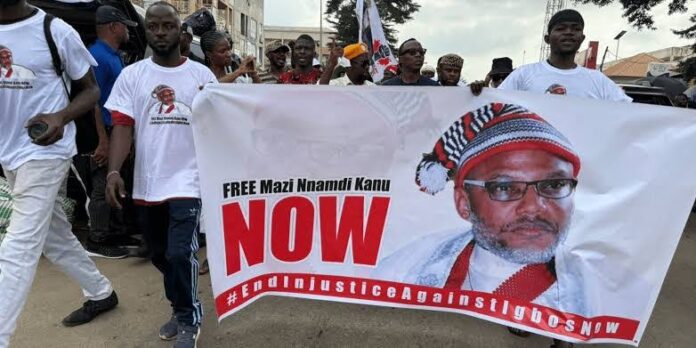
ONITSHA – The agitation for the freedom of Mazi Nnamdi Kanu has reached a boiling point, as Southeast stakeholders and protesters shifted their tone from pleas to “absolute demands” for his unconditional release from the Sokoto Correctional Facility.
The renewed fervor follows a week of high-stakes tension in Anambra State, where traders at the Onitsha Main Market took to the streets to protest a government-ordered shutdown. Chanting pro-Biafran slogans, the demonstrators declared that they are no longer “appealing” to the Federal Government, but demanding the release of the IPOB leader as the only path to lasting peace in the region.
”
We are no longer appealing; we are demanding the release of Mazi Nnamdi Kanu,” several protesters stated during the blockade of the River Niger Head Bridge. They argued that his continued incarceration is the root cause of the economic paralysis and “sit-at-home” conflicts currently ravaging the Southeast.
Political and Legal Pressure Mounts
The demand is gaining traction beyond the streets. A group of 44 Federal Lawmakers recently petitioned President Bola Tinubu to invoke his constitutional powers to discontinue Kanu’s prosecution. Similarly, Peter Obi has reiterated that there is “no justification” for Kanu’s continued detention following his November 20, 2025, conviction on terrorism-related charges.
Even former militant leader Asari Dokubo has joined the fray, describing the life sentence as “unjust” and a catalyst for regional instability.
Court Standoff
Despite the mounting pressure, the judicial process remains deadlocked. On January 27, 2026, a Federal High Court in Abuja struck out Kanu’s motion seeking a transfer from Sokoto back to an Abuja detention facility to facilitate his appeal. The legal battle was further complicated when his lawyers from the Legal Aid Council withdrew from the case, citing “irreconcilable differences” with their client.
As IPOB declares a solidarity lockdown for Monday, February 2, the Federal Government faces a critical choice: maintain the current judicial stance or explore a political solution to douse the rising fire in the East.
Will President Tinubu respond to the lawmakers’ demand for a political intervention, or will the “solidarity lockdown” further cripple the Southeast economy?