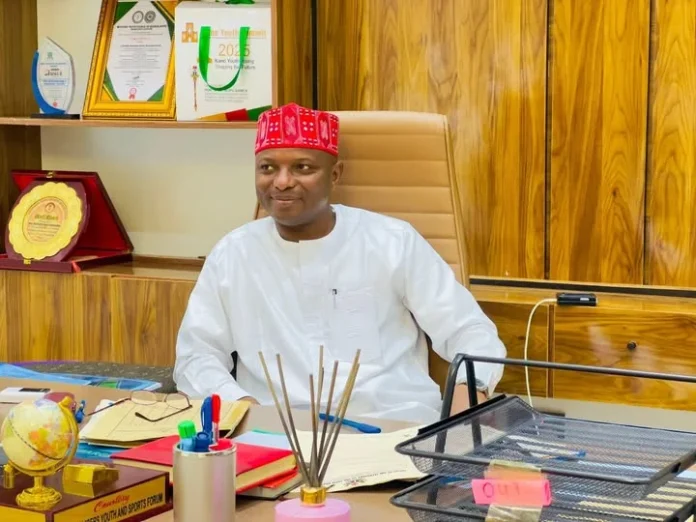
KANO — The political landscape of Kano State suffered another seismic shift on Monday, January 26, 2026, as Mustapha Rabiu Kwankwaso, the son of New Nigeria People’s Party (NNPP) leader Senator Rabiu Musa Kwankwaso, formally resigned his position as the Commissioner for Youth and Sports Development.
The high-profile resignation comes just three days after Governor Abba Kabir Yusuf’s bombshell defection from the NNPP to the All Progressives Congress (APC) on January 23. The exit of the Governor has effectively severed the “Kwankwasiyya” alliance that brought the current administration to power, forcing loyalists of the elder Kwankwaso to choose between their cabinet posts and their ideological movement.
In a statement released on Monday evening, Mustapha Kwankwaso described his departure from the State Executive Council as a decision made “with a heavy heart.” While he avoided direct criticism of the Governor, he emphasized his loyalty to the political principles of the Kwankwasiyya movement, which is now in direct opposition to the Governor’s new party.
“I want to express my deepest gratitude to Governor Abba Kabir Yusuf for the opportunity to serve the great people of Kano State,” the statement read. “I have cherished the experiences and lessons gained while serving, but at this juncture, it is necessary to step aside.”
The younger Kwankwaso’s exit has triggered a wider exodus from the cabinet. On the same day, the Commissioner for Internal Security and Special Services, AVM Ibrahim Umar (Rtd), and the Commissioner for Science, Technology, and Innovation, Yusuf Kofarmata, also tendered their resignations. These officials are seen as the “ideological core” of the Kwankwasiyya movement, choosing to remain in the NNPP rather than follow Governor Yusuf into the APC.
Political analysts suggest that these resignations mark the beginning of a total reconfiguration of Kano politics. By leading a mass migration of 21 state lawmakers and eight federal representatives into the APC, Governor Yusuf has secured the state’s executive machinery, but the departure of Kwankwaso’s son signals that the battle for the “soul of Kano” will be a fierce three-way struggle between the Governor’s new APC bloc, the NNPP, and the remnants of the Ganduje-led APC faction.
As of Tuesday, January 27, 2026, the Kano State Government has not announced replacements for the vacated ministerial slots. However, the mass resignations indicate that the once-unified “Red Cap” revolution has officially fractured, setting the stage for a volatile 2027 election cycle.