
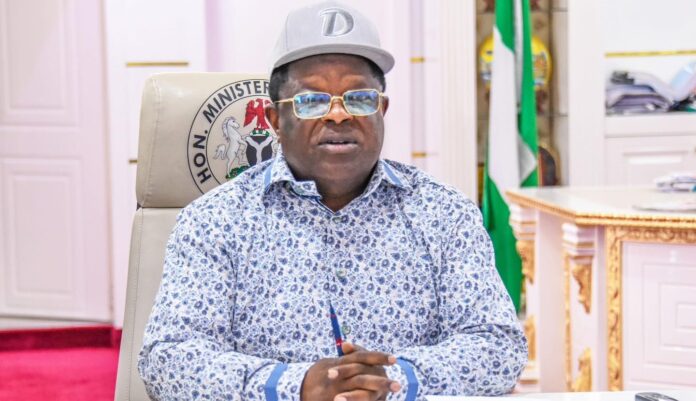

ABUJA — The Minister of Works, Senator David Umahi, has issued a bold and controversial assertion of his personal influence and financial status, declaring that his political and economic standing has grown exponentially since he left the Ebonyi State Government House.
In remarks that have resurfaced amidst the intensification of the 2026 infrastructure “action year,” the Minister characterized himself as a far more formidable force than he was during his eight-year tenure as governor. Umahi emphasized that his family possesses the financial independence to fund any endeavor, a statement seen by analysts as a display of confidence in his ability to navigate the high-stakes political and administrative landscape of the Tinubu administration.
“I am ten times bigger now than I was when I was a governor. I am very dangerous now,” Umahi declared. “God has blessed the Umahi family beyond wealth, and we are capable of funding anything.”
The Minister’s claims of immense wealth come at a time when his ministry is under significant pressure to deliver on the “Renewed Hope” infrastructure agenda. As of Monday, January 26, 2026, Umahi is overseeing several multi-trillion naira projects, including the Lagos-Calabar Coastal Highway and the Sokoto-Badagry Superhighway. Just last week, the Minister held high-level talks with the World Bank to secure innovative financing for 260 weak road links and 50 dilapidated bridges across the federation.
However, the Minister’s boastful tone has drawn criticism from transparency advocates who point to the historical scrutiny of his family’s business interests. Past reports have alleged that billions in government funds were linked to companies associated with the Umahi family during his time in state office—claims the Minister has consistently dismissed as politically motivated.
Critics argue that such open displays of personal wealth by a serving public official are “insensitive” given the current economic climate and hyperinflation facing the average Nigerian. Nonetheless, Umahi remains undeterred, recently warning that he would not hesitate to close sections of major highways, such as the Lagos-Calabar route, if motorists continue to vandalize infrastructure.
For the Minister, his self-described “dangerous” status reflects a uncompromising approach to governance and a refusal to be intimidated by the complexities of the Nigerian political terrain as the 2027 cycle approaches.






