
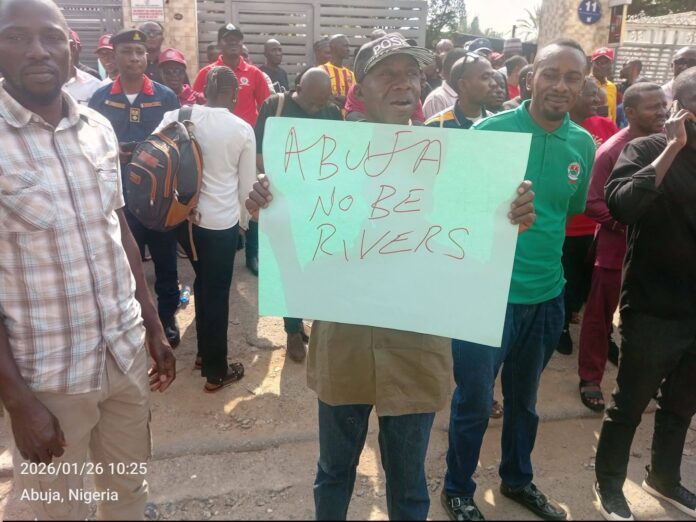

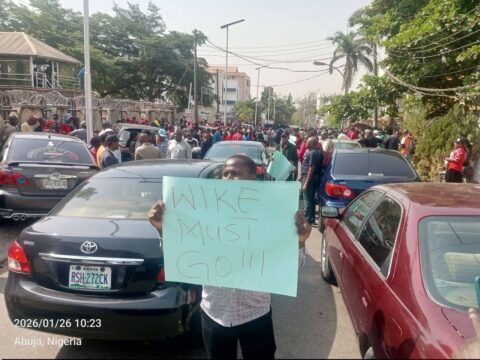
ABUJA — The Federal Capital Territory (FCT) descended into administrative and environmental chaos on Monday, January 26, 2026, as striking workers under the Joint Unions Action Committee (JUAC) barricaded the FCTA Secretariat, effectively preventing the Minister, Nyesom Wike, and his security detail from accessing his office.
The industrial action, which has entered its second week, reached a volatile peak on Monday morning. Protesters, supported by the Nigeria Labour Congress (NLC), established a human blockade at the main gates, turning back political appointees and chanting slogans demanding the Minister’s resignation. While the FCT Administration has attempted to secure a restraining order through the National Industrial Court (NICN) in suit NICN/ABJ/17/2026, the workers have remained defiant, insisting on the immediate payment of promotion arrears and the full implementation of the ₦70,000 minimum wage for area council staff.
A City Under Siege by Waste
The administrative paralysis has triggered a total collapse of essential municipal services. Throughout the city center and satellite towns, Abuja’s once-pristine streets are now littered with overflowing bins and rotting heaps of municipal solid waste. Residents in districts such as Garki, Wuse, and Maitama have raised alarms over the public health implications as waste collection services have completely ceased due to the strike.
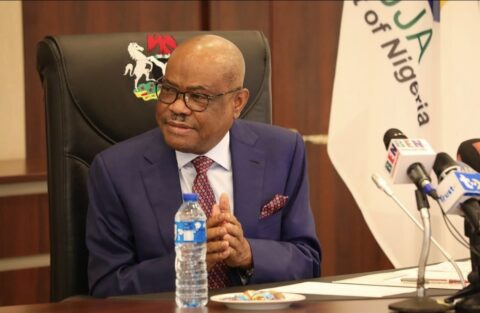
Environmental activists have slammed the FCT Minister for the declining hygiene standards, noting that the “city of excellence” is rapidly being overtaken by filth. “Abuja has never been this dirty,” remarked an official from a local environmental NGO. “The absence of supervision and the strike by cleaning contractors who are owed months of payments have turned the nation’s capital into a landfill.”
Infrastructure in Limbo
Simultaneously, the administration’s flagship road construction projects have suffered a severe setback. Several major sites, including the ongoing expansion of the outer northern expressway and various inter-district bridges, have seen a complete cessation of activity. Sources within the FCT Engineering Services Department confirm that the halt is twofold: a lack of administrative supervision caused by the strike and the continued failure of the Ministry to process payments for contractors.
Critics of the Minister argue that his frequent involvement in the political crisis in Rivers State has led to a leadership vacuum in Abuja. They point to the “slowed pace” of the 2026 infrastructure plan as evidence that the Minister’s focus is divided. “The roads are half-finished, the contractors have packed up their equipment, and the Minister is more concerned with court cases against laborers than fixing the capital,” a disgruntled contractor told reporters.
As of Monday afternoon, the National Industrial Court has adjourned the hearing on the legality of the strike until later this week. With primary and secondary school teachers joining the industrial action and trash piling up along the streets, the FCT faces a mounting humanitarian and administrative crisis that threatens to derail its status as Africa’s premier diplomatic hub.






