
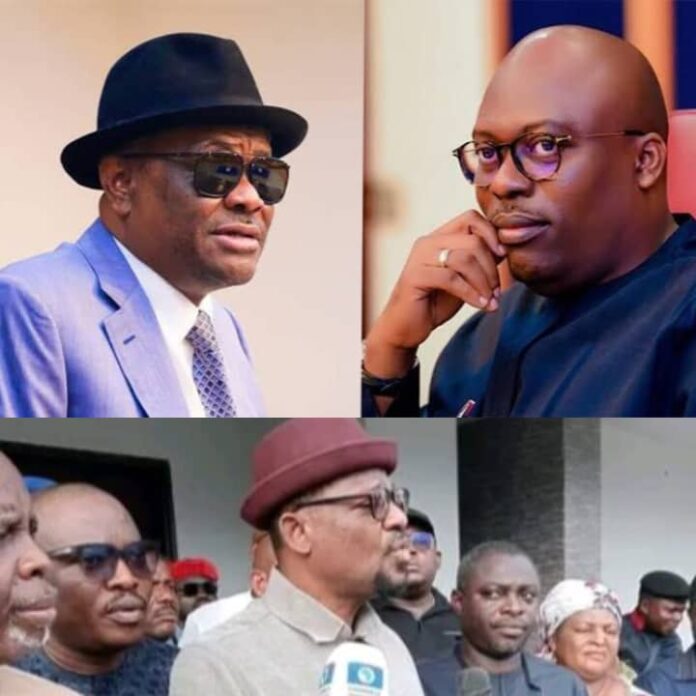

In this exclusive interview, senior lecturer and political analyst Dr. Graham Nseigbe sheds light on the lingering tensions within Rivers State’s political landscape and what the state should expect as the 2027 elections draw closer.
Below are excerpts from the conversation.
Q: How would you describe the current political atmosphere in Rivers State?
Dr. Nseigbe:
The political atmosphere remains very bleak. What we see is not genuine reconciliation. Despite the public handshakes and photographs involving Governor Siminalayi Fubara and former Governor Nyesom Wike, the reality inside government does not reflect unity. The governor and the State House of Assembly are still working at cross-purposes.
I would describe the situation as negative peace: peace that exists only in appearance, with no real harmony beneath.

Senior Lecturer
Department of Social Sciences
Rivers State University
Q: Many residents assumed there was peace after the meetings between the governor and his predecessor. Why do you say the peace is not real?
Dr. Nseigbe:
If there were true peace, it would show in governance. It would show in the Assembly’s posture and in the governor’s actions. But what we have instead are counter-statements, legislative resistance, and continuous political tension. None of these signs indicate reconciliation.
Q: Looking toward 2027, should Rivers people expect anything new politically?
Dr. Nseigbe:
Honestly, nothing significantly different is visible. Rivers State has a long history of political contest dominated by power blocs, and those patterns are still firmly in place. As it stands, the 2027 elections may follow the familiar script: struggles among political gladiators, the bandwagon effect, and heavy influence from entrenched political machines.
Q: There has been speculation about the governor’s political alignment. What is your assessment?
Dr. Nseigbe:
The governor has not clearly indicated where he stands ahead of 2027. Although there is talk of a one-term understanding, it is not officially documented. More importantly, his administration does not appear to be aligned with the current national leadership of the PDP. The governor’s silence in the last PDP convention is very loud, you can conclude that he’s in the APC. He will soon declare it officially.
On the other hand, former Governor Wike’s strong presence at the federal level suggests that Rivers State may be tilting toward the APC, though no formal declaration has been made.
Q: Do you think the FCT Minister still has the “Structures” in Rivers State he’s been fighting for?
Dr. Nseigbe:
The term “political structure” is widely misused in Nigerian politics. Formally, political structure refers to the arrangement of government—the executive, the legislature, and the judiciary.
But what we see in Rivers State are political machines—highly organized groups built mainly to win elections with mechanical precision. These machines determine candidates, influence voting patterns, and shape outcomes long before voters reach the polls.
They are not structures of democracy—they are instruments of political control.
Q: What does all of this mean for Rivers State as 2027 approaches?
Dr. Nseigbe:
It means the state is still in transition. The political direction is not yet clear, alliances are shifting, and internal party conflicts remain unresolved. The coming months will determine whether the state breaks from old patterns or simply repeats them.
For now, Rivers State is waiting, caught between unresolved tensions and uncertain political realignments.






