

By Izunna Okafor, Awka
The job of waste management has been described as one that demands public cooperation and continuous innovation, given its capital-intensive, labour-driven and environmentally sensitive nature.
The Managing Director and Chief Executive Officer of the Anambra State Waste Management Authority (ASWAMA), Engr. Mike Ozoemena, stated this while interacting with newsmen in his office in Awka, the Anambra State capital, over the week, where he also gave a rundown of the Agency’s activities, challenges, achievements, innovations and future plans since his assumption of office.
According to him, clearing and sustaining a clean environment in Anambra is an enormous task, but one that his team has pursued with determination since June 16th, 2022, when he formally assumed office on the mandate of Governor Chukwuma Charles Soludo.

Engr. Ozoemena recalled that the Governor had signalled the beginning of the state’s aggressive waste-management reform on March 17th, 2022, at Okpoko, where he launched a statewide environmental rejuvenation project and subsequently constituted a high-powered taskforce headed by the Deputy Governor, with the ASWAMA MD as a key member. That taskforce, he said, commenced immediate evacuation of refuse that had accumulated for years and become a major public health concern.
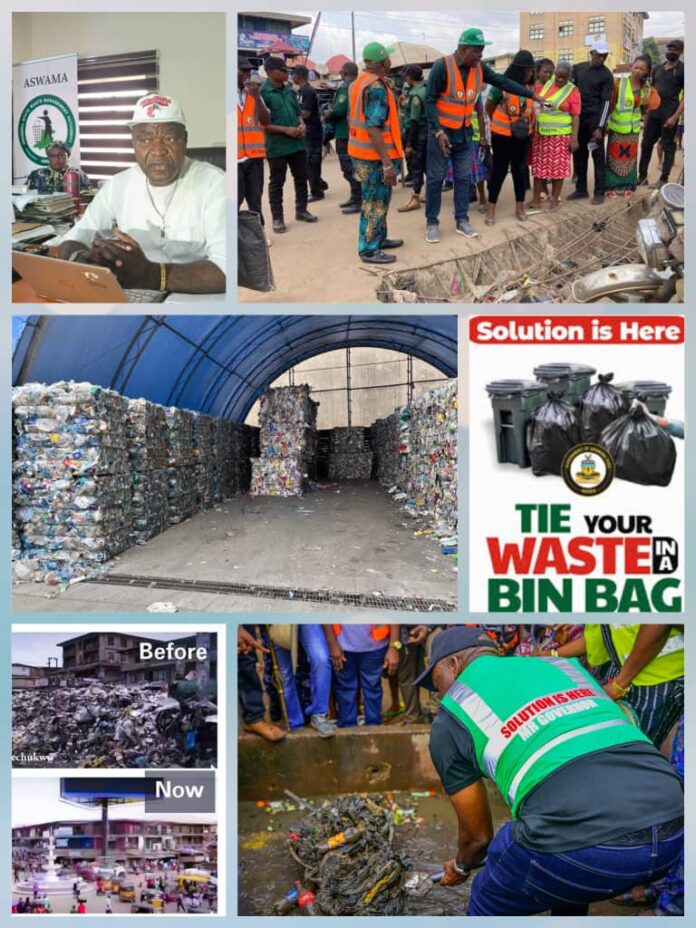
He explained that the transformation achieved since then, especially in places like Ochanja, was a direct result of that early momentum and sustained pressure.
“Before now, Ochanja was a mountain of refuse,” he noted, “but today it is a fountain of water. And every year since then, Anambra has ranked among the top five cleanest states in Nigeria. And this year again, we’ve also been ranked among the top.”

Taking reporters through the structural shifts made since assumption of office, Engr. Ozoemena said the Governor later decentralised waste evacuation to the local governments, while ASWAMA was assigned a regulatory and coordinating role — including enforcement, policy direction, management of the state’s seven campsites, and strict oversight of contractors.
He added that ASWAMA now operates a real-time monitoring system, as according to him, desk officers across all 21 LGAs send in daily on-the-spot video reports to the Authority’s headquarters so that no area is left unchecked.

“Right from here, through our system, we get on-the-spot reports on waste management across the state. My phone receives reports every single morning — including Sundays. Wherever there is waste, we know because we get the report. And we immediately descend on the Mayor or contractor concerned or responsible for that jurisdiction,” he stated.
While appreciating Ndi Anambra for re-electing Governor Soludo (Ọlụatụegwu), the ASWAMA Boss stressed that the Governor’s “gear-three” vision for the second term would also translate into a more advanced, faster, cleaner and more efficient waste-management system. He added that ASWAMA is already retooling itself to match the new gear, with a view to making the state rank number one nationally.

Responding to a question on waste-management funding and payment compliance, Engr. Ozoemena described payment default as one of the most pressing challenges. He reminded residents that waste management is capital-intensive, with diesel alone costing as high as N1,350 per litre, and thus cannot be run on government resources alone. He said consequently, the “Pay-Direct System” —a network of privately contracted operators—funds evacuation in their zones by collecting government-approved levies from residents, while the Authority regulates their activities.
Using the annual N7,200 levy for a flat as example, he stated that many residents underestimate the real cost of waste management: “If we allowed you to use that N7,200 to evacuate your own waste to the dump site, you cannot even do it for one week, because the amount cannot fund it. But yet, many people still find it difficult to pay that token for evacuation of their waste for the entire year,” he lamented.
He therefore urged Ndi Anambra to embrace the necessity of paying for waste services, as is done globally. He further revealed that the ASWAMA currently has goal to meet waste at its source (homes and offices) through enforcement of compulsory waste bins, street-specific evacuation days, and elimination of random public dumping points.

Fielding questions on innovations, he said the Authority has expanded plastic recycling across the state, aided by a partnership with Coca-Cola Company and several private firms in Onitsha and its environs. These efforts, he said, have turned plastic waste into an economic commodity.
“Today, at any event or gathering, you’ll notice that the plastic disappears even before you leave, because plastic is now a big business.”


He also disclosed that ASWAMA is in advanced discussions with three foreign companies on waste-to-power projects that will generate electricity for at least major cities in the state, using biogas technology. He further revealed that Anambra generates over 4,000 metric tonnes of waste daily, a figure that makes large-scale waste-to-energy vision feasible and achievable.

Responding to concerns about heaps of waste at Eke Awka Market, Engr. Ozoemena acknowledged the market’s high volume of waste generation and efforts being by the agency. He, however, assured that ASWAMA has devised a permanent solution to address that.
“By this time next year,” he assured, “Eke Awka will no longer be an issue. As the waste comes in the morning, it will not be there the next morning.”
Reacting to questions on the stopping of the old monthly sanitation exercise, he explained that the decision was cogently taken by the Soludo Administration because waste management should be a daily culture, not a once-a-month ritual. He said even during the once-a-month ritual only a few people may sweep or do some cleanings for a few minutes and relapse thereafter, while some would go to play ball to pass out time as law enforcement agencies would ensure that movements were restricted and business/offices activities stagnated till 10.am.
“Sanitation must be a daily affair, and not a one-off ritual,” he insisted.

Addressing concerns about enforcement, especially with respect to viral videos of properties sealed with occupants and school children locked out, Engr. Ozoemena clarified that ASWAMA does not seal properties and does not enforce sanctions.
“It is the court that seals,” he said. “We only issue demand notices. When people tear them or ignore them, we take them to court. Once a court order is secured, sealing follows, which is not done by ASWAMA per se but by the enforcement arm, the Operation Clean and Healthy Anambra, OCHA Brigade,” he clarified.
The ASWAMA MD also made a public declaration that the agency does not authorize cash payment of ASWAMA sanitation levies, declaring that anybody collecting the ASWAMA levy via cash payment is a criminal.
“If anybody comes to you in Anambra to collect cash in the name of ASWAMA levy, that person is a thief, and wasn’t sent by us,” he emphatically stated.
According to him, “Nobody is allowed to collect cash from anybody. All payments must be made through the bank. My number is public, call me if anyone demands cash.”
Responding to questions on digitisation of the Authority’s activities, he said ASWAMA is moving towards a live operations dashboard where evacuation trucks, contractors and LGAs can be monitored in real time as they work. This, he said, will ensure transparency and also strengthen accountability.
He further addressed concerns about the prevalent cases of open defecation in different parts of the state, especially places like Onitsha and its environs, on pedestrian bridges and other public areas. While noting that, although the OCHA Brigade MD could not meet up with the media chat during which he would have discussed that and the successes so far recorded in the fight; he, however, revealed that ASWAMA and collaborators were already planning a major roadshow and sensitisation campaign that will be launched soonest, to help bring a permanent stop to the practice. He also urged citizens to embrace the culture of using any of the many public toilets in different places across the state, rather than indulging in open defecation and defacing the state.
Recounting some of the criminal activities of illegal scavengers (popularly known as Iron Kwandem) in different parts of the state, the ASWAMA MD reiterated that the government’s earlier pronouncement and ongoing enforcement against such still subsist; even as the government is also redoubling its efforts and re-urging the residents to play their own part of: “If you see something, say something.”

Concluding, Engr. Ozoemena emphasised that waste management thrives on synergy between government, contractors, local governments, enforcement agencies, households, businesses and communities.
According to him, as Anambra moves into the next phase of governance and transformation under Governor Soludo, ASWAMA has equally re-strategized for much faster reforms, deeper technological upgrades, aggressive enforcement through OCHA Brigade, as well as further engagements that will enhance conversion of waste to wealth, create more jobs and deliver a much cleaner, smarter healthier Anambra.








